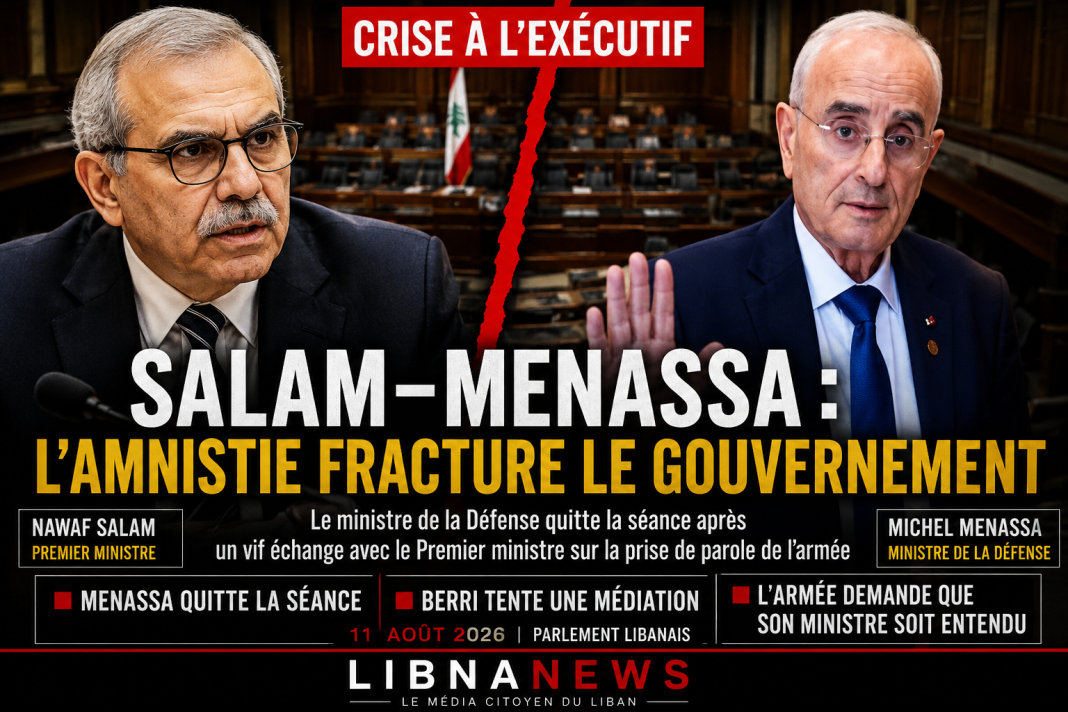






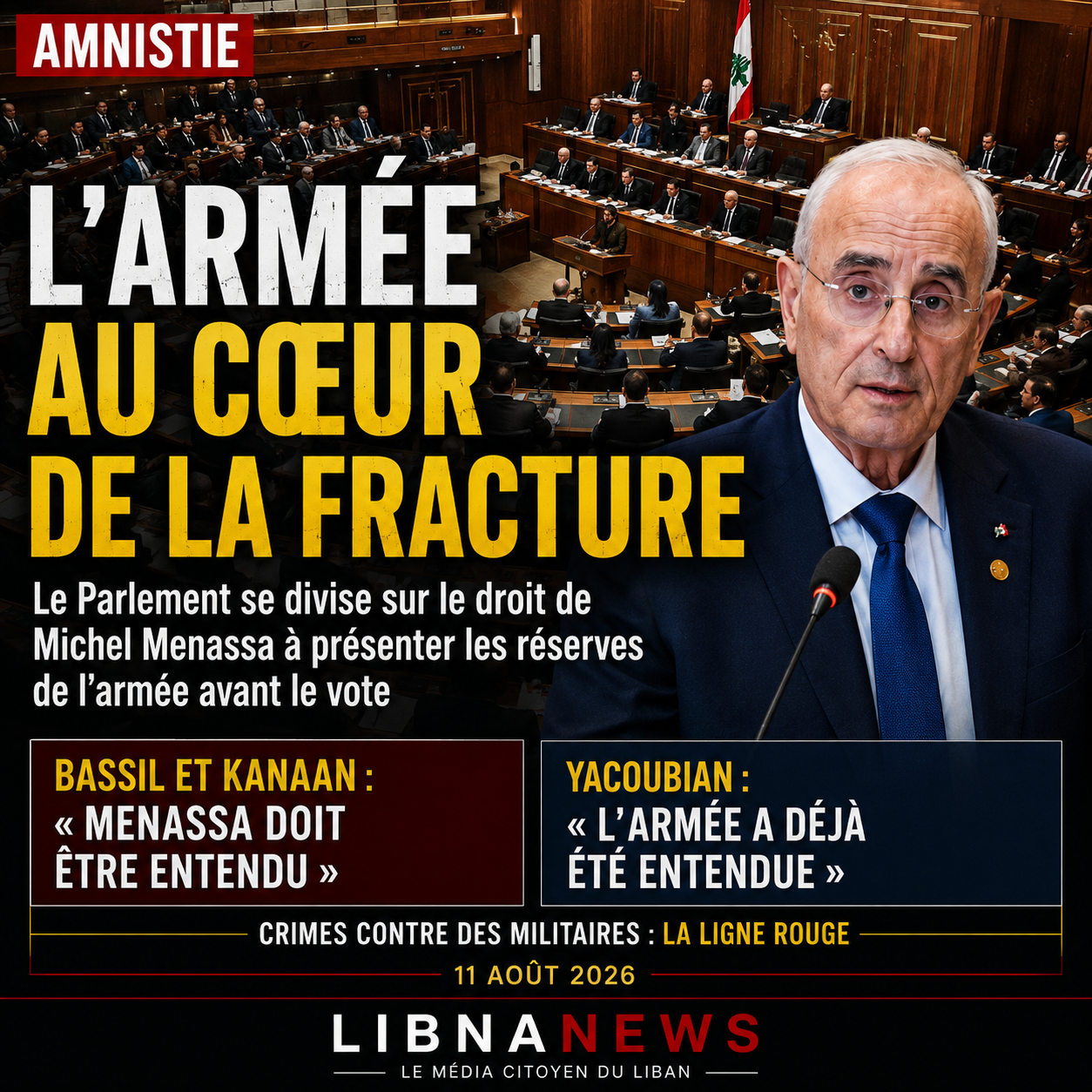
On Tuesday, August 11, 2026, the debate on the general amnesty law led to a strong confrontation in the Lebanese Parliament, where several deputies demanded that Defence Minister Michel Menassa be able to present the Lebanese Army’s observations before any vote. Gebran Bassil and Ibrahim Kanaan defended his right to be heard, while Paula Yacoubian recalled that the army had already presented its remarks in committee and that Prime Minister Nawaf Salam was responsible for expressing the government’s position. The dispute arose after an altercation between Salam and Menassa during the day, since the Minister of Defence had left the sitting after, according to several deputies, having been prevented from delivering an intervention on the amnesty. At the heart of the debate is a particularly sensitive question: can the text benefit people involved in crimes against military personnel, while the state at the same time claims to want to strengthen the army and reserve the arms monopoly to it? (MTV Lebanon)
Bassil: « We must listen to the Minister of Defence »
When the legislative session resumed in the evening, Gebran Bassil directly placed the incident between Nawaf Salam and Michel Menassa at the centre of the debate. The head of the Free Patriotic Movement challenged the manner in which the Minister of Defence had been prevented from expressing himself and asked that Members be able to hear the position he wished to present on the amnesty.
» Is it conceivable that Prime Minister Nawaf Salam would say to Defence Minister Michel Menassa: « You are not allowed to speak? », Basil said, according to the National Information Agency. He then linked this issue to the substance of the text: some of the people involved in the amnesty debate were involved in the death of members of the army, while politicians are today discussing the arms monopoly by the same institution. « We have to listen to him, » he insisted. (أخبار اليوم)
Basil’s argument is therefore not solely about the prerogatives of a minister. It highlights the particular situation of the army in the face of a law likely to have consequences for convicted or prosecuted in security cases. Military personnel were killed in clashes with armed groups, and the issue of exclusions from amnesty remains one of the most sensitive aspects of the proposal considered by Members.
This position is also of wider political significance. For several months, Lebanese institutions have claimed to want to strengthen state authority and concentrate weapons in the hands of the army. For Basil, it would be contradictory to entrust that institution with increased security responsibility while adopting an amnesty for cases that had affected its members without first hearing the remarks of its appropriate minister.
Kanaan also claims Menassa’s opinion
Ibrahim Kanaan took a similar position at the opening of the debate on the proposal. The MP asked that Michel Menassa be heard because he represents the concerns of the military hierarchy. The Minister’s intervention had been prepared before the sitting: on 10 August, Menassa had submitted to Elias Bou Saab the written comments of the Lebanese Army concerning the proposed amendments to the amnesty law. (alkalimaonline.com)
This chronology is important. The army’s position did not appear following the dispute with Nawaf Salam. It was the subject of a document transmitted to Parliament the day before the debate. Menassa met with Nabih Berri before presenting these observations to the Vice-President of the Chamber.
The controversy therefore concerns the possibility of presenting these remarks orally to all Members. For Bassil and Kanaan, Parliament cannot vote for such a sensitive text without directly hearing the minister responsible for the institution concerned. Several elected members of the Free Patriotic Movement have made this issue an important condition for the normal continuation of the debate.
The Free Patriotic Current also denounced in the afternoon how Menassa had been treated. The movement considered that the prerogatives of a minister and his right to speak before Parliament could not be ruled out, particularly when he sought to present the observations of the army command on a matter that directly concerned him. (Elnashra News)
Salam: « I will speak on behalf of the government »
Nawaf Salam gave his own explanation of the incident in the evening. The Prime Minister confirmed that Michel Menassa had prepared a speech on the general amnesty, but challenged the interpretation that he sought to arbitrarily prevent a minister from speaking.
According to the statements made during the session, Salam explained that he had merely informed Menassa that he would speak « on behalf of the government » when the amnesty case was examined and that there would therefore be no need for further government intervention on the same subject. (aljadeed)
This explanation shifts the conflict on the institutional ground. For Salam, the problem is not whether the army can make its reserves known. It is a question of determining who expresses the official position of the executive before the House. The Prime Minister considers that a government cannot simultaneously present two different political positions on the same text.
This reading is contested by Members who believe that Menassa was not seeking to define a competing government policy, but to inform the House of the specific observations of the Lebanese Army. It was this difference that fueled the main controversy on Tuesday: can a technical and institutional note from the army be presented separately from the general political position of the government?
Paula Yacoubian defends institutional position
Paula Yacoubian took a different position than the deputies of the Free Patriotic Current during the evening session. She recalled that parliamentarians had already heard the army’s observations on several occasions through the Minister of Defence at meetings of joint committees.
The MP also relied on the principle of government solidarity. According to her, the Prime Minister speaks on behalf of the government and the executive cannot appear before the House with two contradictory positions on the same law.
Yacoubian further challenged the idea that Menassa was formally denied access to the session. She argued that no one had told him that he could not enter the Chamber. This intervention triggered a tense exchange with Elias Bou Saab. (MTV Lebanon)
The Vice-President of Parliament criticized him for misrepresentation of what had happened and pointed out that a new military note had been produced. Yacoubian replied that military observations had already been made during the work he himself chaired in committees. Nabih Berri finally intervened to calm the exchange. (MTV Lebanon)
This new pass of arms shows that the debate now exceeds the only relationship between Salam and Menassa. Members are divided on the need to hear the army again, but also on the very nature of the position the minister wanted to present.
Crimes against the army in the centre of the red lines
Behind the procedural controversy remains the content of the law. The preparatory work on the amnesty has sought to address several situations: persons detained for long periods, cumulative convictions, fugitives and categories of prisoners involved in various judicial cases. Parliament has been working on this text for several months, as the joint committees continued their review in the spring. (Government of Lebanon)
But the crimes committed against the Lebanese Army are a red line for some of the deputies and for the families of the killed soldiers. It was precisely this question that Bassil put forward in the evening when he recalled that members of the army had been killed by persons who might be affected by the debate.
This problem is at the root of some of the difficulties encountered by the various attempts at general amnesty in Lebanon. The text must respond to old claims concerning certain detainees without giving the impression of removing the responsibility of persons convicted of killing military personnel or participating in armed organizations.
Amnesty advocates stress the need to distinguish those directly responsible for serious crimes against detainees who have been in a difficult judicial situation for years. Much of the parliamentary compromise is based on the precise definition of beneficiaries and exclusions.
A majority sought around a long blocked text
Parliament is approaching this new attempt after several failures to bring the dossier to a successful conclusion. The proposal had already caused disagreement at previous meetings, to the point that its consideration had been postponed. The joint committees then worked on different formulations to bring positions closer together. (Annahar)
Prior to the 11 August meeting, Elias Bou Saab had indicated that this time there was a serious will to reach the adoption of a law. The debate on Tuesday was intended to turn the compromises drawn up into committees into a text voted by the assembly.
However, the altercation between Salam and Menassa added a difficulty which did not initially concern the content of the proposal. According to Jamil Sayyed, a parliamentary majority seemed willing to vote before the incident. The MP accused the Prime Minister of having risked compromising this balance by preventing the Minister of Defence from presenting his position.
Sayyed’s comments on the contents of the altercation remain his version of the facts. In particular, he claimed that Salam told Menassa that a rejection of the law might put the army in confrontation with the Sunni community. Salam did not confirm this formulation and presented in the evening a different explanation, centered on his role as government spokesman.
The debate goes back to the central question: who will be amnestied?
Tuesday’s exchanges have therefore added a political crisis to an already complex issue, but Parliament’s decision will ultimately have to deal with the text itself. The question remains which offences will be covered by the amnesty, which categories will be excluded and what guarantees will be given to victims.
The opinion of the army takes on its importance in this particular place. MEPs in favour of Menassa’s intervention believe that an institution that has lost men in clashes involving certain issues must be able to make its remarks before the vote. Those who defend Salam’s position respond that these observations have already been transmitted and that the political decision is the responsibility of the government and Parliament.
The resumption of the debate on Tuesday night did not therefore erase the afternoon argument. She moved him to the Chamber, with the interventions of Basil, Kanaan, Yacoubian and Bou Saab. As Members move forward with the amnesties review, the issue now is whether the written observations submitted by the army will lead to changes in the exclusions provided for in the text or whether the majority will choose to retain the compromise drawn up in committees.