





The experience of John B. Calhoun does not describe Lebanon. However, it highlights a disturbing question: what becomes of a society when some of its members withdraw from any collective responsibility, live in a bubble of artificial abundance and continue to capture scarce resources while the rest of the country dwindles?
Lebanon sometimes gives the impression of living in several realities at once. There are those who count every dollar, postpone a medical consultation, give up certain drugs, reduce school expenses or just worry about the next bill. There is also that of young people who no longer see the future here and prepare for their departure, sometimes with the support of families who know that a diploma is no longer just a promise of social ascent, but often a exit ticket.
And then there is another Lebanon. Luxury cars travelling on high roads, full restaurants, private clubs, Pilate’s halls, yoga retreats, rooftops, nightclubs and panels where there is talk of resilience, innovation or leadership before leaving in vehicles that sometimes exceed the cumulative income of several families over years.
These worlds cross without really seeing each other. The most serious is not just inequality. Lebanon has always been a deeply unequal country. The most serious is the disappearance of the feeling of belonging to the same society. One part of the population suffers, another organizes its comfort, and between the two indifference settles as if the distress of one no longer concerned the other.
It is in this context that the so-called « Universal 25 » experiment, conducted in the late 1960s by American researcher John B. Calhoun, finds a strange news. This experience really existed, even though it is now often oversumed on social networks. Calhoun had placed four pairs of mice in a closed environment where food, water and protection against predators were guaranteed. At first, the population grew rapidly. The animals breeded, occupied space and formed a relatively stable organization.
Then something went wrong. Some males became aggressive, others withdrew. Females abandoned their young. The reproduction slowed down and then ceased. Calhoun described a particular category of males which he called the « Beautiful Ones », the « Beaux ». They were no longer fighting, defending no territory, no longer seeking to mate, and virtually no longer participating in the life of the colony. They ate, slept and maintained their coat. Being more exposed to confrontations, they remained physically impeccable, without injuries or scars.
They were beautiful, clean, well fed, but socially absent.
The colony ended up extinguishing. Of course, we must be careful. Experience does not prove that abundance condemns human societies or that comfort automatically leads to decadence. The mice lived locked up, without the possibility of migrating, freely reorganizing their environment or creating new institutions. Humans have more complex capabilities. They can transmit a culture, change their rules, build institutions, leave, return, resist and rebuild.
But experience raises a useful question: what happens to a society when those who have the means stop participating in its continuity?
In Lebanon, this issue does not arise in a context of general abundance. The country has been impoverished, looted, indebted and fragmented. Deposits have been blocked, incomes have lost their value, public services have collapsed and a large part of the population is now living with much less than before. Lebanon did not destroy itself because it would have given too much to its citizens. It destroyed itself because it took too much from one while allowing others to protect their interests.
This is where the comparison with the Lebanese « Beautiful Ones » becomes more accurate. They don’t just live in their bubble. They also grab some scarce resources that could be used otherwise.
In Lebanon, capital has become valuable. Credit is almost non-existent. Productive investment is low. Entrepreneurs who want to start or develop a business lack funding. Smaller structures struggle to buy equipment, recruit, train or export. Associations lack resources. Vulnerable families often depend on one-off support to feed, care or maintain their children in school.
In this context, every large sum that goes into a purely ostentatious consumption also represents a lost opportunity. The money used to buy an additional luxury car could have been the starting capital of several small businesses. It could have financed a workshop, a farm, a service company, a laboratory, a business or a training programme. It could have enabled ten families to have a sustainable income, not through charity, but through work.
It could also have been used more directly for the most vulnerable. Part of Lebanese society does not require conferences on resilience. She needs medicine, food, access to school, minimum social protection and jobs. Amounts swallowed up in one evening, a single watch, a single car or a single trip can represent several months of essential expenses for entire families.
The question is not to turn every affluent person into a charity or to prohibit comfort. A society does not rebuild itself by permanent guilt. But in a country where resources are limited, their use also becomes a moral issue. Spending is never a totally neutral act when around self the essential lacks.
The contrast becomes even more shocking when some of this money has not been produced by those who spend it. Many of those who are presented as having « successful » have sometimes built nothing. They consume a wealth accumulated by their parents or grandparents. They transform into cars, trips, evenings and appearances what other generations have taken decades to create.
To inherit is obviously not a fault. But inheriting is not successful. Success begins when we develop what we have received, when we create in turn, when we turn capital into jobs, know-how, businesses or something that will survive the one who owned it. Dilapiting a family heritage is not an achievement. It is a liquidation presented as a way of life.
In other cases, fortunes do not come from work or innovation. They come from rents, monopolies, political relations, markets obtained through favouritism, commissions, privileged access to institutions or financial mechanisms whose losses have been transferred to the population. Some became rich while depositors lost access to their money. Others used their proximity to power to get what an ordinary entrepreneur would never have been able to get.
Nor is it a success. It’s a capture.
Yet Lebanon has developed a strange admiration for visible wealth, regardless of its origin. We look at the car before we ask how it was paid. One admires the house, the travel or the reserved table, without questioning what was created, the jobs generated, the taxes paid or the value actually brought to society.
This confusion between wealth and merit is one of the deepest forms of our moral crisis. A society that no longer distinguishes one who builds from the one who captures, one who creates from the one who steals and one who invests from the one who dilapidates ends up transmitting to his youth the wrong models.
The message becomes simple: no matter how money is obtained, as long as it sees itself. No matter what is produced, as long as the life train impresses. Whatever the contribution, as long as the appearance gives the illusion of success.
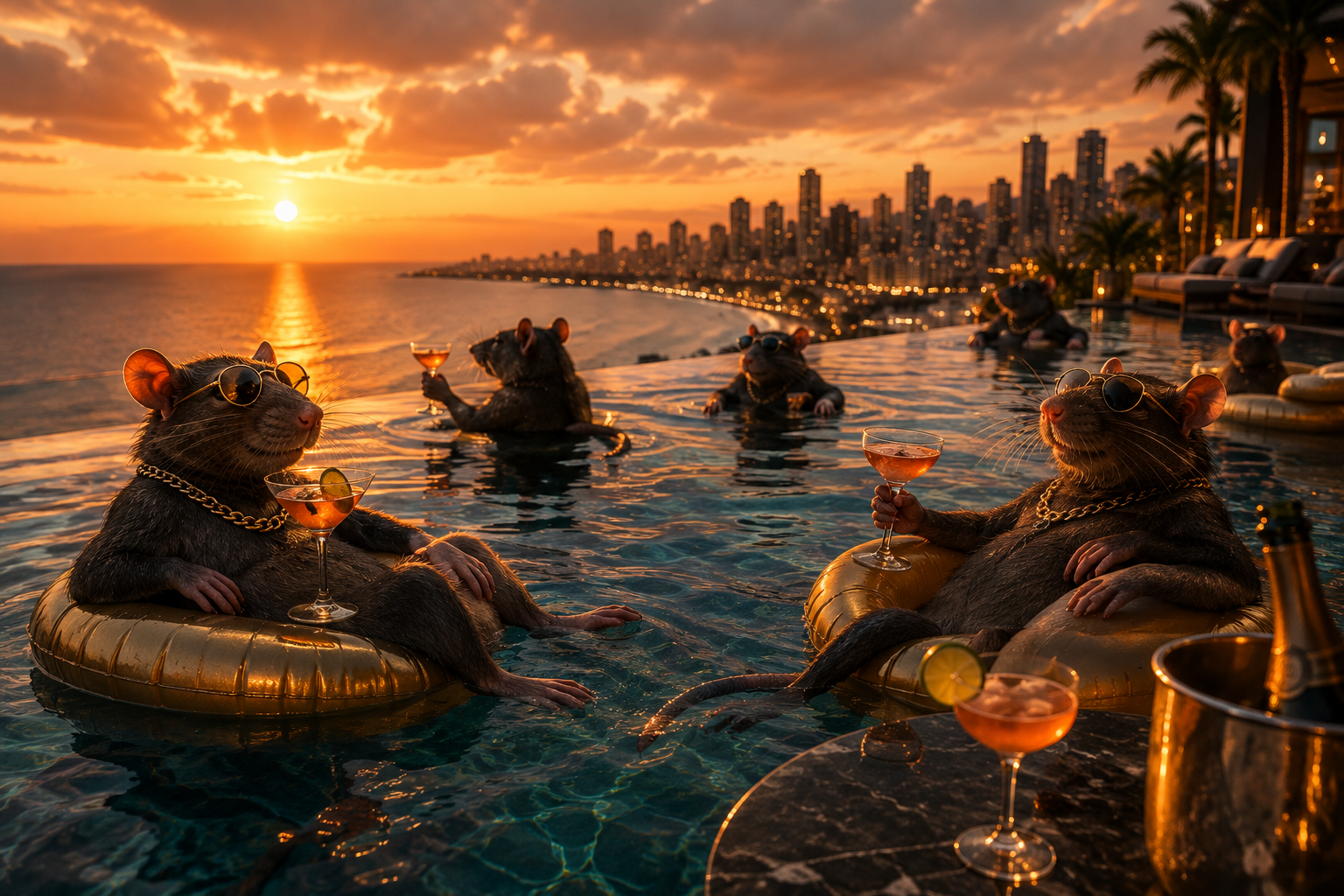
Our « Beautiful Ones » embody this confusion. They live well, sometimes very well, in a country where others can no longer meet their basic needs. But above all, they no longer seem to feel concerned. They live in their bubble, protected by their generators, insurance, schools, private hospitals, networks and purchasing power. The country can deteriorate around them: they buy individual solutions at each collective collapse.
Because public services are no longer needed, some end up losing sight of the usefulness of the community. Why defend public school when you can pay for a private school? Why require a functional hospital when insurance is available? Why claim public transport when you own several cars? Why reform the state when one can circumvent each of its failures?
Thus, a privileged class gradually ceases to be an elite. It retains money, networks, visibility and sometimes influence, but abandons what should justify these privileges: responsibility.
A true elite is not defined by the price of what it consumes. It is defined by what it builds, by the risks it takes, by the institutions it strengthens, by the jobs it creates and by its ability to make possible the future of others. It does not run into a bubble when the country suffers. It understands that its security also depends on collective stability.
In Lebanon, many have kept privileges and forgotten obligations.
They can be seen in social events, dinners, conferences and social networks. They talk about overtaking, positive energy, well-being and leadership. They give lessons on the country’s future without always investing a dollar in a productive enterprise, creating sustainable employment or contributing to a public institution. They know how to present their lives, but not necessarily build something that goes beyond their own comfort.
The most disturbing is their indifference to the suffering of others. The problem is not that they come out, travel or take advantage of their money. The problem is this ability to continue as if the crisis were only an external difficulty, reserved for those who do not have the means to escape it. Poverty is becoming a background noise. The distress of a pensioner, the emigration of a young doctor, the closure of a small business or the inability of a family to pay for treatment does not really disturb the evening program.
One might even say that part of this ostentatious consumption needs not to see. It works because it excludes the rest of the country from the field of vision. Real Lebanon disturbs photography. It must therefore be kept behind tinted windows, beyond the walls of the private club, outside the framework of social networks.
Here again, the parallel with Calhoun finds its scope. The « Beautiful Ones » of the experiment were not dangerous because they were violent. They were by their withdrawal. They had ceased to participate in the behaviour that allowed the colony to maintain itself. They continued to consume available resources, but no longer contributed to the continuity of the group.
The Lebanese « Beautiful Ones » sometimes go further: they consume a disproportionate share of limited resources without helping to renew them. They capture capital that could be invested, create little new wealth, offer few jobs and distribute almost nothing. They participate in an imported consumer economy, often financed by family resources, external transfers or rents, rather than in a production economy.
An imported luxury car creates almost nothing locally. It mobilizes currencies, feeds some intermediaries and produces above all a social sign. Conversely, the same amount invested in a company can buy equipment, finance wages, support suppliers, produce exports and support several families. It can become a capital that circulates and reproduces instead of disappearing into a depreciated asset.
It is not a question of pretending that any luxurious purchase should be banned or transformed into a social work. It should be recalled that a country in crisis cannot afford to see dilapsing as a success. When capital is scarce, those who own it have a special responsibility in the way they use it.
Lebanon already exports a large part of those that produce. Doctors, engineers, researchers, nurses, entrepreneurs and teachers leave because they no longer find the necessary conditions to work or live in dignity. The country forms skills that it then offers to other companies. It finances its own flight of talents, then celebrates diaspora transfers as if emigration had become an economic model.
At the same time, some of those who remain live on wealth, annuities or consumption. The paradox is cruel: Lebanon exports those who create and preserve part of those who spend.
In the long term, no country can survive such an imbalance.
An economy does not only live in restaurants, nightclubs, imported cars and real estate. It has investment, production, innovation, skills and trust. When the money available is mainly used to consume imported products or display a status, it does not build the country. He often leaves the productive circuit as fast as he entered it.
The problem is therefore also economic. Rare resources are diverted from productive investment to appearance. Family capital is dissipating. Currency comes out. Small businesses lack financing. The kids are leaving. Sectors capable of producing value remain underdeveloped.
But the crisis is mostly moral because this situation continues to be admired. A man is said to have succeeded because he owns, not because he created. We invite him, we photograph him, we present him as an example without asking whether his fortune is inherited, captured or honestly built.
By seeing corruption rewarded, we end up seeing it as a skill. By seeing honesty penalized, we think it’s naivety. By seeing opaque fortunes honored, we even forget to ask the elementary questions.
Did he build anything? Did he create jobs? Did he pay for his obligations? Did he produce, innovate, transmit? Or has he simply inherited, captured, protected his interests and spent ostentatiously?
This question should not be rude. It should be central.
However, Lebanon has real successes. Entrepreneurs maintain businesses under absurd conditions. Doctors remain in spite of the deterioration of income. Teachers continue to train students. Craftsmen preserve their jobs. Farmers invest despite the risks. Associations replace certain public services. Families and members of the diaspora fund productive studies, care and projects.
They still hold the country.
They are often less visible than parading, but they are infinitely more useful. Their wealth, when it exists, has a function. It supports activity, know-how, jobs or transmission. It is not based solely on the display.
The morality of Universe 25 is therefore not that abundance inevitably leads to death. It would be too simple a reading. Rather, the lesson is that a community can continue to have resources while gradually losing the behaviours, responsibilities and links that ensure its continuity.
In Lebanon, we are witnessing another form of the same danger. Resources are not abundant, they are scarce. But a minority continues to capture, consume and dilapidate them as if they were infinite. She lives in a bubble, barely looks at those who suffer and does not measure that every sum destroyed in appearance is also a sum that produces nothing, creates no jobs and supports no one.
A country is not only rebuilding with good intentions. It is rebuilt with production-oriented capital, with companies, wages, schools, care and institutions. It rebuilds when those who have more understand that they also have more responsibilities.
Continuing to live is not a fault. Going out, traveling, sports, buying a nice car or dinner in a good restaurant are not crimes. But when this life rests on a stolen, captured or dilapidated fortune, when it mobilizes scarce resources without creating anything in return, and when it is accompanied by total indifference towards those who suffer, it deserves neither admiration nor respect.
It’s not a success.
It is the sterile consumption of what remains, while others already pay for the addition.
References
John B. Calhoun, Population Density and Social Pathology, Scientific American, February 1962.
John B. Calhoun, Death Squared: The Explosive Growth and Demise of a Mouse Population, Proceedings of the Royal Society of Medicine, vol. 66, 1973.
Edmund Ramsden, « Escaping the Laboratory: The Rodent Experiments of John B. Calhoun and Their Cultural Influence », Journal of Social History, vol. 42, No. 3, 2009.
National Library of Medicine, archives dedicated to the work of John B. Calhoun and the « Universal 25 » experience.