

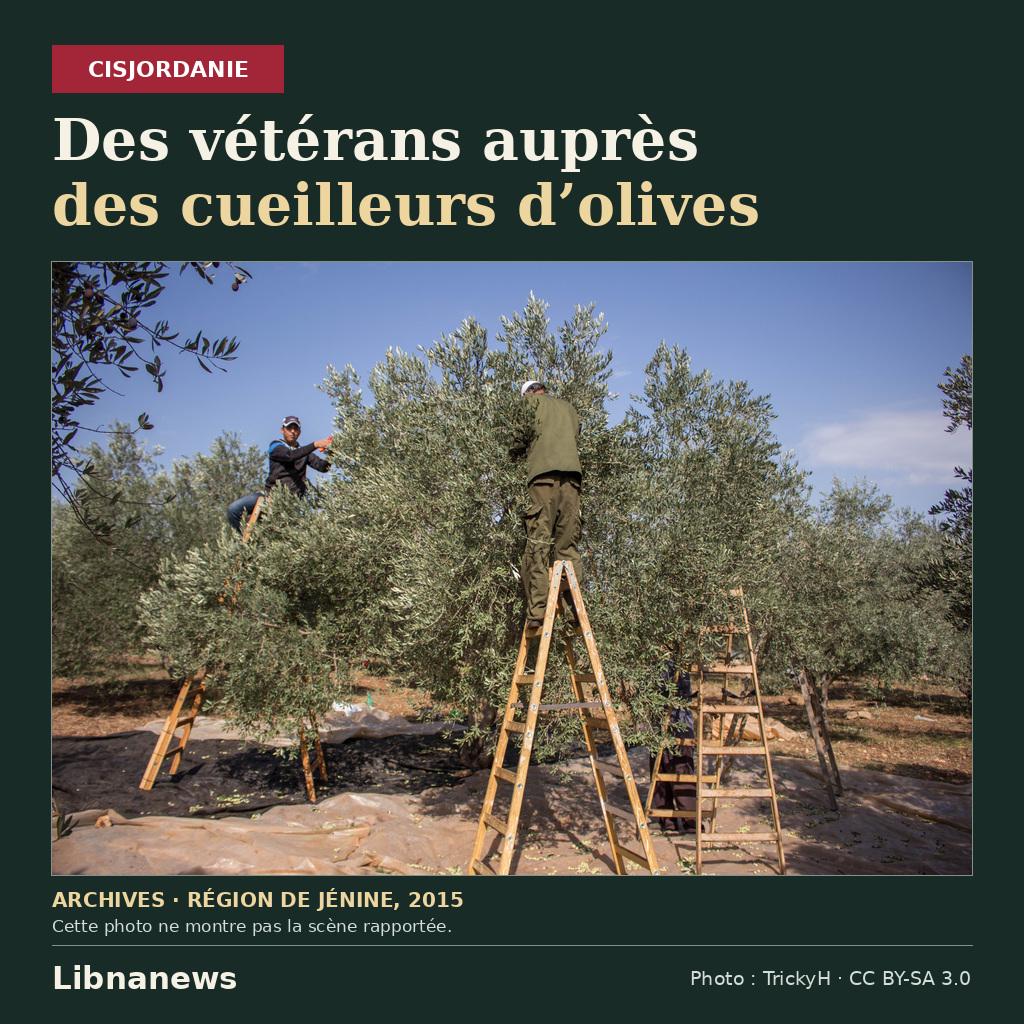
In the occupied West Bank, former Israeli army and intelligence officials join volunteers accompanying Palestinian farmers. A report by Haaretz tells of what happened in October in Duma, near Nablus: an interrupted gathering and two Israeli militants arrested. The video published on 19 November by the newspaper looks back at the role of these army, Shin Bet and Mossad elders.
Watch the original video of Haaretz on X.
In Duma, picking doesn’t end
In her 6 November report, journalist Noa Limone follows a group who came to help with the harvest. In Burin, where he intended to work first, access to the village was closed. In Duma, a family agrees to go to its olive grove with the volunteers. The group’s presence allows it to start harvesting, but the gathering stops after the arrival of settlers, according to the story of Haaretz. Only olives from a few trees could be picked that day, in the plot where the journalist was.
The newspaper reports that the Israeli police are calling on two escorts, including retired Brigadier General Joel Feldschuh. The newspaper states that they are released on the same day under conditions. Their arrest is not worth a sentence. The video announced on 19 November, credited by Haaretz in Noa Limone and Tal Elkayam, do not establish that a new exit took place that day.
Army elders, but not a military mission
The report attributed the initiative to Eyal Ben-Reuven, a former general of the Israeli army. It counts according to Haaretzformer officers as well as former senior officials of Shin Bet, responsible for internal security, and Mossad, foreign intelligence service. These routes describe the composition of the group, not the list of people present in Duma on that day. Participants are not sent by the institutions where they served.
These former leaders join activists already present in Palestinian communities. Ben-Reuven explains in the report wanting to help farmers, support long-standing volunteers and make the situation in Israel more visible. The prestige that some derive from their former functions has helped to draw attention to Feldschuh’s inquiry. In the field, it was not enough to allow the family to complete its harvest.
Volunteers cannot guarantee access to land
The United Nations Office for the Coordination of Humanitarian Affairs (OCHA) identified 410 settler attacks related to the olive harvest between 1 January and 31 Decemberand september and November 9 in the West Bank. In its report of 13 November, it also identified cancellations and postponements of access to agricultural land, as well as limited days of collection. Aid from humanitarian partners is reaching only a limited number of farmers in most localities, even though these partners provide equipment or accompany harvesters.
The Israeli army claimed on 27 October that the vast majority of the coordinated gatherings it protected were conducted without unusual incidents. This declaration concerned these operations, not all the parcels that farmers sought access to. She did not specifically respond to Duma’s case. What it describes Haaretz the difference is that being able to start picking with volunteers does not mean being able to stay, or coming back the next day.





Comments