

To demand that a case be referred to the Council of Justice is not sufficient to bring it before it. In Lebanon, referral to this exceptional jurisdiction requires a decree adopted by the Council of Ministers. This decision must be distinguished from the investigation and the judgement, which intervene in another context.
In a sensitive case, the request to change jurisdiction can become a political issue as visible as the investigation itself. However, it alone does not produce the transfer of the file. The existence of a public declaration, a family appeal or a partisan stance does not make it possible to announce that a dismissal has been decided.
A decree, not a mere announcement
The Ministry of Justice indicates that the Council of Justice is seized by a decree issued by the Council of Ministers. Its jurisdiction includes crimes against State security and certain public security offences. It does not constitute a court that any complainant could freely choose to obtain alternative treatment of his case.
A legal study published by the Lebanese University sets out the consequence of this rule: the Council does not deal with itself. In the absence of the required decree, the jurisdiction remains with the ordinary or military courts, according to the applicable rules. On the other hand, the removal order constitutes the act which allows the relevant procedures to be transferred. To identify an actual change, it is therefore necessary to examine this act and its scope, not only the announced intention to obtain it.
Discharge does not resolve guilt
Once the case is dismissed, a magistrate is appointed for the investigation, in accordance with the procedures laid down with the Ministry of Justice and the Higher Council of the Judiciary. This examining magistrate is not confused with the training in charge of the trial. The investigation may result in dismissal or indictment followed by referral to the Council.
The Council is chaired by the first President of the Court of Cassation and consists of four other judges of that Court. The Ministry recalls that remedies against its decisions are particularly limited, with exceptions for opposition and review. The change of jurisdiction is therefore not limited to a change of title: it initiates a specific procedural path.
Two decisions not to be confused
The executive branch decides on the dismissal in legal terms; However, he does not pronounce a sentence. Imputed facts, individual responsibilities and evidence remain to be examined in the judicial proceedings. To describe an order as a formal admission of guilt would be as inaccurate as to make an application for an order as a transfer already completed.
This reading grid applies to any matter referred to in the public debate. Before referring to referral, the decisive information remains the existence of the removal order. Before we talk about guilt, we need a court decision that clears up.
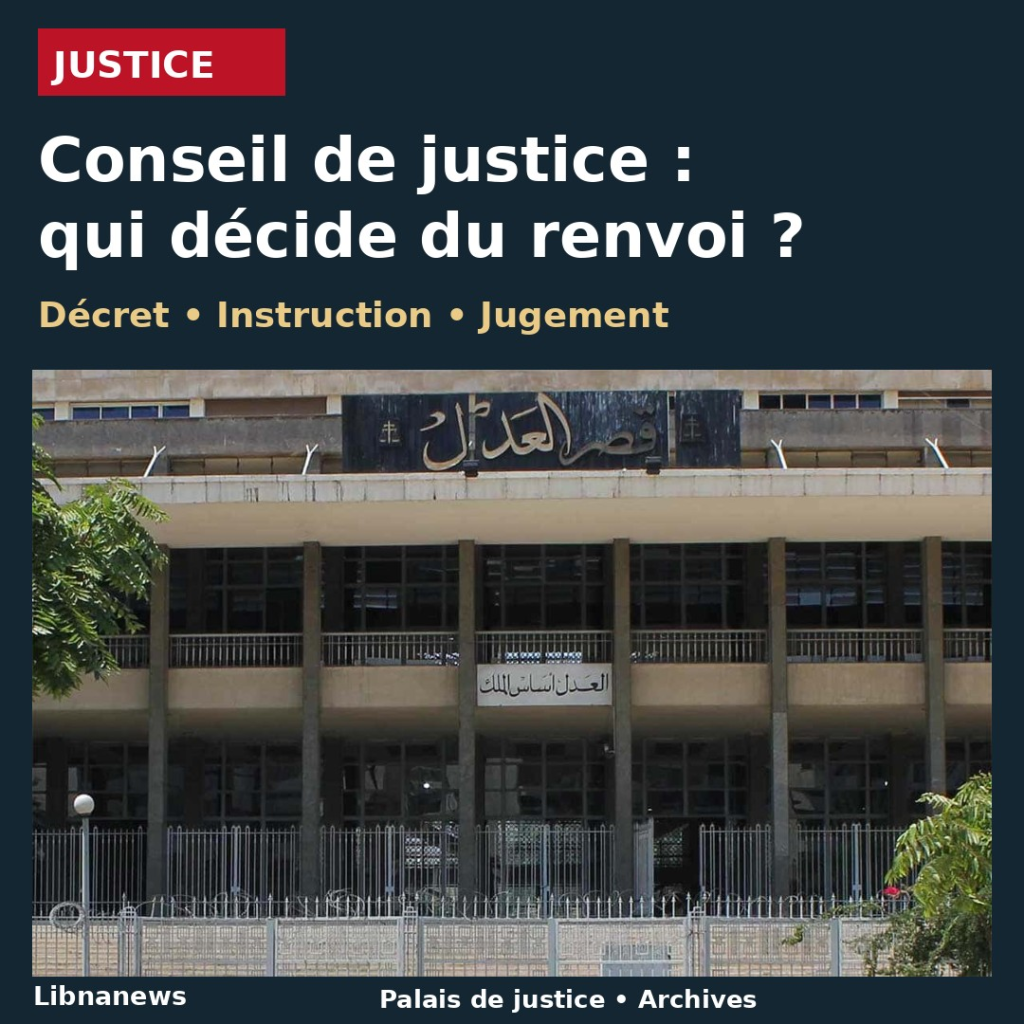
Cover: Beirut Courthouse, Libnanews archive. Date and photographer not informed. General illustration, no audience represented.





Comments