

A US arms sale to Israel can be announced, discussed in Congress, negotiated and delivered several years later. These steps are not equivalent. In order to understand parliamentary debates, it is also necessary to distinguish a motion to consider a resolution of a ban that has actually entered into force.
This decryption relates to the procedure described by the Congressional Research Service in its updated report on 13 May 2026, and to dated votes. There is no new general suspension of sales.
Two circuits, different obligations
The Foreign Military Sales program organizes transactions between the US government and a foreign government. Direct Commercial Sales refers to exports made directly by U.S. licensed companies. In both cases, certain transactions must be notified to Congress before the executive can take the next step.
For Israel, the regular formal deadline is 15 calendar days for the operations concerned, compared with 30 for many other recipients. The thresholds are also different. In the intergovernmental circuit, notification is required from, inter alia, $25 million for major military equipment, $100 million for the total value of defence equipment and services, and $300 million for design and construction services. It is therefore not a uniform time limit applicable to each exported part.
These 15 days do not designate the time required for manufacture or a delivery date. They constitute a review period before the administration can continue the transaction. The report states that the interruptions in parliamentary proceedings do not automatically suspend this deadline.
An administrative update of the DSCA of 25 September 2026 takes up these same thresholds. It also specifies that, for the notifications concerned, a final offer cannot be made before the expiry of the legal period. The communication of a draft offer requires confirmation by the State Department that Congress has been formally seized, or an express written agreement by the competent head of the DSCA. These are rules of procedure, not a general authorization to deliver.
Examination begins before formal announcement
The State Department also makes prior informal notification to the relevant committees of the Chamber and Senate. It allows for clarification and objections to be raised before the public phase. A reservation expressed at this stage may affect the timing or content of a sale.
However, it does not constitute an absolute individual veto. The CRS recalls that the executive is not legally prevented from pursuing a transaction with an informal objection. It is therefore necessary to check whether the word « blocking » describes political negotiation, administrative suspension or legal restriction.
What the votes of 15 April mean
The official record of the Senate provides a specific example. On 15 April 2026, a motion concerning resolution S.J.Res.32 on bulldozers for Israel was rejected by 40 votes to 59. Another, concerning S.J.Res.138 and 1,000-pound bombs, failed by 36 votes to 63.
These votes concerned the divestiture of the committee in order to allow the chamber to move forward in the consideration of resolutions. They were not final votes adopting an embargo. They measure parliamentary opposition to identified transactions, without showing by themselves the cessation of their deliveries.
The distinction remains useful when a majority changes: gathering enough votes to open a debate, adopting a resolution in a chamber and introducing a restriction in force are three different stages.
The veto and the emergency exception
A joint resolution of disapproval must follow the legislative process. The President may veto it. The 2019 example, taken from the CRS, shows this limitation: the two chambers had adopted several resolutions concerning transfers to Saudi Arabia and the United Arab Emirates, but the presidential veto had not been overcome.
The law also provides for an emergency procedure allowing the executive not to wait until the end of the ordinary period. It must transmit to Congress a detailed justification of the urgency and national security interests invoked. The report lists its use for sales to Israel in March and May 2026. The urgency therefore changes the examination schedule; It does not turn an advertisement into proof of delivery.
After notification, the check is not completed
Finally, the CRS points out that Congress can use the ordinary legislative procedure to prohibit or modify a sale until the equipment is delivered. This may be done through an autonomous text or an explicit restriction in a budget law. It still requires a text adopted by both chambers and submitted to the President.
Intervening after a contract is signed may, however, have diplomatic or financial consequences. Therefore notification, contractual commitment and delivery must be monitored separately. In order to assess a decision on weapons destined for Israel, the concrete questions remain the same: what material is being targeted, at what stage is the transaction taking place, what text produces an effect and does this effect concern financing, authorization or delivery?
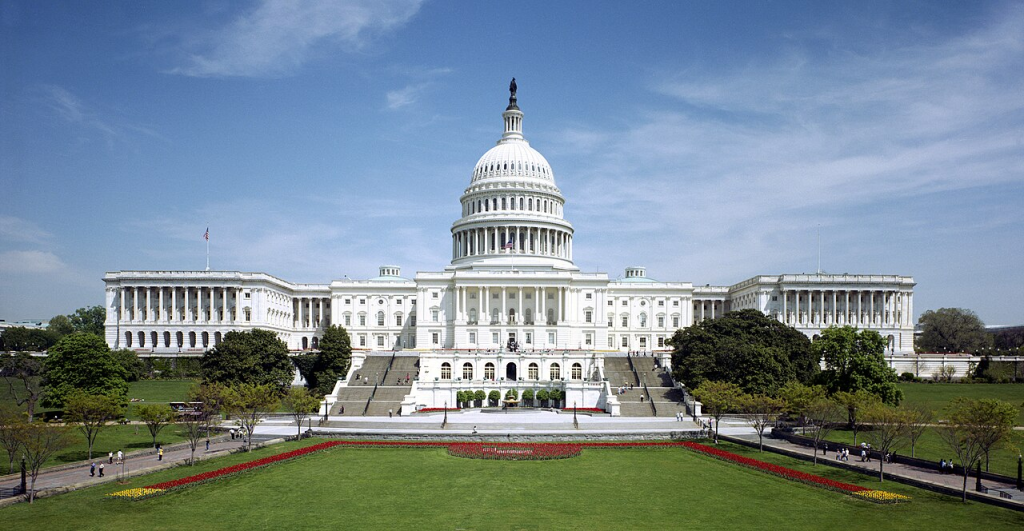
Illustration: American Capitol in Washington in 1997. Architect of the Capitol, a public domain in the United States, via Wikimedia Commons and Libnanews archives. This photograph does not represent a vote of 2026.





Comments