

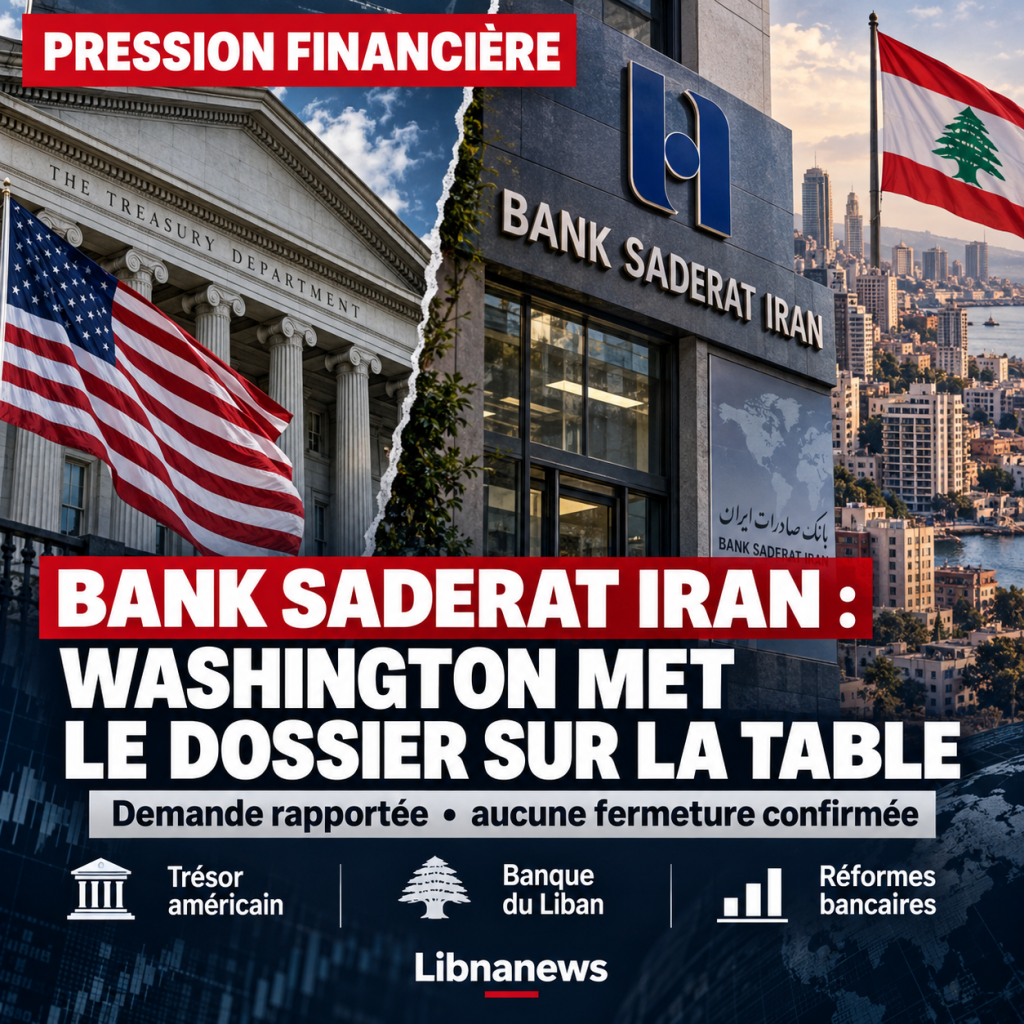
The Lebanese Government delegation’s visit to Washington might have opened a much more sensitive case than the only financial reforms expected from Beirut. In the middle of discussions on the International Monetary Fund, banking restructuring and public finance, Bank Saderat Iran was said to have been directly mentioned by US Treasury Secretary Scott Bessent. The information was not the subject of an official US or Lebanese announcement. It is reported exclusively by Al Sharq in its 2 October 2026 edition, based on sources presented as informed. This reserve is essential. However, it does not detract from the political scope of the case if the evidence is confirmed.
According to Al Sharq, Scott Bessent addressed Bank Saderat Iran during his meeting with the Lebanese government delegation in Washington. He reportedly asked Lebanese officials to « help » the case. The publication interprets this wording as a sign that Washington would like to see Beirut take action against the establishment, up to and including its closure in Lebanon. The newspaper, however, makes an important point: the US official would not have detailed the measures expected. He would have insisted above all on the need to take the subject seriously.
This distinction prevents, in the state of available sources, from asserting that Washington has formally handed over an order of closure to the Lebanese government. The title used by Al Sharq goes further than the details reported in the body of information. They only establish, according to the newspaper’s sources, that the file would have been raised and that Lebanese action would be expected.
A request voluntarily left in the blur
The imprecise nature of the application is precisely one of the most interesting aspects of the file. A very detailed U.S. request would immediately have put the government before the need to accept, refuse or negotiate. A general formulation leaves more possibilities. It allows the US authorities to signal their expectations while leaving Beirut the responsibility to determine which legal, regulatory or banking instruments could be used.
Al Sharq also states that no substantial Lebanese response was given during the meeting. Scott Bessent would have mentioned the subject towards the end of the discussions, without entering into a thorough technical discussion. Therefore, the sources cited do not indicate the position of the Government of Nawaf Salam.
This lack of known response is important. It means that it would be premature to present a possible closure as a decision already taken. There is no evidence in the source files that an administrative order has been prepared, that proceedings have been initiated against the bank or that the Bank of Lebanon has received specific instructions.
The file is therefore at this stage in an intermediate area. This is no longer a general American concern, if the information is accurate. The topic was allegedly presented directly to a government delegation. But this is not yet a Lebanese decision.
Washington expands the scope of its requests
The context of Nawaf Salam’s visit to the United States gives this episode a special meaning. The Lebanese government is engaged simultaneously on several fronts. It seeks to move forward in international financial negotiations. It is also trying to obtain a change in the situation in the South and to relaunch the negotiating process with Israel. Finally, it must manage the internal file of the concentration of weapons in the hands of the State.
In the various reports published on 2 October, the American visit appears as a moment of confrontation between Lebanese demands and American priorities.
In particular, Beirut is seeking progress on Israeli withdrawal and the implementation of the framework agreement. The Lebanese authorities insist on the continuation of Israeli operations and, in their view, the non-compliance with certain obligations. At the same time, Washington continues to place the issue of arms at the centre of its discussions with Lebanon.
The appearance of Bank Saderat Iran’s file would add a financial dimension to this equation. The pressure would no longer be limited to military capabilities or security decisions. It would also affect the financial channels that Washington considers to be linked to Iranian influence.
This would significantly change the nature of the problem for the government. A military issue mainly involves the army, the Council of Ministers and the political forces. A banking issue also involves the Bank of Lebanon, supervisory authorities, compliance mechanisms and legal procedures for financial institutions.
The government should therefore avoid two pitfalls. The first would be to transform a foreign political demand into an automatic administrative decision. The second would ignore the international consequences of a refusal to examine a case presented as sensitive by the US Treasury.
The moment chosen is not insignificant
This information comes at a time when the Lebanese financial sector is going through a decisive phase. The government is trying to move towards an agreement with the International Monetary Fund. At the same time, the country is debating the restructuring of banks and the treatment of the financial divide accumulated since the beginning of the crisis.
Discussions with international institutions focus on the State’s ability to bring its financial system into order. They concern governance, banks, losses, the Bank of Lebanon and the credibility of the control mechanisms.
Finance Minister Yassine Jaber continued discussions on the reform agenda. Discussions focused on banking restructuring, the financial divide, public finances and the conditions for further negotiations with the International Monetary Fund.
In this context, a request from the United States concerning a specific establishment places Beirut before an additional question. Lebanon must restore the credibility of its banking system while avoiding its financial policy as a mere application of decisions taken abroad.
The situation is all the more delicate as President Joseph Aoun has challenged a provision in the text dealing with the situation of banks. This battle includes the powers of the Bank of Lebanon and the reference to the Currency and Credit Code.
Governor Karim Souaid is thus at the centre of a period when several questions intersect: restructuring of the system, division of powers, relations with international financial institutions and, now, possible US pressure on certain financial actors.
An increasingly thinning border between security and finance
Bank Saderat Iran’s file cannot be isolated from other developments reported in the Lebanese press on 2 October. The same issue of Al Sharq highlights another information: Al Qard Al Hassan’s case began to follow a judicial path.
Interior Minister Ahmad Al Hajjar states that this procedure was initiated following a request from the Minister of Justice. His department awaits the results of investigations before making decisions within his jurisdiction.
These two cases are legally different. There is nothing in the sources to confuse or assert that they are subject to a common procedure. But their simultaneous appearance reveals a change in the terrain on which part of the debate about Hezbollah and Iranian influence is taking place.
For a long time, the issue had been formulated mainly in military terms: weapons, missiles, territorial control and the decision on war and peace. It is now also addressed from a financial point of view.
This may have far wider consequences than a measure aimed at a given establishment. Financial issues relate to transfers, international banking relations, compliance mechanisms and the ability of Lebanese institutions to maintain their relationship with the global financial system.
The government must therefore manage a difficult balance. It seeks international support for reconstruction, public finances and the army. But any measure affecting institutions perceived as linked to Iran may also become an internal political issue.
A case that could test Lebanese institutions
A possible action against Bank Saderat Iran could not normally amount to a political decision announced since Washington. The Lebanese authorities should determine the legal basis for action, which institutions are competent and what specific elements justify a measure.
Source files do not provide the evidence to establish that such a procedure is already underway. They also do not give any decision attributed to Karim Suaid on this file.
It’s an important documentary limit. It would therefore be abusive to state that the Governor of the Bank of Lebanon accepted or rejected the US application.
On the other hand, the institutional question is inescapable. The current period is precisely marked by a discussion of the powers of the Governor and the Bank of Lebanon. Joseph Aoun’s appeal against a provision of banking reform is presented by his advocates as a protection of monetary authority. On the contrary, its critics fear that the appeal will delay the timetable for reform.
The simultaneous arrival of a dossier as sensitive as Bank Saderat Iran can give this theoretical discussion a very concrete dimension. Who has the authority to act against a financial institution? On what basis? What is the government’s place? What is the responsibility of the Bank of Lebanon?
The response will also determine how Lebanon can demonstrate to its partners that it has institutions capable of making its own decisions.
The American visit takes on another dimension
Nawaf Salam’s move to Washington was presented from several angles. The Prime Minister himself sought to dispel the idea that his American interlocutors had only exerted pressure on Lebanon. Other publications of the corpus, however, give a more demanding reading of the discussions, particularly on the issue of weapons.
Information about Bank Saderat Iran adds an additional piece to this mosaic.
She suggested that the US interviews would have covered a wider range of cases than the one publicly highlighted. The government would face an American approach combining security, finance, reform and control of networks considered to be linked to Iran.
This method is particularly important to understand the current period. Records are no longer necessarily negotiated separately. Economic reforms can influence international support. Financial support may depend on trust in institutions. Security issues in turn can affect reconstruction and donor relations.
In this architecture, the banking file becomes political and the political file becomes financial.
A narrow Lebanese margin of manoeuvre
Nawaf Salam must now move forward between several sometimes contradictory demands. His Government wanted to restore international financial relations and continue negotiations with the International Monetary Fund. It also seeks resources for the reconstruction and functioning of public institutions.
At the same time, it must avoid an internal political crisis that could jeopardize the same reconstruction.
A spectacular action against a financial institution associated with Iran could be interpreted by government opponents as the application of an American agenda. Conversely, the total lack of response to a U.S. Treasury request could complicate relations with Washington.
The method chosen will therefore be as important as the final decision.
A procedure based on general rules, transparent controls and the ordinary competences of the institutions would be different from an exceptional measure adopted following external pressure. In the first case, the Government could present its action as an application of Lebanese law. In the second, political controversy would be almost inevitable.
The sources of October 2 do not yet indicate what course will be taken.
What we know and what remains to be established
At this stage, only one element of the body of evidence indicates that Bank Saderat Iran’s case was raised directly with the Lebanese delegation: the exclusive information published by Al Sharq on 2 October 2026. It is itself based on anonymous sources and also contains information attributed to another publication.
No official document reproduced in the corpus confirms an American closure instruction. No communiqué from the Lebanese Government cited in the sources announces a closure procedure. There is also no evidence that Karim Souaid received or executed such instruction.
The strongest formulation therefore remains that of aalleged US request to deal seriously with Bank Saderat Iran’s file, with an interpretation that Washington would like measures up to closure.
This caution does not reduce the importance of information. On the contrary, it makes it possible to measure its scope correctly.
If the request is confirmed, the government of Nawaf Salam will face a major institutional test. He will have to determine how to respond to an American priority without giving the impression that Lebanese banking policy is decided in Washington. It should also articulate this issue with the restructuring of the banking sector, negotiations with the International Monetary Fund and tensions over Hezbollah-related financial networks.
The file could thus become much more than a bank case. It could be one of the first tests of the state’s new financial strategy against Iranian influence in Lebanon.





Comments