

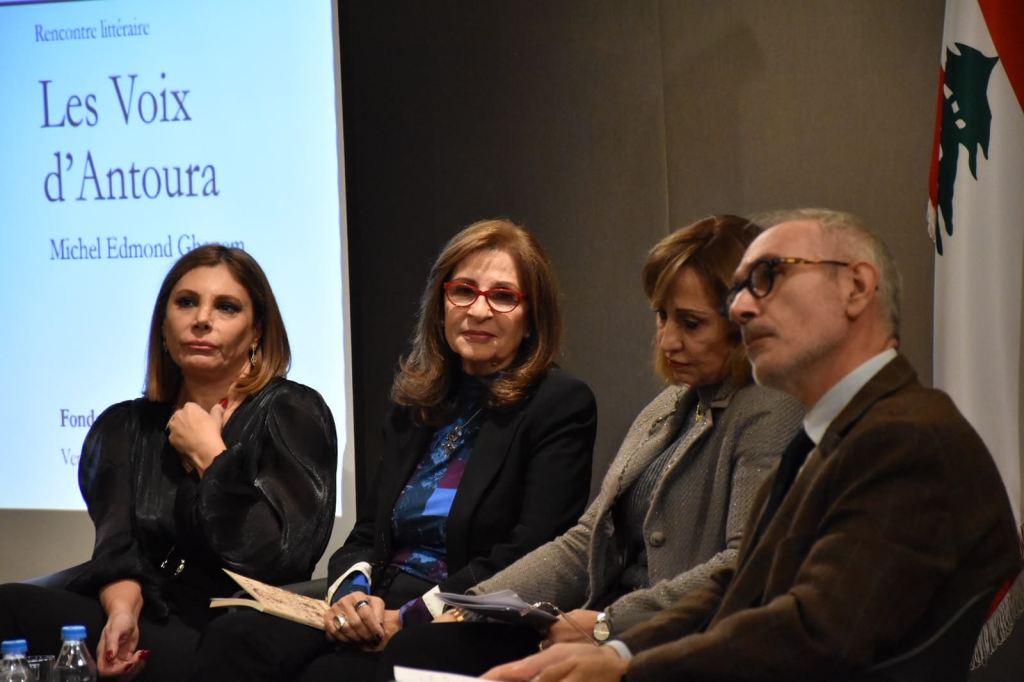
On November 13, 2026, the Charles Corm Foundation and the Artliban Calima Editions dedicated a meeting to the Voices of Antoura, the novel by Michel Edmond Ghanem selected in the first selection of the Prix France Liban 2026. The evening was attended by the poet Henri Zogheib, Minister Vrej Saboundjian, Mr. Fadi Yarak, Director General of the Ministry of National Education, Dr. Charaf Abu Charaf, former President of the Order of Physicians, and Krikor Alozian, Director of the Aram Bezikian Museum in Byblos, dedicated to the orphans of the Armenian genocide.
Nidal Haddad explained why she wanted to publish the novel. She spoke of the language and culture that Armenians continued to transmit after the genocide, and then the children who are now growing up under bombardments or on the roads of exile.
Based on her preface, Christine Babikian Assaf returned to the discovery, in 1993, of children’s bones during work at the Lazarist College of Antoura. During the First World War, the Ottoman authorities requisitioned the college to make it an orphanage. The testimonies of the survivors say what assimilation policy meant daily. Children were removed from their names, assigned a number and punished for speaking Armenian. In his memoirs, Halide Edib, who was in charge of the orphanage, evoked his visit to Antoura as one of the happiest periods of his life.
Zeina Saleh Kayali recalled that the children had had to perform 13 times The Shepherds of Canaan, an opera composed by Wadia Sabra on a Turkish booklet by Halide Edib. They sang on stage in the language they were forced to attend the orphanage. Biographer of Sabra, Zeina Saleh Kayali said that the composer’s archives leave open the question of what he knew about the conditions in which children interpreted his work.
In his speech « When silences become literature », Ghada Karaki attached himself to the form of the novel. The letters, memories and testimonies return in fragments, such as memories of a violent childhood. The plural of the title lies in this way of making heard singular experiences.
Bahjat Rizk distinguished what is being negotiated in politics from what calls universal condemnation. States can negotiate the terms of their relations. An ideology that dehumanizes a people must be condemned without reservation. He stressed the need for the Turkish authorities to recognize the Armenian genocide. The refusal of this recognition explains why the history of the children of Antoura remains a question of the present.
Michel Edmond Ghanem told how he had discovered the history of the orphanage in a college where two of his forefathers, Khalil and Chekri Ganem, had studied well before the war. The stories of Karnig Panian, Melkon Bedrossian and Harutyun Alboyajian fed the novel. From these accounts, the author imagined a correspondence between a former orphan and Halide Edib, whose responsibility he wanted to explore by keeping the experience of children at the forefront. He summarized his approach in two sentences. « The letters are invented. The voices are not. »
The book
The Voices of Antoura, novel by Michel Edmond Ghanem, Éditions Artliban Calima. Preface by Christine Babikian Assaf and postface by Jacques Bedrossian.





Comments