

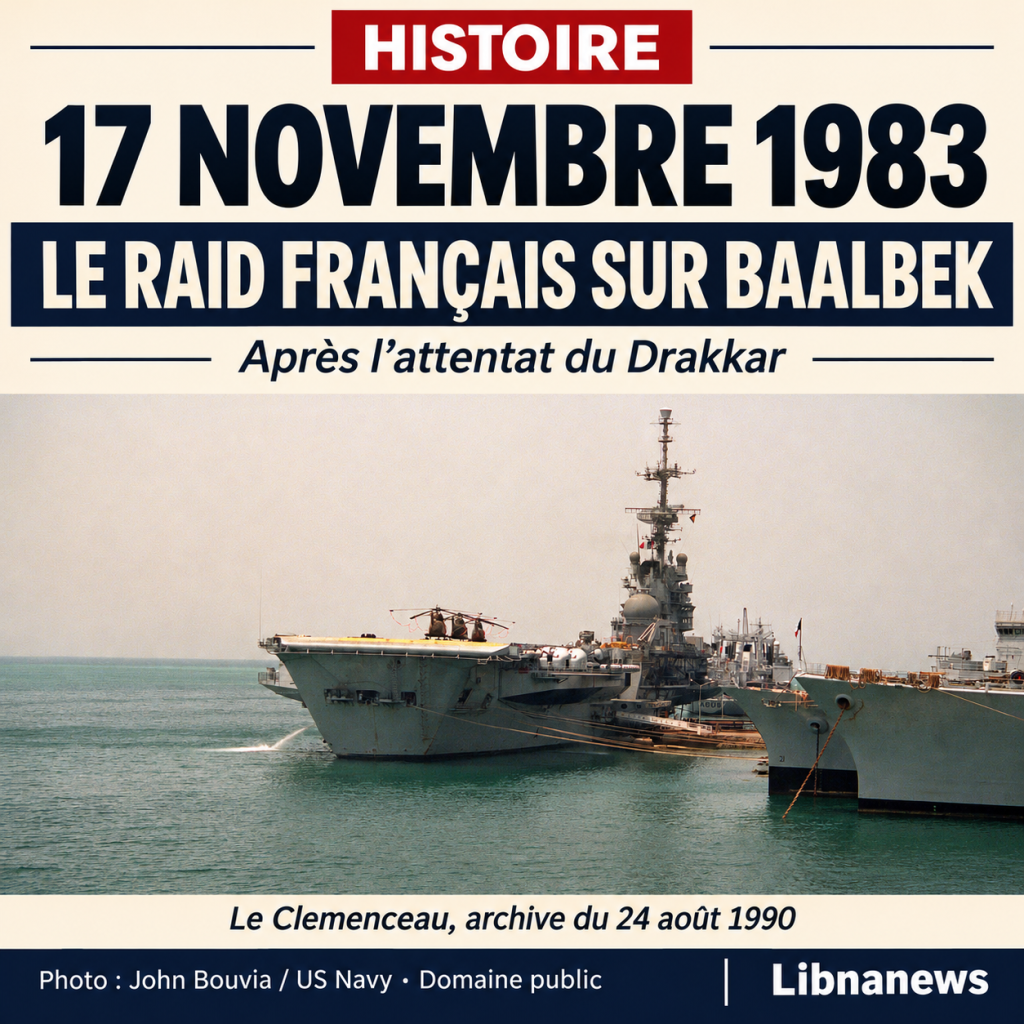
This day in the history of Lebanon. On November 17, 1983, eight French Super-Étendards took off from the Clemenceau aircraft carrier to strike a barracks in Baalbek, Bekaa. Operation Brochet responds to the Drakkar attack, which killed 58 French soldiers in Beirut on 23 October. This air response will not put an end to attacks against the multinational security force.
The raid on Baalbek, twenty-five days after the Drakkar
The destruction of the Drakkar post upset the French commitment to Lebanon. The paratroopers killed belong to the 1st and 9th regiments of paratrooper fighters. They serve in a force deployed in Beirut since September 1982, with American and Italian and then British contingents.
Paris decides to hit in the Bekaa. The target is far from the destroyed cantonment in the capital. It is presented as a militia training camp allied to the regional powers involved in the Lebanese war.
The bombing took place in the early afternoon. The French Ministry of Defence then explained that it wanted to prevent further attacks against its contingent. The day before, François Mitterrand announced on television that the attackers would not go unpunished. After the raid, Paris said all the planes returned to their buildings.
A strike from the Mediterranean
Clemenceau provides the platform for this intervention. The eight naval aircraft carried the French response to Baalbek, beyond the perimeter of the multinational presence in Beirut. The raid thus links two areas of the conflict: the neighbourhoods of the capital, where foreign contingents station and the Bekaa plain, where their opponents are located.
The French military story holds the destruction of the barracks despite the firing of anti-aircraft missiles. However, it points to an essential limitation: the occupants reportedly left the site before the attack. The hypothesis of a leak appears in this account, without allowing it to be established here the origin.
A distinction must therefore be made between the execution of the bombardment and its strategic outcome. Reaching a building does not mean neutralizing the targeted men or suppressing the action capabilities of an armed movement. The historical narratives thus describe Operation Brochet as a response whose real scope remains limited.
In Venice, Mitterrand defends the French decision
The following day, on 18 November, the French President took part in a Franco-Italian summit in Venice. Journalists repeatedly question Baalbek. First, he refused to elaborate on his explanations in this context, which dealt with bilateral relations and European issues.
François Mitterrand finally goes back to the death of Drakkar to justify the response. He asked not to judge the French action in the light of the 24 hours that had elapsed. In the same press conference, he joins Italian wishes for national reconciliation in Lebanon. The presidential speech thus juxtaposes the military response and political objective of a return to peace.
Multinational force leaves Beirut in 1984
The operation of 17 November did not lead to a lasting stabilization of the Western presence. Military members of the multinational force remain exposed to attacks. At the beginning of 1984, the US and French governments committed their withdrawal from Beirut.
France is preparing for the withdrawal of its contingent under Operation Carrelet. The multinational security force disappeared in March 1984 after the departure of the last French and American contingents. This withdrawal is not confused with the end of the French presence in UNIFIL, a separate United Nations force deployed in southern Lebanon.





Comments