






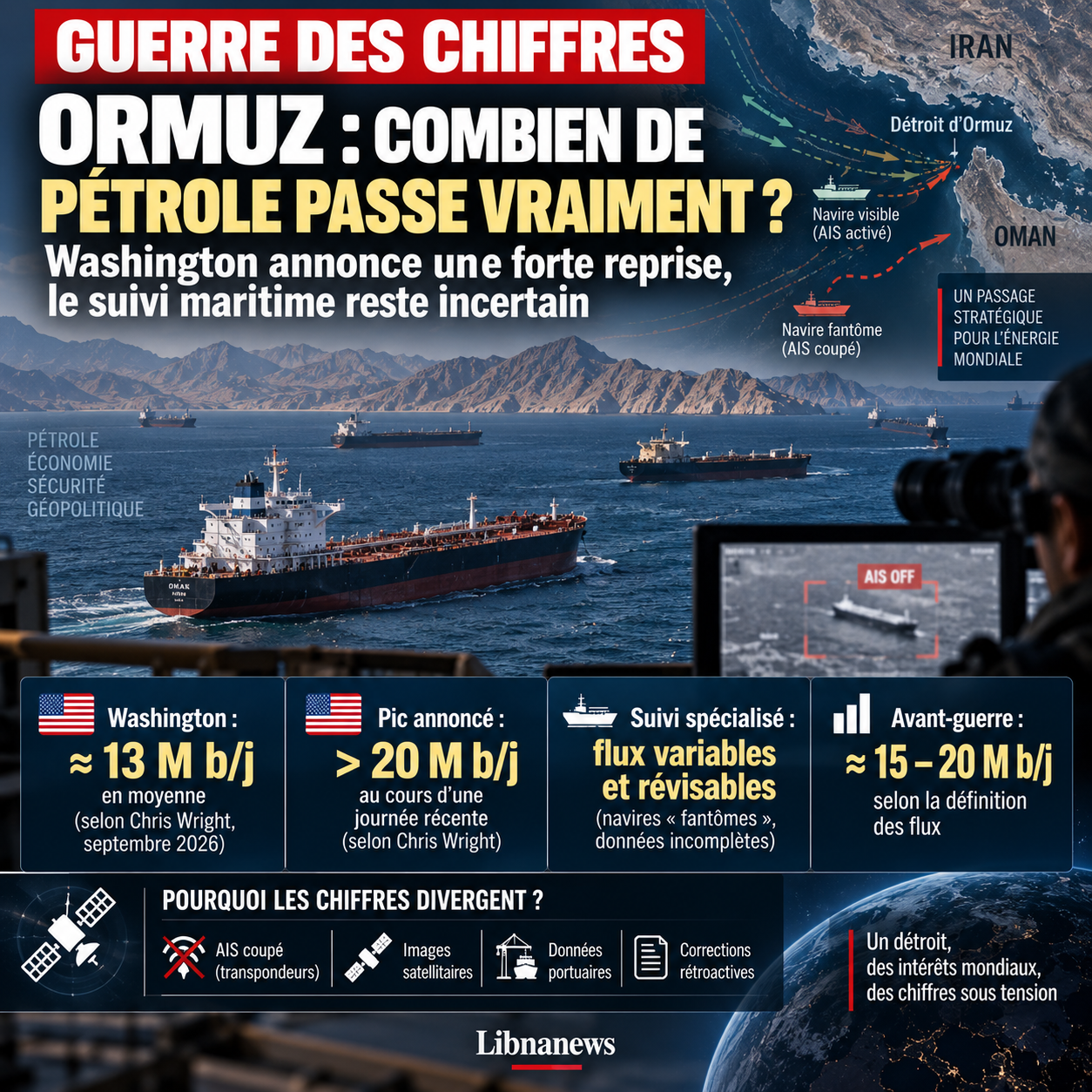
The Strait of Ormuz became the scene of a second confrontation, less spectacular than military operations but almost as strategic: a war of numbers. Washington claims that oil flows have resumed strongly. President Donald Trump even assured that a record amount of oil had recently crossed the Strait, according to him, exceeding the volumes observed before the war. Its Energy Secretary, Chris Wright, has advanced an average of about 13 million barrels per day and over 20 million over one of the last days. Behind these statements, however, is a rarely explained difficulty: counting in real time the barrels that cross Ormuz has become extremely complicated.
The war has disrupted the behaviour of ships, disrupted the ports and increased the number of cargoes whose movements are only known late. Oil tankers can turn off their automatic identification system and temporarily disappear from the screens used to track maritime traffic. But they do not stop sailing. A few days or weeks later, their movements can be reconstructed by means of port data, satellite images, reappearance at sea or arrival at a destination terminal. Historical statistics are then corrected. An invisible barrel on the day of its passage can thus reappear several weeks later in the accounts of the day it had actually crossed the strait.
This mechanics makes triumphal statements as fragile as catastrophistic announcements. A spectacular daily figure may reflect a real recovery, but also the evacuation of cargo accumulated for several days. An average calculated on vessels immediately visible may underestimate traffic before revision. And a political opening of the Strait does not mean that Gulf exports can immediately return to their previous level. In Ormuz, oil is now followed as intelligence.
The Washington figure: 13 million barrels a day
The U.S. administration wants to demonstrate that the Iranian lock on Ormuz no longer produces the desired effects of Tehran. Chris Wright claims that outflows now average about 13 million barrels per day. He also states that they have exceeded 20 million over a recent day, which, according to his interpretation, is more than before the conflict started. Donald Trump takes up the same idea when he says that a record amount of oil crossed the strait during the weekend.
The political message is transparent. If oil flows again in large quantities, Iran loses part of the pressure instrument of closing or restricting the passage. The rise in energy prices could then be attributed to other factors. Chris Wright insists precisely on refining capabilities, which he presents as a problem now greater than the volume of crude through the Strait.
This presentation also serves the American discourse on the effectiveness of pressure against Tehran. Washington states that its economic isolation campaign is beginning to produce its effects, while Donald Trump continues to evoke a possible resumption of negotiations and does not rule out further strikes. To show that the Gulf oil trade can resume despite the confrontation is therefore to reduce the strategic reach of the Iranian weapon.
But the measurement of maritime traffic does not work like a meter installed on an oil pipeline. There is no device at the entrance to Ormuz instantly adding up each barrel transported under the hull of the tankers. The figures come from the monitoring of ships, the estimation of their cargoes and the reconstruction of their movements. When visibility deteriorates, the margin of uncertainty increases.
Ormuz before the crisis: about 15 million barrels as reference
Data used in traffic analyses place the reference oil level before the crisis at around 15 million barrels per day. This is the basis for measuring the magnitude of the shock caused by war and navigation restrictions. It also allows us to understand why American statements about a return above previous levels are of such political importance.
If the 13 million barrels per day announced by the US Secretary of Energy correspond to a sustainable and directly comparable average, the gap with the pre-crisis level would indeed have narrowed considerably. A day of more than 20 million could even give the impression that the strait crisis is already in the past.
The problem lies in the word « sustainable ». Oil traffic is naturally irregular. Several large tankers can cross a crossing point on the same day, followed by a much weaker day. In times of war, this effect is amplified. Ships wait, cargo accumulates, a navigation window opens and several departures are made at the same time. The daily volume then jumped without changing the strait’s structural capacity.
That is precisely what makes peaks difficult to interpret. They show that oil can pass. They do not necessarily prove that traffic has returned to normal.
The previous 55 million barrels
An episode in early July illustrates this statistical trap perfectly. Between 1 and 6 July, more than 55 million barrels would have crossed the Strait. Compared to a few days, the figure gives the image of a spectacular reboot of traffic. Taken in isolation, it might even suggest that the market had regained a capacity close to normal.
However, a significant part of these volumes were previously accumulated cargo. The resumption of navigation had freed a floating or delayed stock. The oil tankers therefore did not only illustrate the production and export of these six days; They also evacuated the consequences of the previous blockage.
This distinction is fundamental to understanding the war of figures around Ormuz. A strait can have a very high flow for a few days precisely because it has worked at idle before. The peak is then the consequence of the blockage as much as the proof of its relaxation.
In order to know the actual situation, the observation period must therefore be extended. An average over several weeks is more instructive than a daily record. It is also necessary to know whether the volumes exported correspond to new production or cargo already awaiting their departure. Finally, the physical passage of a vessel must be distinguished from the immediate identification of its cargo.
It is at this third level that the « phantom ships » appear.
When a tanker disappears from the screens
Modern commercial shipping is largely based on the automatic ship identification system. In particular, it transmits their identity, position and trajectory. This information helps to avoid collisions, but it has also created a huge market for maritime data. Specialized companies continuously monitor tankers, bulk carriers and container carriers to estimate the movement of goods around the world.
When a vessel turns off its beacon, it disappears from this immediate reading. He obviously did not become invisible in the physical sense. Satellites can still photograph it. Radar can detect it. The military authorities have additional resources. But for the commercial bases used to quickly establish oil flows, part of his journey becomes more difficult to follow.
This behavior was not born with the present war. Cargoes carried in environments subject to sanctions have long used practices to complicate their traceability. Temporary removal of beacons, flag changes, transfer of cargo between ships or changes in commercial identity may create shadow areas in databases.
The Ormuz crisis, however, gives new importance to these phenomena. It is no longer just a question of whether a sanctioned cargo has changed ownership. It is necessary to measure almost in real time how much oil is actually coming out of the Gulf while this data influences world prices and the power ratio between Washington and Tehran.
How to find a ship that has become a ghost
The disappearance of an oil tanker from monitoring systems is often only temporary. Analysts can rebuild their trip after the fact. A satellite image may reveal its presence in a given area. A port register can confirm its loading. Its reappearance in the automatic identification system can help to reconstruct its trajectory. Its arrival in a foreign port finally provides additional information on the origin and destination of the cargo.
The work then looks more like a survey than just a statistical reading. Specialists cross the hours, positions, characteristics of the vessel, its draught, the busy terminals and the movements observed before and after the silence period. Once the journey has been reconstructed, the volume transported can be reallocated to the day the tanker actually crossed the strait.
This retrospective correction produces a confusing phenomenon: the past changes. The number of barrels attributed to a day of the previous month may increase several weeks later, not because new barrels have travelled in the past, but because analysts have only just found their trace.
Recent maritime statistics should therefore be understood as an estimate that could be revised. The more vessels attempt to mask their movements, the more important this revision can be.
This makes any comparison between a political figure announced today and a historical average recalculated several weeks after the facts particularly difficult.
A much lower adjusted average
The data reported from the specialized monitoring lead to a much more conservative reading of the recovery. Once the movements and exceptional episodes have been corrected in their context, the recent average flow would be around 4 million barrels per day, far from the 15 million observed before the crisis.
The gap is considerable. At this level, Ormuz would not operate at nearly 90% of its previous capacity, but around a quarter of its reference oil traffic. The difference completely changes the economic and political interpretation of the situation.
It does not necessarily mean that the US figure of 13 million is false. Both values may correspond to different periods, definitions or methods. The U.S. figure relates to recent outflows. The lower average reported by the expert analyses seeks to measure a wider period and correct the effects of exceptional days. Without access to the raw series and a strictly identical methodology, the two values cannot be compared as if one mechanically cancelled the other.
But their divergence is sufficient to show that the expression « return to normal » is premature. The reality of the Strait cannot be summed up by the best day of the week.
Opening up of Ormuz would not be enough to restore exports
Another mistake would be to assimilate the opening of the transition to the immediate restoration of the entire Gulf energy apparatus. War has not only affected maritime traffic. Oil and gas infrastructure has also been affected. Their restoration takes time.
Even in the event of a political agreement fully restoring freedom of navigation, exporters would not necessarily be able to return overnight to their previous volumes. Damaged facilities must be repaired, certain supply chains must be restored and the equipment required for loading must be returned to service.
Another obstacle is the behaviour of shipowners. A company does not decide to bring an oil tanker into an area at risk solely because a diplomatic communiqué announces a de-escalation. It examines the military risk, the price of insurance, the availability of crews and the possibility of a sudden resumption of hostilities.
Insurers do the same calculation. The higher the probability of loss of a ship or cargo, the higher the premium. These costs then affect the price of transport and, indirectly, energy.
The return to normality therefore involves several steps: opening the strait, restoring facilities, returning shipowners, reducing insurance premiums and restoring regular flows. Only one of these elements is not enough.
Qatar trapped in geography
The crisis also recalls that the Strait is not only an Iranian or American problem. The Gulf States also depend on this sea route. Qatar insists on this fact: when the passage becomes dangerous, restrictions also affect countries seeking to export their own hydrocarbons.
Doha therefore has an interest in achieving a lasting reopening through negotiations. Unlike some neighbours, Qatar does not have the same architecture of land pipelines to partially bypass the Strait. His energy geography makes him particularly dependent on freedom of navigation.
This partly explains his role as mediator between Washington and Tehran. The Qatari government is not only defending an abstract principle of free maritime movement. It directly protects a vital economic interest.
At the same time, other countries are seeking to strengthen land routes. The crisis has revived pipeline projects to transport more hydrocarbons to the Red Sea, the Mediterranean or other terminals. Projects are planned or developed in Saudi Arabia, Iraq and the United Arab Emirates.
But pipelines are not absolute insurance. They can be hit themselves, as well as the refineries and terminals to which they are connected. The war has shown an uncomfortable reality: diversifying roads reduces vulnerability without removing it.
Behind the barrels, a battle over prices
The statistical battle around Ormuz has an immediate consequence: it influences market expectations. If operators believe that traffic is returning to its pre-war level on a sustainable basis, the risk premium integrated with oil prices can decrease. On the contrary, if they consider that volumes remain low and vulnerable to further closure, this premium persists.
So Washington better show that the passage is working. Tehran has an interest in demonstrating that it retains the ability to disrupt an essential artery in world energy trade. The Gulf countries want to convince that their exports can continue while pushing for a diplomatic solution.
In this confrontation, the number becomes itself a weapon. The announcement of 20 million barrels in one day tells a story: that of a strait that Iran would not have been able to stifle. Putting forward an average of close to 4 million tells another: that of an artery still far from its normal functioning.
Both stories can be based on actual observations while selecting different periods.
Therefore, the average, the duration of observation and the methodology count as much as the final figure.
Satellites against war fog
The Ormuz crisis finally shows how trade data has become a component of contemporary intelligence. A few decades ago, it was primarily the responsibility of port authorities, companies and intelligence services to know precisely the movement of tankers. Today, private companies are crossing billions of localization points, satellite images and commercial information to almost rebuild global supply chains live.
The war, however, puts a certain amount of uncertainty in this system, which is considered transparent. A ship can turn off its signal. A cargo can wait offshore. A transfer may take place between two tankers. An announced destination may change. Automated monitoring must then give way to human analysis and reconstitution.
So « phantom ships » are not just a curiosity of maritime warfare. They reveal the limit of instant statistics in an environment where actors are trying to deceive the tools that observe them.
This limit should encourage caution when politicians turn a day of traffic into a verdict on the state of the Strait.
Ormuz may be more open than it was a few weeks before without regaining normal functioning. Volumes can increase without repairing infrastructure. Oil tankers can cross the path while remaining invisible in the first estimates. And a daily record can be followed by a new fall.
In this war, therefore, the question is no longer just whether the ships are passing. It is important to know how much they actually spend, how much oil they transport, how long their cargoes have been waiting for and how many other tankers are still sailing in the shadow of statistics. As long as these answers remain moving, Ormuz figures will have to be read as images of a radar in wartime: indispensable to understand the situation, but never sufficient, alone, to declare the strait back to normal.