






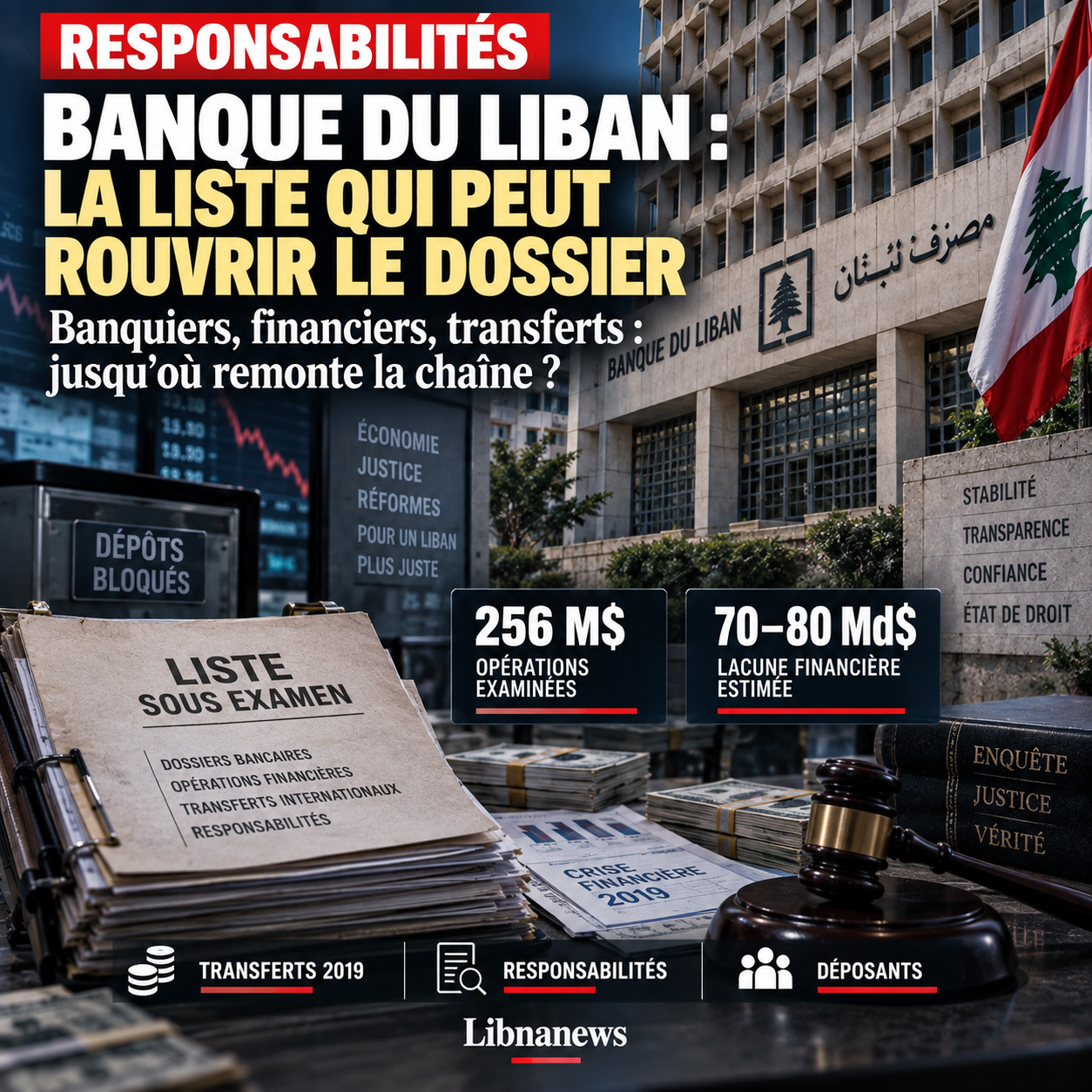
Past information almost unnoticed could reopen one of the most sensitive issues of the Lebanese crisis. A list transmitted or prepared as part of the Bank of Lebanon’s prosecution efforts would include individuals from the banking and investment sectors, some of whom have so far been outside the proceedings. No complete nominative inventory was made public in the available items. But the reported existence of this list comes at a particular time: outgoing Governor Riad Salamé remains at the centre of judicial proceedings, the government seeks to deal with a financial gap estimated at several tens of billions of dollars and depositors are still waiting to know what part of their assets can actually be recovered.
The question therefore goes far beyond the judicial fate of a former governor. Since the collapse of Lebanon, there has been a debate between the search for individual responsibilities and the explanation of a system in which the State, successive governments, the Bank of Lebanon, commercial banks and political authorities have participated, to different degrees, in pre-crisis decisions. If new prosecutions are actually directed at bank or financial officials previously outside the judicial sphere, the centre of gravity of the case could move. It would no longer be just a matter of judging certain transactions attributed to Riad Salamé, but of reconstructing the much wider chain that has allowed to accumulate losses, to continue to finance the State and, from 2019 onwards, to let some capital leave the system while the majority of depositors’ access to their money closed.
A list still in the shadow
The information available remains fragmented but sensitive enough to attract attention. A list of persons liable to be prosecuted at the request or on the basis of elements from the Bank of Lebanon would include bank and financial figures that would not have been really worried during the early years of the crisis. However, the documents consulted do not provide a complete nomenclature or sufficient evidence to publicly attribute a specific offence to specified persons. It would therefore be premature to turn that list into an indictment.
His interest is elsewhere. Since 2019, the question of financial responsibility has been largely personified around Riad Salamé. The former Governor, who led the Bank of Lebanon from 1993 to 2023, is the subject of several financial transactions. He has been detained since 31 July 2026 as part of a new procedure involving, inter alia, operations related to Bank Audi, after having already spent about 13 months in detention prior to release in September 2025 against a $14 million bond. At the age of 76, his state of health also became part of the case file, as his defence team reported repeated transfers between the prison and the hospital.
The Lebanese financial crisis cannot be materially reduced to the decisions of one man. The very duration of the system that collapsed makes this reading insufficient. For years, the State has borrowed, governments have spent, Parliament has voted budgets and texts, the Ministry of Finance has issued debt, the Bank of Lebanon has financed the system and commercial banks have placed a considerable part of their resources with the State and the central bank. Reconstituted responsibilities therefore means separating possible individual infringements from the general functioning of a mechanism in which many institutions have participated.
If the new list leads to effective investigations, it could precisely expand that search.
The 256 million dollars that now occupy justice
The contrast with the current procedures is striking. Part of the investigations against Riad Salamé involved operations allegedly carried out through four offshore companies in the Cayman Islands. Two amounts are mentioned: $154 million for a transaction dating back to 2010 and $102 million for another transaction dating back to 2012, in a case related to Bank Audi. Suspicions concern the nature and flow of these transactions, while the proceedings remain ongoing and no guilt can be presumed before a court decision.
However, one element makes it difficult to read the file. The Bank of Lebanon, which is a civil party, would itself have indicated that the credit granted to Bank Audi in 2010 had been approved by the Central Council and was therefore not the result of a personal decision by the Governor. According to the discussion, this appropriation was fully repaid in 2012 with an interest of 5 per cent, generating $33 million in income. A second credit would also have been repaid in 2016 at a rate of 6.5%. The central bank would argue that it did not have a financial loss on these two loans.
These elements are not sufficient to terminate the proceedings. The repayment of a credit does not, on its own, exclude the existence of an infringement which may concern other aspects of the transaction, its structuring or its beneficiaries. On the other hand, they show why justice must distinguish several issues: was an operation allowed? Did she cause a loss? Were parallel circuits used? Did anyone get any unfair benefit from it? And were decisions made by the governor alone or by collegiate bodies?
This distinction is often lacking in public debate. The amount of an operation does not prove its legality or illegality. A decision of the Central Council does not automatically remove individual responsibility. Conversely, the presence of the Governor’s name in a proceeding does not mean that all institutional decisions taken for 30 years can be personally imputed to him.
256 million against a gap of 70 to 80 billion
The case becomes dizzying when the amounts currently at the heart of some prosecutions are compared to the size of the financial collapse. The transactions reviewed in the Bank Audi proceedings amount to a few hundred million dollars. The country’s financial gap is estimated in the documents available between $70 billion and $80 billion.
A report by Alvarez & Marsal refers to losses of more than $76 billion and challenges their accounting treatment, notably through the registration of assets whose value is contested. Since 2022, the Lebanese State has estimated the gap around $70 billion, while the work on the new text on this gap shows an amount of up to $80 billion.
The difference in scale does not mean that proceedings involving a few hundred million would be secondary. Any potentially illegal transaction must be examined independently of its amount. But it raises a fundamental political and judicial question: where is the investigation into the tens of billions of losses that constitute the heart of the crisis?
The response is necessarily more complex because a systemic loss is not automatically the product of a diversion. Part may come from debts that have become uncollectible, depreciation of assets, financing of persistent government deficits or money mechanisms that have ceased to function. Judicial work consists precisely in identifying, within this collapse, operations that may be criminally responsible. Political and financial work involves determining who will bear the remaining losses.
The list assigned to the Bank of Lebanon becomes interesting at the intersection of these two issues. If it involves people who have played a role in specific operations, it could allow the transition from the general narrative of the crisis to individual responsibilities. The investigation must establish the facts.
Financial engineering at the heart of the mechanism
To understand how the gap reached several tens of billions of dollars, it is necessary to return to relations between the State, the Bank of Lebanon and commercial banks. Financial engineering has played a central role in this system. In particular, the central bank organised liquidity and securities exchanges with banks, while the State continued to finance its needs through debt.
The mechanism was based in part on the circulation of Treasury bills denominated in Lebanese pounds, euro-bonds in dollars, bank deposits and Bank of Lebanon liabilities. As long as currency inflows and confidence allowed the system to refinance itself, the building could continue to function. But as needs increased and new capital became more difficult to attract, the central bank became more exposed.
In 2019, owing to the lack of sufficient buyers, the Bank of Lebanon would itself have subscribed to more than 75 per cent of the issues in dollars and 92 per cent of the Treasury bills concerned. These proportions illustrate the degree to which the central bank had become indispensable for the financing of a State that markets could no longer absorb normally.
The question of liability cannot therefore be limited to who designed the engineering. It must be understood why the State continued to borrow, why banks continued to concentrate their investments in the system, and which bodies validated the operations. The Central Council of the Bank of Lebanon also had a role. Its members were called upon to participate in decisions, in an institutional architecture that was not limited to the Governor’s only person.
It is here that a possible extension of proceedings to banking and financial circles could change the nature of the case. It would require not only the central bank to be considered as the issuer of monetary policies, but also institutions that have benefited from certain transactions, accepted certain risks or made certain investment decisions.
October 2019, when applicants were no longer equal
One of the most sensitive episodes remains autumn 2019. In October, the Bank of Lebanon announced about $30 billion in usable reserves. However, no uniform legal control of capital was immediately adopted when the crisis broke out.
This lack of legislation has created a deeply asymmetrical situation. Banks have progressively imposed de facto restrictions on withdrawals and transfers. But these restrictions were not initially framed by a single text applied identically to all. In the meantime, some people with better information or privileged access could have transferred funds abroad, while the assets of a large part of the depositors would have been immobilized.
This is one of the most important issues in understanding the feeling of injustice that still accompanies the crisis. Financial loss is one thing. Another impression is that not all applicants were placed under the same rules.
A true accountability survey should therefore examine not only what happened before October 2019, but also the movements that occurred during the months when the banking system closed down. What transfers have been executed? Under what criteria? Which customers were able to move their funds? Have political, banking or financial leaders received different treatment? Were decisions made by establishment or were there common instructions?
The list mentioned around the Bank of Lebanon could become particularly sensitive if it were to affect that period. There is, however, nothing in the available evidence to suggest that it relates specifically to post-crisis transfers. The question therefore remains open.
The failure of 2020 and the responsibilities of the State
Another decisive moment comes on 7 March 2020. For the first time in its history, Lebanon decides not to repay a $1.2 billion bond maturity. At that time, public debt reached approximately $92 billion, or nearly 170 per cent of gross domestic product.
This decision was not taken by the Governor of the Bank of Lebanon. She was a member of the then government. This reminder is essential because it puts collapse in a much larger institutional chain.
For years, successive governments have accumulated deficits. Public spending was financed by debt. Projects have absorbed considerable resources without always producing the infrastructure or services expected. The Bank of Lebanon has facilitated the financing of this model, while commercial banks have invested heavily in it the resources collected from their clients.
When confidence disappeared, all these commitments were concentrated in the same system.
Seeking criminal responsibility therefore requires not to confuse a bad economic policy, a risky decision and an offence. The three may cause losses, but they are not covered by the same treatment. A government can make an economically disastrous decision without necessarily constituting a crime. On the other hand, an official may use a legitimate institutional decision to organise an illegal personal benefit.
It is precisely to distinguish these situations that the judicial investigation must go beyond slogans.
The new direction of the Bank of Lebanon changes the situation
The issue has also taken on another dimension since the change in governance at the Bank of Lebanon. Karim Souaid now runs the institution in a period when it must simultaneously preserve monetary stability, participate in financial restructuring and cooperate with the judicial authorities on cases inherited from the past.
This position is delicate. The central bank is both one of the institutions whose old policies are being examined and an indispensable player in the solution. It must provide documents on its own historical functioning while participating in the development of the system that should replace the one that collapsed.
If a list of persons to be prosecuted actually emanates from its work or from the files it has transmitted, the approach could signal a desire to broaden the search for responsibilities. But the credibility of such an operation will depend entirely on its method. A list cannot become a substitute for the investigation. Each name must be associated with specific transactions, documents and a legal basis.
Otherwise, the exercise could turn into a new political battle around the crisis.
Riad Salamé cannot be the file of the applicants
The procedure for the former governor is obviously still major. It must move quickly enough so that the charges can be examined and the defence can respond. His state of health reinforces the judicial emergency, but does not alter the presumption of innocence or the need to establish the facts.
The risk, however, would be to make the fate of the entire financial crisis depend on that of Riad Salamé.
Depositors have not lost access to tens of billions of dollars only because a judicial proceeding is now aimed at a former governor. Their problem is first of all that of a system whose liabilities exceeded the assets available. The judicial issue may establish responsibilities and, where appropriate, allow the recovery of certain funds. It alone cannot fill an estimated gap between $70 billion and $80 billion.
This is why the treatment of the crisis must progress on two parallel tracks. Justice must determine whether and by whom offences have been committed. The Government, the Bank of Lebanon and banks must define the allocation of losses and the modalities for returning deposits.
Consolidating these two paths would save each one time. Political leaders could wait for the courts. The banks could wait for the law. The State could wait for negotiations with the International Monetary Fund. Meanwhile, depositors would continue to wait for their money.
Names count less than transactions
The existence of a new list inevitably creates an expectation: who is there? The temptation would be to turn its possible publication into a major event. It would be missing the essential.
A name without documented operation explains nothing.
In order for the list to have a real judicial scope, it is necessary to know which transactions are being examined, which decisions have been taken, who approved them, what profits have been realized and whether a loss has been imposed on the Bank of Lebanon, the State or depositors. It is also necessary to distinguish between directors of establishments, shareholders, operational managers and persons who may have received special treatment.
This requirement is all the more important given that the Lebanese banking sector is itself a party to the settlement of the crisis. Banks will have to be recapitalised, restructured, merged or, for some, out of the market. Unsubstantiated court proceedings could be used to settle accounts. Conversely, the absence of a serious investigation would fuel the idea that system managers can participate in its reconstruction without ever being held accountable for their past decisions.
The credibility of the new banking model therefore also depends on the quality of this accountability.
The real question: who knew the state of the system, and when?
Beyond individual operations, a question goes through the entire crisis: when did the various officials understand that the system was no longer sustainable?
The answer is crucial. A decision made when a risk remains hypothetical does not have the same meaning as a transaction performed while insolvency has become obvious. Similarly, a transfer made in the normal operation of the system cannot be assessed in the same way as a privileged transfer made at the time the other applicants were already blocked.
It is therefore necessary to reconstitute the chronology accurately. When did banks begin to consider that foreign currency liquidity was becoming insufficient? When did the Bank of Lebanon consider that the mechanisms used so far could not attract enough dollars? From what date were political authorities informed of the seriousness of the situation? And most importantly, what transactions were allowed between then and the introduction of the restrictions that affected the majority of applicants? It is within this period that an essential part of the responsibility file could be found. Justice should not only look at the amounts and beneficiaries, but also at the date of each transaction and the level of information available to those who authorized it.
This chronology is all the more important as the collapse was not an instant event. It was preceded by a long deterioration in financial balances and then by an acceleration phase in which the ability to attract new currencies was reduced. Banks, the Bank of Lebanon, the Ministry of Finance and successive governments did not hold the same position in the system, but each had some of the information to assess the state. To determine who knew what, and when, would make it possible to distinguish decisions made under a model still considered viable from those adopted when its limits had become manifest.
2019 transfers, blind spot of accountability
The period following the outbreak of the crisis remains one of the most sensitive. In the absence of an immediate legal control of capital, the restrictions were implemented by banks in ways that were not initially regulated by a general rule adopted by Parliament. For depositors, this situation produced a lasting sense of inequality: some could no longer freely dispose of their accounts, while the suspicion that others had managed to transfer large amounts abroad persisted.
It is precisely here that a possible extension of investigations to bank or financial officials would be of great interest. It would not be enough to list transfers made after October 2019. They should be compared with the restrictions applied at the same time, identify the criteria used by each establishment and determine whether certain transactions have been given preferential treatment. Could a bank allow a significant transfer while simultaneously limiting withdrawals from other customers? Have managers, shareholders or politically exposed persons benefited from different conditions? These questions are at the heart of the lost confidence, but the available evidence does not yet provide a general answer.
The search for responsibilities should also distinguish ordinary transfers from movements that may have been motivated by a privileged knowledge of the situation. A commercial payment, medical expenses or a contractual obligation cannot automatically be equated with an outflow of capital intended to shelter a fortune. Judicial work is precisely about reconstituting the context of each operation. It is less spectacular than a list of names, but much more decisive in establishing possible responsibilities.
Banks, both creditor, intermediary and future restructured
The banking sector occupies a particularly uncomfortable position in this research. The banks collected savings, financed the State directly or indirectly, and placed a considerable part of their resources with the Bank of Lebanon. They are now called upon to participate in the settlement of losses resulting from a system of which they form one of the pillars. This dual position explains why the debate on responsibilities is inseparable from the debate on restructuring.
The Banking Restructuring Act is a first step, but it does not answer all questions. Restructuring a bank involves examining its assets, liabilities, capital and ability to continue its business. Establishing judicial responsibility implies another thing: demonstrating that a person has committed a specified wrongdoing. A bank may have taken significant risks without each of its officers having committed an offence. Conversely, a particular transaction may incur personal responsibility even if the institution itself remains viable.
Therefore, a list from or fed by the work of the Bank of Lebanon could become explosive if made public without its context. The issue is not to refer indiscriminately to bankers as responsible for the crisis. It is necessary to identify the decisions that need to be reviewed, the people who made them and the potential benefits they have generated. The credibility of the process will depend precisely on this ability to individualize responsibilities rather than to build collective guilt.
The financial gap project puts the issue back at the centre
This research comes at a time when the government is at the same time trying to move forward on the legislation to address the financial gap. Finance Minister Yassine Jaber presented the adoption of bank restructuring as a signal to the International Monetary Fund and Lebanon’s partners. The next step is to determine how the accumulated losses in the system will be recognized and distributed.
That is where the debate becomes politically explosive. Recognising a loss does not yet say who has to bear it. The State may be held liable for part of the liabilities arising from its debt. The Bank of Lebanon takes stock of the consequences of monetary and financial policies accumulated for years. Banks must absorb part of the losses according to their capital and responsibilities. Finally, applicants refuse to transfer most of the cost to them after years of restrictions and depreciation.
The judicial question is here. The more blurred individual responsibilities, the more difficult it becomes politically to ask the population to accept a distribution of losses. A depositor who is explained that some of his money cannot be returned will inevitably ask whether the decision makers who led to this situation have been concerned. The financial regulation and accountability are therefore not legally identical, but are politically inseparable.
Depositors refuse to be the last link in the chain
The crisis has profoundly altered the Lebanese report to their banks. For decades, the banking sector was presented as one of the pillars of the national economy. Starting in 2019, the same depositor who considered his account as an available savings discovered that the recording of an amount on a bank statement no longer guaranteed that he could freely dispose of it. This breakdown explains why the technical debates on restructuring provoke such a strong reaction.
Applicants do not only want to know the theoretical amount of the gap. They wanted to know what part of their assets would be protected, what time frame and with what resources. They also want to understand why certain decisions were taken before the crisis and why no uniform legal solution immediately regulated capital movements when it broke out. As long as these questions remain unanswered, any reform may be interpreted as a new attempt to allocate losses without assigning responsibility.
Recent statements by the Maronite Patriarch Bechara Rai illustrate this pressure. He stressed that banking reform and restitution of rights could not remain indefinitely delayed. The case has long passed the circles of economists and lawyers. It directly affects the trust agreement between the state, the banking system and citizens.
Justice must go back to decisions, not just accounts
If new prosecutions are actually envisaged, their value will depend on their ability to reconstitute decision-making mechanisms. A financial investigation is not just about tracking money. It must also follow the signatures. Who proposed an operation? Who approved it? Which body was consulted? What documents were available at the time of the decision? Did the oversight bodies object? Have the risks been reported?
The role of the Central Council of the Bank of Lebanon is becoming particularly important here. The example of the loans granted to Bank Audi shows that certain decisions in the public debate attributed to the governor were also made by collegial bodies. This in no way prejudges the legality of the operations examined, but requires the rebuilding of the formal chain of responsibility. If a decision has been voted, it is necessary to know the participants, the opinions expressed and the information on which they relied.
The same reasoning must apply to commercial banks. Large investment decisions are normally not made by a single employee. They go through branches, boards of directors and risk committees. When billions of dollars of deposits have been placed in State- or Bank-related instruments, it is legitimate to seek to understand how these risks have been assessed and presented.
A list could be the beginning of the investigation, certainly not its end
The prospect of a list of bank or financial managers has an obvious political strength. After years of crisis, some of the opinion awaits names. But justice cannot function as the publication of a list of those responsible for the collapse. A person mentioned in a file is not necessarily prosecuted; a person prosecuted is not necessarily guilty; and economic responsibility does not automatically correspond to criminal responsibility.
The real interest of this list would therefore be whether it opens up new and documented avenues. If it allows people to be linked to specific transactions, transfers, credits or decisions whose conditions need to be examined, it could be an important step. If it remains a collection of names without a clear legal qualification, it will mainly fuel the political battle.
The new management of the Bank of Lebanon, led by Karim Suaid, has a special responsibility in this regard. It must cooperate with the judiciary on cases inherited from the past without turning the central bank into a court. It must also preserve the documents, facilitate their use and make it possible to understand the decisions taken by the institution in the years preceding the collapse. Such transparency is essential for the reconstruction of its credibility.
Political responsibility remains the big issue
Even a considerable extension of prosecution would not, however, answer the whole question. The Lebanese crisis has a political responsibility dimension that is not necessarily dealt with in court. For years, governments have maintained deficits, postponed reforms and continued to borrow. The electricity sector has absorbed considerable resources. Public debt has increased to become unsustainable. Policymakers have benefited from a system that allows the cost of imbalances to be deferred.
This responsibility cannot be removed by the prosecution of financial officials. If justice discovers offences, it must punish them. But the history of the collapse will remain incomplete if it gives the impression that a governor and a few bankers alone would have built a system in which all public institutions have participated for decades.
The March 2020 decision to suspend the repayment of euro bonds illustrates this distinction. It belongs to the government and is part of a sovereign debt crisis. The consequences affected banks and the Bank of Lebanon, but the decision itself was political. Similarly, the absence of structural reforms in previous years is a collective responsibility of the public authorities that goes beyond the scope of criminal proceedings.
The issue of recoverable assets
For depositors, another question remains: how much money could actually be recovered if financial offences were established? The amount is crucial, as the gap between the amounts mentioned in some procedures and the total size of the gap remains immense. Even the recovery of hundreds of millions of dollars would not be enough to fill a deficit of several tens of billions.
This does not make prosecution unnecessary. Every amount unduly obtained must, if justice so establishes, be recoverable. Restitution also has a strong symbolic value: it shows that losses are not only socialised, while private profits remain untouchable. But it would be dangerous to believe that asset recovery will replace a complete restructuring of the system.
The treatment of the crisis therefore requires simultaneously the recovery of funds where it is legally possible, the recapitalisation or restructuring of banks, the clarification of State and Bank of Lebanon bonds, and a credible mechanism for returning deposits. None of these elements can replace the others.
The next test will be names, but above all evidence
If the list actually leads to prosecution, public attention will naturally focus on the identity of the persons concerned. But this will be the time when caution will be the most necessary. The publication of a name can destroy a reputation even before the facts are established. Conversely, prolonged secrecy can fuel suspicion of protection granted to certain personalities.
The only way out of this contradiction is to let the procedure produce verifiable acts. Convocations, indictments according to applicable procedures, seizures, financial expertise and judicial decisions allow progressively to distinguish information from rumours. Transparency does not involve premature publication of all names. It is to ensure that the same right applies to all and that records do not disappear when they reach powerful personalities.
This is precisely what will or will not give a historical significance to this new sequence. After seven years of crisis, Lebanon no longer needs an additional narrative explaining abstractly that « everyone is responsible ». Too general a collective responsibility eventually becomes a lack of responsibility. Policy choices, mismanagement, assumed financial risks and possible infringements must now be distinguished.
The list assigned to the Bank of Lebanon is therefore not yet valid for the names it contains. It is worth the opportunity it opens: the possibility of finally moving the investigation from Riad Salamé’s unique figure to all the decisions and operations that accompanied the collapse. If this leads to the end, it could help answer the question that depositors have been asking since 2019: not only where the money went, but who knew that the system could no longer hold, who was able to protect himself before others and who would ultimately have to answer for the decisions made.