





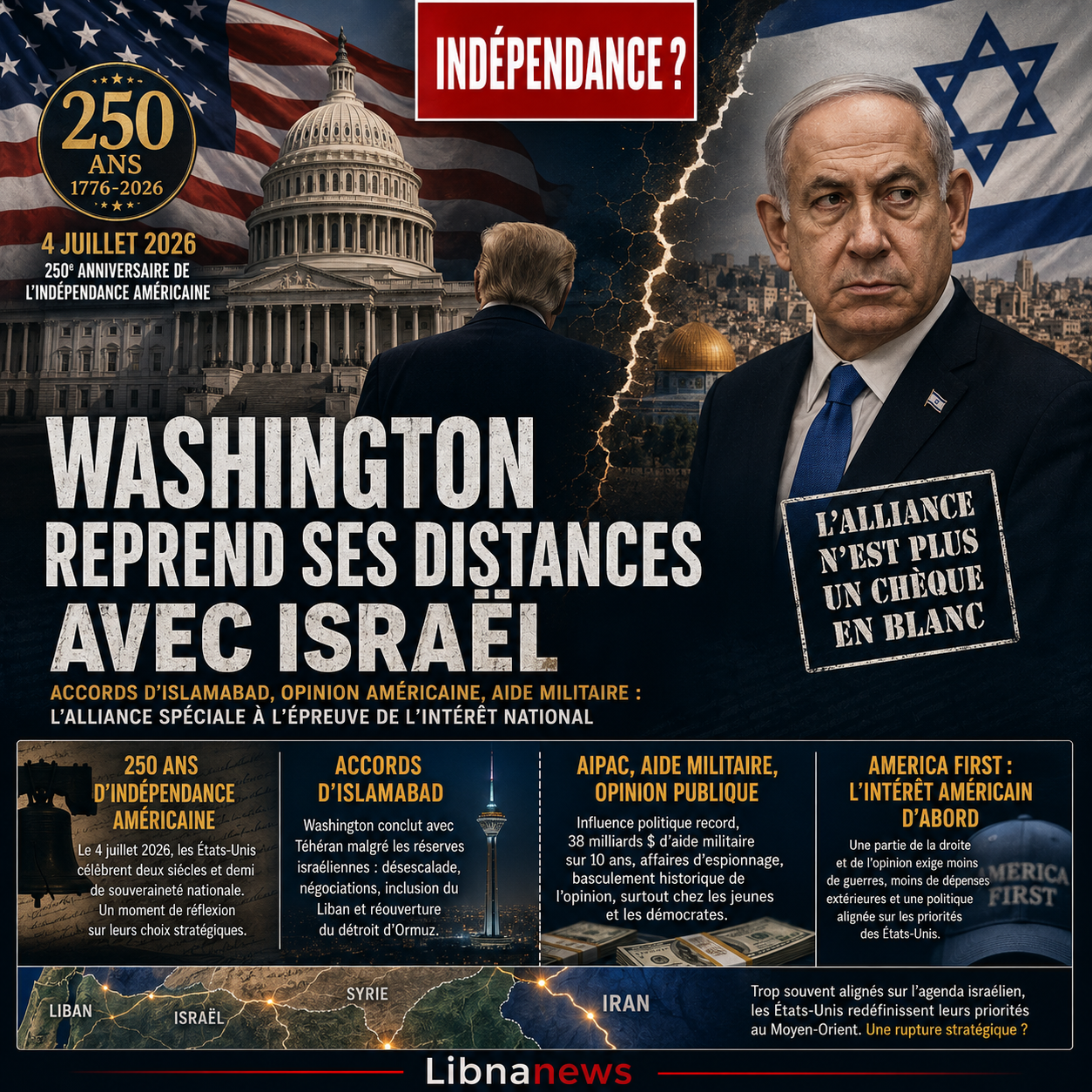
As the 250th anniversary of independence approaches, the United States is going through a unique diplomatic moment. The power that celebrates, on 4 July 2026, two and a half centuries of national existence seems to rediscover an ancient question: where does the alliance with Israel cease, and where does the United States’ own interest begin? The debate is not new. For decades, academics, diplomats, former military officials and American think tanks have questioned the strategic, financial and political cost of the special relationship with Israel. But the Islamabad agreements, negotiated with Iran despite Israeli reservations, gave this question a new topicality. For the first time in a long time, Washington seems to have chosen a regional priority that is not confused with Benjamin Netanyahu’s.
The phrase « Israel would control the United States » is a controversial and often simplifying political discourse. It can also slide towards conspiracy or anti-Semitic springs when it essentializes American Jews or presents the American state as a captive with an invisible hand. The facts available draw a more complex picture. Israel does not control the United States. But the Hebrew state has enjoyed for decades a network of political, military, religious, ideological and electoral influence in Washington. This network has long made any public divergence very costly. What is changing today is that this cost is decreasing. Part of the American opinion is detached from Israel, part of the Trumpist right wants to reduce external commitments, and part of the strategic elite believes that unconditional support for Netanyahu now harms American interests.
250 years of independence, and a matter of strategic sovereignty
The symbol is powerful. The year 2026 marked the 250th anniversary of the Declaration of Independence of the United States, adopted in 1776. The America250 Commission presents this commemoration as a moment to « think about the past » and imagine the future of the country. The State Department also recalls that July 4, 2026 celebrates 250 years of American independence. This celebration, however, takes place in a tense internal climate, marked by deep polarization, distrust of institutions and fatigue with external commitments.
It is in this context that we must put the debate on Israel. For a long time, the Israeli-American alliance was presented as moral, strategic and political evidence. Israel was described as an allied democracy, a Western outpost, a reliable military partner, an intelligence relay and an actor capable of containing common enemies. This reading grid remains present. It continues to structure part of Congress, military apparatus and evangelical circles.
But another reading is progressing. It considers that the United States has too often aligned its Middle East policy with Israeli priorities, at the risk of damaging its relations with the Arab world, fuelling anti-American hostility, involving itself in endless wars and reducing its room for manoeuvre against Iran. This criticism is no longer only carried by the pro-Palestinian left. It also exists in realistic, conservative, libertarian or nationalist circles.
The Islamabad accords crystallized this shift. Washington has agreed to a compromise with Tehran that does not fully meet Israeli demands. The text opens a negotiation sequence, recognises the need for regional de-escalation, includes Lebanon in the equation and reduces the possibility of permanent confrontation with Iran. For Netanyahu and his allies, this result looks like a diplomatic defeat. For Donald Trump and JD Vance, it can be presented as a strategic independence choice.
This moment does not mean the end of the special relationship. The United States remains Israel’s first military and diplomatic support. But it reveals an inflection: Washington no longer automatically accepts that the Israeli agenda determines the American calendar. This nuance is decisive.
A Cold War Alliance Extended After It
The special relationship between the United States and Israel was not built at once. Washington recognized the State of Israel in 1948, but the narrow military alliance was strengthened especially after the 1967 war. In the context of the cold war, Israel then appears to be a regional partner in the face of the Arab regimes supported by the Soviet Union. The relationship becomes strategic: intelligence, armaments, military cooperation, diplomatic coordination.
This logic is long defended by the American presidents of both parties. Israel offers the United States a militarily successful ally in a key region for energy, maritime routes and global balance. The cold war therefore gives a clear framework: Israel is useful because the United States and Israel have common opponents.
After the end of the cold war, this justification becomes less obvious. Itamar Rabinovich, former Israeli Ambassador to Washington and recognized analyst, observed that the strategic case for the Israeli-American relationship was more difficult to support after the disappearance of the USSR. In an analysis published by Brookings on John Mearsheimer’s and Stephen Walt’s thesis, he acknowledged that the relationship had changed in nature and that realistics could now present Israel as a « weight » more than a strategic asset.
This question was reinforced after the 2003 Iraq War. Several authors, diplomats and analysts felt that American politics in the Middle East had been distorted by an ideological vision favourable to the Israeli right and neo-conservatives. The debate culminated with the publication of the essay and the book by John Mearsheimer and Stephen Walt,The Israel Lobby and U.S. Foreign Policy. Their central thesis states that the American commitment to Israel is not only explained by strategic or moral interests, but by the influence of a pro-Israeli lobby capable of guiding US foreign policy.
Their work caused intense controversy. Some saw it as a necessary breakthrough in a locked debate. Others denounced an exaggerated, reducing or even dangerous analysis by its formulations. But the debate they opened never disappeared. Today he returns with a new force, because the question is no longer merely theoretical: the agreement with Iran shows that Washington can now accept an explicit divergence with Israel.
The pro-Israeli lobby: real influence, imaginary control
The word « lobby » refers to a legal and organized activity in the United States. Pressure groups defend industrial, trade union, religious, community, environmental or foreign interests. The pro-Israeli lobby is part of this system. Its power lies in its discipline, seniority, electoral mobilization and access to Congress.
The AIPAC, founded in 1959, has long avoided direct contributions to candidates. The organization was primarily influential in advocacy, travel, conferences, relations with parliamentarians and in drafting or supporting legislation. This strategy changed from the 2022 cycle, when AIPAC created a CAP and a super PAC, United Democracy Project, capable of directly financing independent campaigns or advertisements. FactCheck.org recalls that this tip marks a break in the organization’s history.
The electoral impact was visible in 2024. Pro-Israeli groups have invested massively in democratic primarys to beat Israel’s critical progressive elected officials. ABC News, based on OpenSecrets data, estimated that nearly two thirds of the $38.4 million spent by outside groups in primary schools involving members of the « Squad » came from organizations supporting candidates attached to the US-Israel relationship. Funding contributed to the defeats of Jamaal Bowman in New York and Cori Bush in Missouri.
The figures give the measurement of the phenomenon. According to electoral deposits cited by specialized media and pro-Israeli sources, the AIPAC and the United Democracy Project reported about $95 million in election expenses in 2024, more than double their 2022 level. Other estimates referred to a target or volume in excess of $100 million over the cycle.
This influence is real. It does not mean that AIPAC « controls » Congress. It means that an American elected official knows that criticizing Israel can be expensive, especially in a primary school. The shade is important. The power of the lobby is not based on a magical ability to impose a decision. It is based on very concrete mechanisms: electoral money, donor networks, political notation, access to elected officials, message discipline and the ability to present an opponent as hostile to Israel or even tolerant of anti-Semitism.
This mechanism worked for a long time because it was part of a bipartisan consensus. Republicans and Democrats sometimes argued on the tone, but rarely on the principle of massive support for Israel. This consensus is breaking down today. Young democrats, progressives, some of the independents and a fraction of the America First right now challenge the central elements of this relationship.
US aid to Israel, material heart of dependency
The special relationship is not only diplomatic. It is measured in billions of dollars. The memorandum of understanding signed in 2016 under Barack Obama provides $38 billion in military assistance over ten years, for fiscal years 2019 to 2028. This envelope includes $33 billion in foreign military funding and $5 billion in missile defence programs. The Department of State reports that the United States provides $3.3 billion annually in military funding and $500 million annually for missile defence programmes.
This aid is often defended as an investment in American security. Alliance supporters point out that a large part of these funds is used to buy US equipment, which supports the US defence industry. They also recall that Israel provides intelligence, tests technologies, develops anti-missile systems such as Iron Dome and contributes to regional deterrence.
Critics say that this aid creates a two-way political dependency. Israel depends on American material. But Washington also becomes dependent on the diplomatic protection of Israel, the justification for this aid and the need to cover the consequences of the use of these weapons. The Council on Foreign Relations recalls that US aid to Israel reached exceptional levels after 7 October 2023, with at least $16.3 billion in direct military support legislated since the beginning of the Gaza war, in addition to the annual framework.
The cost of war project at Brown University goes further. In a study by William D. Hartung published in 2025, he estimates that the United States provided at least $21.7 billion in military assistance to Israel between October 7, 2023 and September 2025, not including tens of billions of dollars in arms sales committed for the following years.
For America First, these figures become politically explosive. The United States is experiencing high public debt, aging infrastructure, housing crisis, social polarization and growing military needs in China. In this context, the billions paid or guaranteed to Israel are increasingly perceived by some voters as a permanent cheque to a rich and technologically advanced country.
Israel itself seems to measure this development. According to Reuters, Israeli officials considered in 2026 a new security framework with Washington, where more emphasis would be placed on joint projects than on direct grants. Prime Minister Benjamin Netanyahu himself referred to the idea of eventually reducing Israel’s dependence on American aid.
Israeli espionage in the United States, persistent taboo
One of the most sensitive elements of the debate concerns espionage. Allies sometimes spy. The United States is also spying on its partners. But the Israeli case occupies a special place in the American security memory, especially because of the Jonathan Pollard case.
Jonathan Pollard, US Navy civilian analyst, was arrested in 1985 and pleaded guilty in 1987 for having transmitted classified information to Israel. The declassified documents of the time show that the operation involved Israeli officials and identified intelligence channels. Pollard was sentenced to life imprisonment and released on parole in 2015 before leaving for Israel in 2020.
The Pollard case left a deep mark in the US services. It has been fueled by the idea that Israel, despite its unalloyed status, did not hesitate to aggressively collect information in the United States when its interests demanded it. The Israeli authorities have for a long time minimized the case before more clearly recognizing their responsibility. For many American intelligence officials, the case remains an injury.
Other charges have revived this suspicion. In 2019, Politico reported that US officials suspected Israel of placing mobile phone surveillance devices near the White House and other sensitive locations in Washington. Israel categorically denied. Israeli officials have described these accusations as false, and the Trump administration has not publicly sanctioned Israel. But the episode reinforced the idea that the special relationship does not erase the distrust of services.
In 2024, Politico also reported that a disinformation campaign linked to Israel had targeted at least 128 American parliamentarians with pro-Israeli content during the Gaza war. The Israeli ministry concerned denied any involvement. The case remains contested, but it illustrates a change of perception: Israeli influence is no longer only analysed as legal lobbying. It is also observed in terms of informational interference.
These records do not prove that Israel is « leading » Washington. They prove something else: the alliance is accompanied by a competition of interest, sometimes brutal. The Hebrew state defends its priorities, including against American preferences. For a long time, this reality remained marginal in the public debate. It becomes more visible as the relationship becomes politicized.
The turning point in American opinion
Perhaps the most profound change is not in Washington, but in American society. For decades, the Americans expressed much more sympathy for Israel than for the Palestinians. This trend was gradually weakened and then accelerated with the Gaza war.
Gallup published a historical result in February 2026: 41% of Americans said they were more sympathetic to Palestinians, compared to 36% with Israelis. The gap is not statistically massive, but it breaks with twenty-four years of clear domination of pro-Israeli sympathies. Among the independents, 41% more sympathize with the Palestinians, compared with 30% with the Israelis. Among the Democrats, the gap is spectacular: 65 per cent for Palestinians, 17 per cent for Israelis.
Generation plays a major role. Gallup notes that a majority of 18-34 year olds now express more sympathy for the Palestinians. Pew Research had already shown in 2024 that young Americans had a more favourable opinion of the Palestinian people than of the Israeli people. In 2025, Pew noted that 53% of American adults had an unfavourable opinion of Israel, compared to 42% in March 2022. In 2026, a new analysis by Pew found that the negative views of Israel and Netanyahu continued to grow, especially among young people.
This development does not mean that Americans become massively anti-Israeli. Pew also shows that Americans distinguish people from their leaders. In 2025, 56 per cent had a favourable opinion of the Israeli people and 52 per cent of the Palestinian people, while the negative views were much more strongly directed towards the Israeli government, the Palestinian Authority and Hamas.
This distinction is essential. The shift of opinion focuses on Israeli politics, the conduct of war, the destruction in Gaza, the strikes in Lebanon, the Netanyahu government and perceived impunity. Young Americans, exposed to images of war on social networks, far less marked by the memory of the Shoah as a direct political experience, and more sensitive to post-colonial analysis grids, no longer read conflict as their parents.
The Democrats are the most affected by this change. Vox noted as early as 2025 a growing gap between the democratic base, which had become very critical of Israel, and the party leaders, who continued to largely support military aid. This tension created a political space for figures like Bernie Sanders, Rashida Tlaib, Ilhan Omar, Alexandria Ocasio-Cortez or younger local candidates.
The America First Right and the Cost of Israel
The other shift comes from the right. Historically, Republicans have remained more pro-Israeli than Democrats. Evangelicals, neoconservatives, pro-Israeli donors and anti-Iranian hawks have structured a very strong support. Gallup still shows in 2026 that 70% of Republicans sympathize more with Israelis than with Palestinians. But this support also declines, falling to its lowest level since 2004 in Gallup data.
This decline is not only due to a new sympathy for the Palestinians. It comes from an American nationalist reflex. The MAGA base wants less war, less external aid, less allied constraints and more material return for the US taxpayer. America First implies a hierarchy: no alliance must go beyond the American interest.
It is this language that JD Vance used in recalling that American and Israeli interests are not always confused. The sentence had a political effect because it came from a Republican vice-president, not a progressive elected one. She did not contest Israel’s security. She recalled that Washington should not be dragged into an Israeli strategy that could block the deal with Iran.
Think tanks close to a realistic or restrictive line hold a similar discourse. The Quincy Institute asserts that unconditional support for Israel deepens American problems in the Middle East. In an analysis of 2025, the Institute argues that Israeli security doctrine threatens the long-term American interest, as it requires a stronger and more lasting US military presence in the region.
Responsible Statecraft, a Quincy Institute-related media, also published an analysis in 2026 criticizing the increasing integration between American and Israeli security apparatus. The author argues that the United States should not outsource elements of its national security to a country whose interests are not always the same.
This language speaks to a right who no longer wants to pay for peripheral wars. He also speaks to voters who see Israel as a developed country with a powerful army, advanced technology industry and high GDP per capita. The argument becomes simple: why should the American taxpayer continue to subsidize a rich ally massively, especially when this ally leads policies that complicate US objectives?
The Islamabad Accords, a moment of American emancipation
The Islamabad agreements are the most visible test of this new American autonomy. According to Reuters, the United States and Iran signed a ceasefire agreement opening a 60-day negotiating period. The text includes the cessation of hostilities, the reopening of the Strait of Ormuz, discussions on sanctions, a framework for nuclear material by IAEA and regional de-escalation including Lebanon.
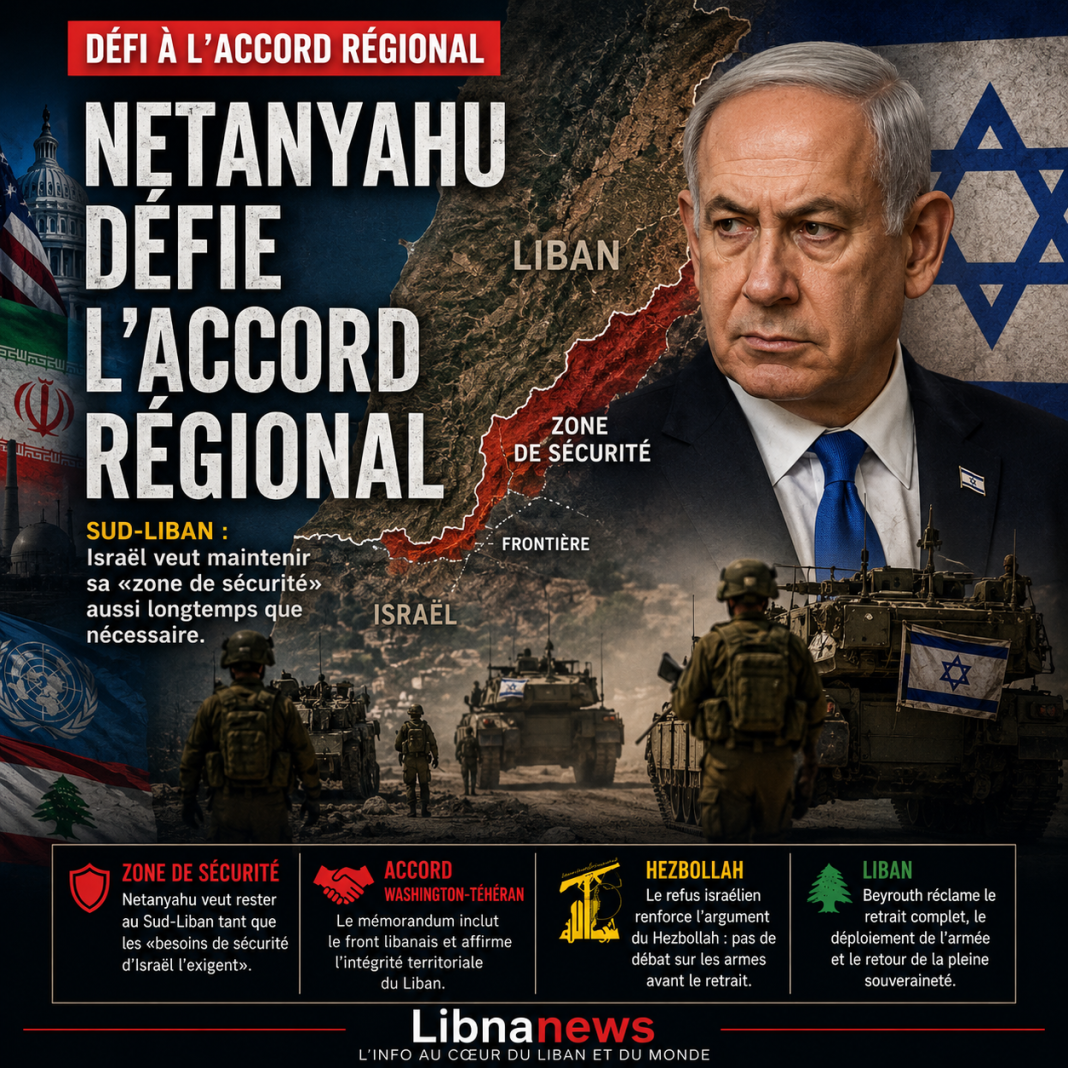
For Israel, the text poses several problems. It does not immediately dismantle Iranian capabilities. It does not remove the ballistic programme from the outset. It enables Tehran to obtain a form of recognition and economic prospects. It also gives Lebanon a place in de-escalation, while Israel wants to maintain its freedom of action against Hezbollah.
Netanyahu found himself in a difficult situation. He had long defended the idea that military pressure could permanently weaken Iran and its relays. But the agreement shows that Washington wants to get out of the war logic. Reuters described a Netanyahu placed on a collision path with Trump, while the US President was seeking to reach an agreement with Tehran and prevent Israel from derailing the sequence by strikes in Lebanon.
Trump himself criticized Israeli conduct in Lebanon. According to Reuters, he said Netanyahu could take a more measured approach, implicitly denouncing the destruction of buildings to achieve limited objectives. In the same sequence, Trump presented Israel as a « very small partner » in the wider conflict, an unusual formulation for an American president as politically close to the Israeli right.
This change of tone does not mean Trump becomes anti-Israeli. He means he wants control of his own story. After engaging American power against Iran, he wants to be able to say that he got an agreement. Netanyahu, by continuing the war in Lebanon or demanding the complete surrender of Tehran, threatens this story. Interest thus diverges publicly.
It is here that the idea of « independence » makes sense. The United States does not emancipate from total Israeli control, which never existed as such. They emancipate from a reflex: the one that was to treat Israeli objections as an implicit veto over American policy in the Middle East.
Netanyahu, symbol of a toxic relationship
Benjamin Netanyahu has long been the master of the relationship with Washington. He knew Congress better than many American presidents. He knew how to speak to evangelicals, Republicans, donors and conservative media. He challenged Barack Obama on Iran, cultivated Donald Trump, obtained the transfer of the American embassy to Jerusalem and consolidated Abraham’s agreements.
But his style became a problem. Judicial reform, the war in Gaza, far right ministers, regional strikes, diplomatic isolation and international prosecutions have transformed Netanyahu into a key figure in the United States. The World, in a recent analysis, believes that the relationship with Washington, which once supported its political power, has become a burden.
Reuters also describes a prime minister exposed to voter anger after the agreement with Iran. Netanyahu’s promise was to reshape the Middle East by force and contain Iran. The Islamabad accords give the opposite image: Iran survives politically, Washington negotiates, and Israel appears forced.
This moment is all the more dangerous for Netanyahu as Israeli society has hardened. Ministers Bezalel Smotrich and Itamar Ben Gvir reject any limitation of military action. Defense Minister Israel Katz defends the maintenance of safe areas in Lebanon, Syria and Gaza. This line reassures part of the Israeli electorate, but it worsens the divergence with Washington.
The White House can tolerate a strong Israel. It less tolerates an Israeli who sabotages an American agreement. That’s the new limit. Support remains massive, but it is no longer fully automatic.
The Iraqi precedent and US strategic fatigue
Critics of the Israeli-American relationship often rely on Iraq. Mearsheimer and Walt argued that the pro-Israeli lobby and neoconservatives played an important role in the march to the 2003 war. This thesis remains disputed. The invasion of Iraq was also responding to the logics of the Bush administration, the trauma of 11 September, American neoconservative ambitions and intelligence errors. But there is no doubt that some American war supporters saw Saddam Hussein’s eviction as beneficial to Israel and regional reconfiguration.
Since then, the cost of American wars has transformed the debate. Afghanistan, Iraq, Syria, Libya, campaigns against the Islamic State, tensions with Iran: US voters saw Middle Eastern commitments as costly, long and often unproductive wars. This fatigue weighs on both parties.
The American realistics, from Stephen Walt to Andrew Bacevich, from Quincy to some former Pentagon officials, repeat that the United States must reduce its regional exposure and focus its resources on Asia, Chinese deterrence, domestic security and industrial competitiveness. From this perspective, Israel becomes a problem when it encourages a permanent confrontation with Iran or makes it impossible to achieve a regional de-escalation architecture.
This reasoning does not imply abandoning Israel. It implies making the alliance conditional on a convergence of interests. If Israel acts in a way consistent with the US strategy, support continues. If Israel leads Washington to a war that Washington does not want, the alliance must be contained. This is precisely what the Islamabad agreements seem to indicate.
AIPAC against a changing company
AIPAC remains powerful. His access to Congress remains considerable. His conferences attract officials from both parties. Its super CAP can change the fate of a primary. But his model has three limits.
The first is generational. Young Americans no longer regard Israel as an obvious cause. They see Gaza, settlements, checkpoints, bombings in Lebanon, far right ministers and Netanyahu’s comments. Their political memory begins less with the Holocaust or the Cold War than with the occupation on 7 October, Gaza and social networks. This generation more easily distinguishes anti-Semitism, which it can condemn, from support for the Israeli government, which it can reject.
The second limit is partisan. The AIPAC tried to remain bipartisan. But his frequent alignment with Netanyahu, his fights against Iran’s nuclear deal under Obama, and his interventions in the Democratic primarys have reinforced the idea, among many Democrats, that the lobby leans to the right. The expenses against Bowman and Bush sent a message of power. They also nurtured lasting resentment in the progressive wing.
The third limit is nationalist. Camp MAGA less readily accepts universalist moral arguments or automatic alliances. He wants accounts. How much does it cost? What does America get? Why should the United States protect an Israeli policy that can raise the price of energy, block an agreement with Iran or expose American soldiers?
This triple pressure does not destroy the pro-Israeli lobby. It forces him to adapt. The old formula, based on bipartisan consensus and political intimidation of critics, works less well. It remains effective in Congress. She’s less in opinion.
A US Independence Still Incomplete
It would be excessive to talk about a breakup. The United States continues to provide weapons to Israel. They continue to block or soften international texts against the Hebrew state. They continue to regard Israel’s security as a strategic interest. The Pentagon, the Congress, the defence industry and the pro-Israeli political networks retain a decisive weight.
But the novelty is elsewhere. Washington now agrees to publicly state that American interest may diverge from Israeli interest. This sentence, once reserved for marginal critics, is part of the discourse of officials in power. It is resumed in a concrete moment: the agreement with Iran, the strikes in Lebanon, the pressure on Netanyahu, the need to stabilize the Strait of Ormuz and to emerge from a regional war.
The American independence recovered is therefore not a philosophical declaration. It’s a practice. It consists in negotiating with Tehran despite Israel. To criticize Netanyahu despite AIPAC. To consider American opinion despite Congressional reflexes. To calculate the cost of military aid despite the historical argument of the special relationship. To consider Lebanon, Iran, the Gulf and energy as American issues, and not just as annexes to Israeli security.
This may remain temporary. A major incident, a Hezbollah attack, an Iranian breakdown or an American election campaign can reactivate old reflexes. Pro-Israeli networks are still powerful. Republican opinion remains largely in favour of Israel. The democrats, even if divided, have not yet turned their base into a coherent foreign policy.
But the taboo is cracked. At the age of 250, the United States seemed to rediscover that independence was not just a celebration of 1776. It also consists of prioritizing its alliances. Israel remains a major ally. It is no longer always the center of the American compass. The Islamabad agreements do not end the special relationship. They may be opening a longer period for her: the one when Washington asked Israel not only what it wanted, but what it cost the United States.