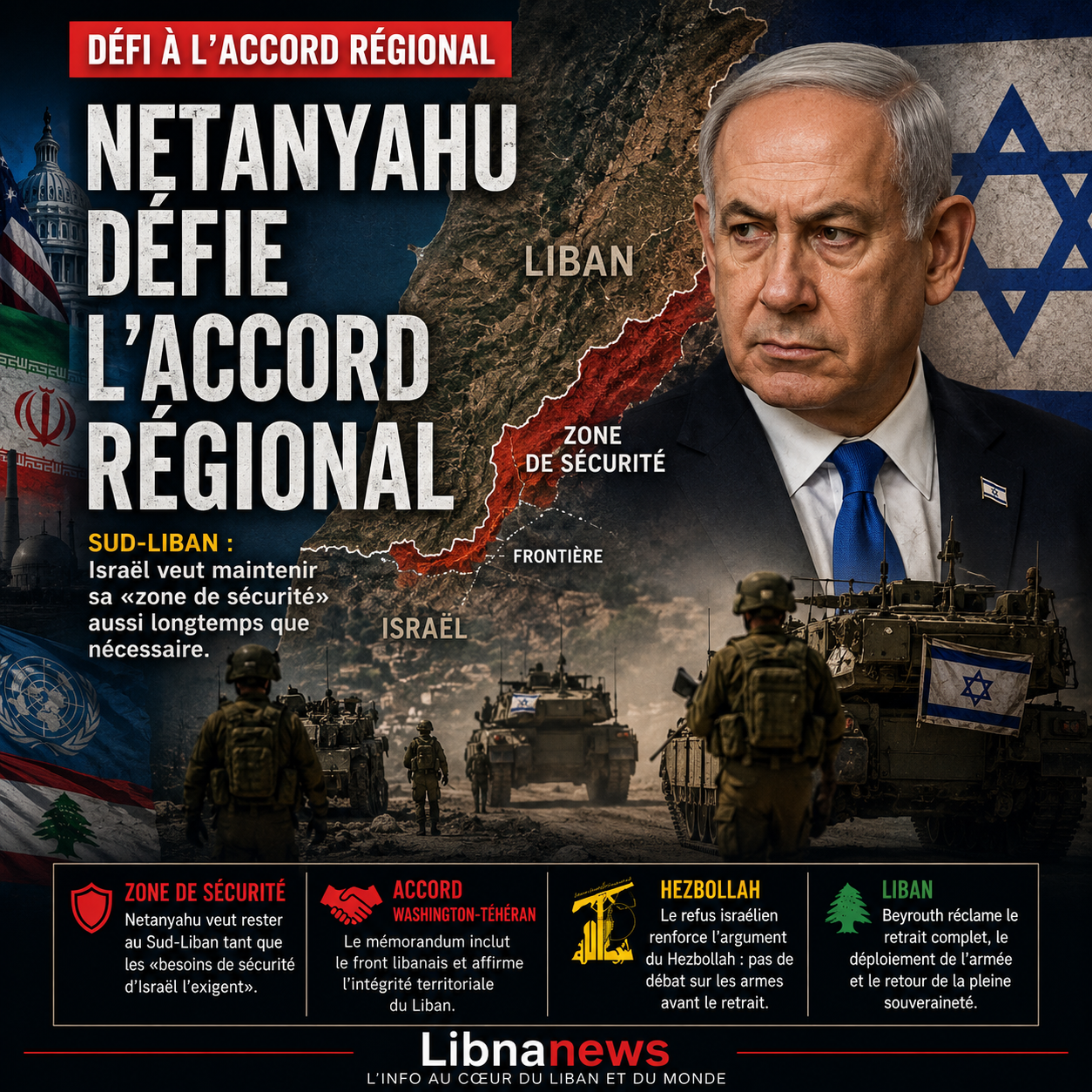
Benjamin Netanyahu chose the political confrontation with the dynamics opened up by the Washington-Téhéran agreement. As the United States seeks to support the memorandum signed with Iran and to include the Lebanese front in a regional de-escalation, the Israeli Prime Minister claims that the war is not over and that the Israeli army must remain in a « security zone » in southern Lebanon as long as Israel’s security needs require it. This declaration places Israel in a state of failure with American logic, with the Lebanese claim of sovereignty and with the Iranian reading that the Israeli withdrawal from Lebanon must be part of the final agreement. For Beirut, Netanyahu’s words confirm that withdrawal from the South will be the real test of the diplomatic power ratio.
A Challenge Statement after the Washington-Teheran Accord
Benjamin Netanyahu spoke in a sequence of strong political tension. The agreement between the United States and Iran provides for a 60-day negotiating phase, de-escalation on several fronts and reference to the territorial integrity of Lebanon. Israel is not a party to this text. Nor does Hezbollah. But the Lebanese front is now integrated into the regional mechanics that Washington wants to preserve. This is precisely what Netanyahu contests with his line of support in southern Lebanon. The Interim Agreement affirms Lebanese sovereignty without explicitly imposing an immediate Israeli withdrawal in the terms made public. Israel uses this ambiguity to defend the maintenance of its forces.
According to available public evidence, Netanyahu stated that the conflict was not over and that challenges remained before Israel. He added that his Government would continue to move forward with caution, wisdom and discernment. This first part of the statement is intended to show that the Prime Minister does not regard the American-Iranian memorandum as the end of the military sequence. It treats it as a new diplomatic constraint, but not as an operational order.
The most sensitive part concerns South Lebanon. Netanyahu claims that Israel will restore security and prosperity in northern communities, as he claims to have done in the Gaza area. He adds that this requires maintaining a « security zone » in southern Lebanon and not leaving it until Israel’s security needs so require. According to him, this area separates Hezbollah from Israeli citizens and communities. The international press had already reported a close formula in which Netanyahu claimed that Israeli forces would remain in the safe areas as long as necessary to protect the country.
Netanyahu then put this line back into a broader objective: to prevent Iran from possessing nuclear weapons. He presented this objective as a central mission in his political life. In an earlier statement largely repeated by the Israeli press, he had stated that Iran would not have nuclear weapons with or without agreement, neither today nor tomorrow, as long as he was Prime Minister of Israel.
The heart of the declaration: Staying in South Lebanon
The formula on the safe area is the political heart of the message. Netanyahu is not just asking for guarantees. He claims that the Israeli presence in southern Lebanon must last as long as Israel deems it necessary. This unilateral condition is incompatible with the Lebanese position, which calls for the complete withdrawal of Israeli forces from the occupied territories and the deployment of the Lebanese army at international borders. It also complicates the American position, as Washington wants to preserve the agreement with Tehran without causing an open break with Israel.
The vocabulary used by Netanyahu is revealing. He’s not talking about occupation. He’s talking about a safe area. He’s not talking about Lebanese territory. He talks about a space that protects Israeli communities in the north. He doesn’t set a calendar. It makes withdrawal conditional on Israel’s « security needs ». This formulation gives Tel-Aviv the power to decide the duration of the retention alone. It turns withdrawal into a distant hypothesis, dependent on an Israeli assessment, not an international mechanism.
This approach extends the line already defended by Israel’s Defense Minister, Israel Katz. He had claimed that Netanyahu and he were leading a clear policy: to maintain the Israeli army in the safe areas in Lebanon, Syria and Gaza without any time limit, in order to protect Israeli borders and localities. This position shows that the Prime Minister’s statement is not improvisational. It corresponds to a doctrine of prolonged presence on the margins of Israeli territory.
For Lebanon, this doctrine means maintaining a military fait accompli. Israel claims to be acting for its security. Beirut sees this as an infringement of its sovereignty. Hezbollah finds it an argument to refuse any debate on its weapons before withdrawal. The United States now sees this as a risk to the agreement with Iran. The buffer zone thus becomes the main point of friction between Israeli imperatives and regional de-escalation.
A line in contradiction with American pressure
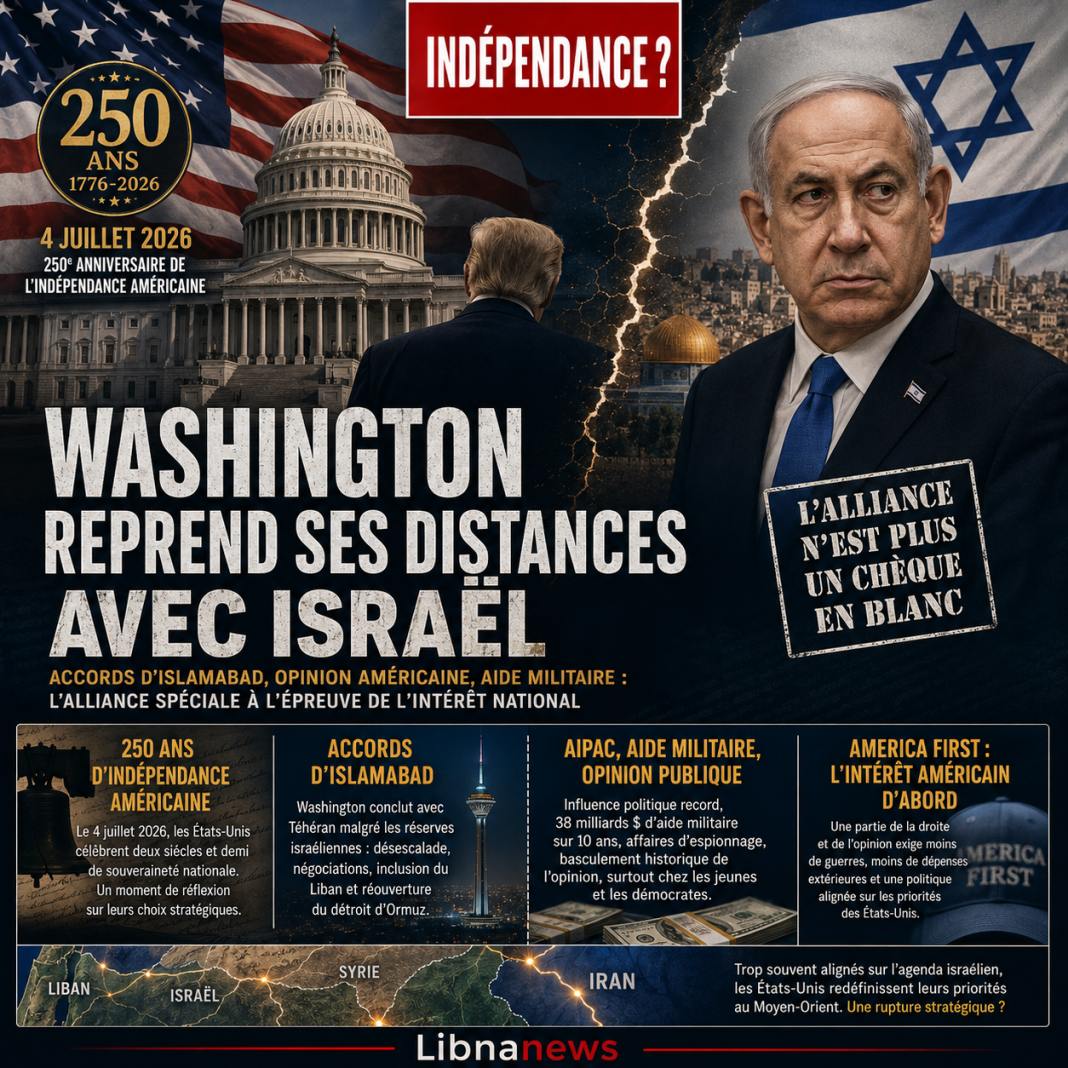
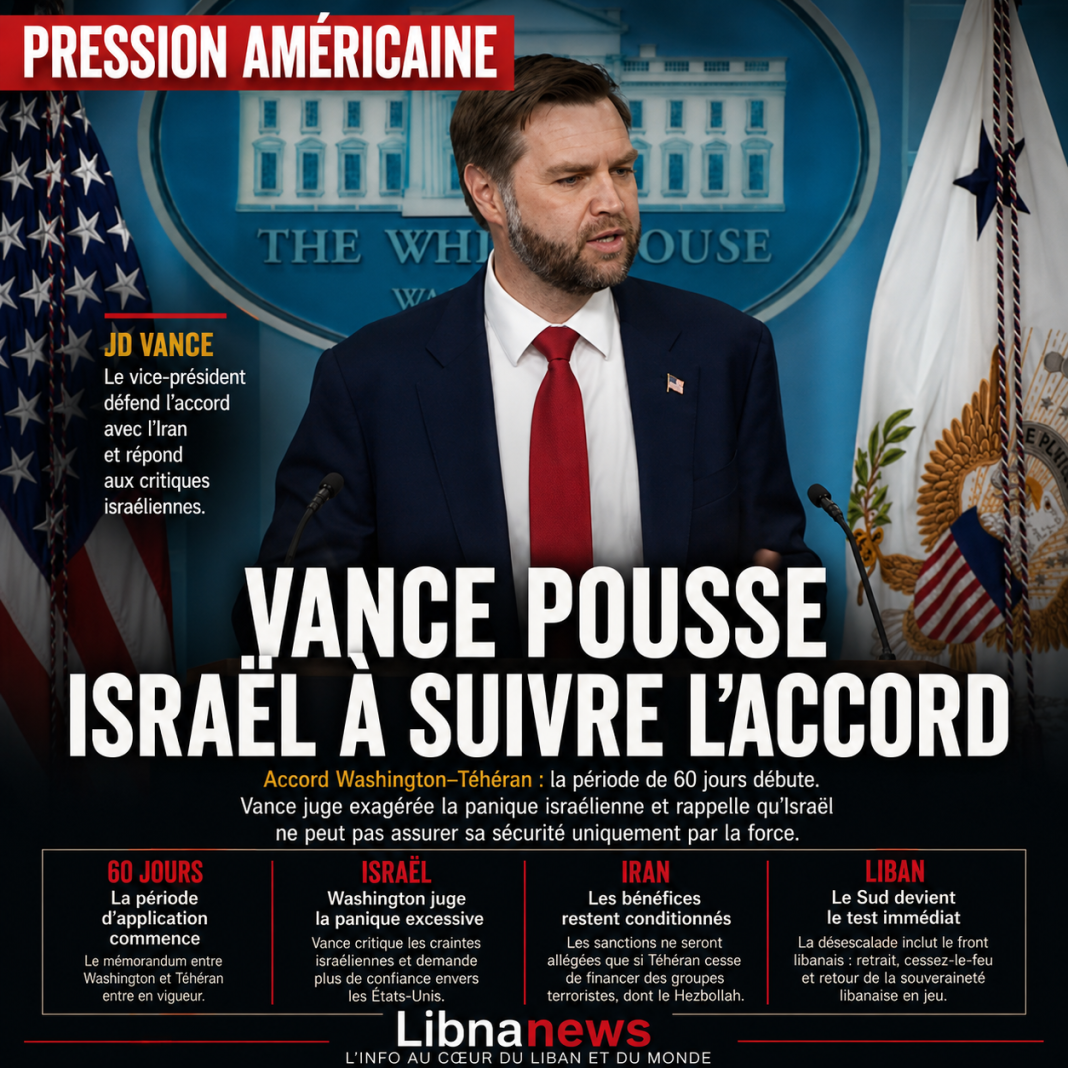
Netanyahu’s statement comes after several unusual American signals. Donald Trump criticized Israeli conduct in Lebanon, believing that Netanyahu could adopt a more measured approach. JD Vance defended the agreement with Iran and challenged the Israeli panic around the text. The US Vice-President also recalled that Israel could not solve all its national security problems by force alone. This sequence shows that Washington now wants to limit Israel’s ability to derail the regional agreement.
Netanyahu responds by a reverse line. It does not say that the regional agreement is invalid. He does not attack it in front of every sentence. But he asserts, through his position on southern Lebanon, that Israel retains its own military logic. For him, the security of the northern localities takes precedence over the withdrawal dynamics. The Israeli presence therefore remains justified as long as Hezbollah is not remote, weakened or contained in a manner deemed sufficient by Israel.
This position places Trump before a choice. Either Washington accepts an Israeli exception in Lebanon, which would weaken the credibility of the memorandum with Iran. Either the US administration pushes Netanyahu towards a gradual withdrawal, at the risk of causing a crisis with the Israeli government and its toughest right. Reuters reported that Israel was already engaged in discussions with the United States to maintain its deployment in southern Lebanon, while the American-Iranian agreement affirmed the territorial integrity of Lebanon.
The Israeli Prime Minister therefore seems to be trying to save time. By presenting the safe zone as a vital necessity, it attempts to make any US pressure politically costly. He talks to northern Israelis, soldiers deployed in Lebanon, his coalition and American officials. The message is the same: leaving now would, in his view, expose Israeli citizens to Hezbollah.
Hezbollah reinforced by Israeli refusal
The paradox is that Netanyahu’s statement reinforces Hezbollah’s argument. The Shiite party has been saying since the beginning of this sequence that the Israeli withdrawal must precede any debate on its weapons. The more Israel insists on maintaining the security zone, the more Hezbollah can say that its weapons remain necessary. The Israeli line thus creates the political pretext that the movement uses to delay any internal discussion on the monopoly of force by the Lebanese State.
This mechanism is one of the central blockages of the file. Israel refuses to leave as long as Hezbollah retains its capabilities in the South. Hezbollah refuses to discuss its weapons as long as Israel remains in the South. The Lebanese State wants an Israeli withdrawal, an army deployment, the return of the displaced and a reconstruction, but it cannot impose this sequence alone. Netanyahu’s statement therefore freezes the impasse.
It also complicates Joseph Aoun’s position. The Lebanese President insists that Lebanon follows its own path in the negotiations and that no one can speak for it. But if Israel maintains a security zone and Iran asserts that Israeli withdrawal is a condition of the final agreement with Washington, Lebanese sovereignty may be discussed between external powers. The Israeli refusal therefore makes a unified Lebanese position even more necessary.
The Israeli declaration may also affect the Lebanese-American-Israeli negotiations scheduled for June 23, 24 and 25. Beirut will defend the final ceasefire, the Israeli withdrawal, the deployment of the Lebanese army, the return of prisoners and reconstruction. Netanyahu comes to this end with a line of hold. The impact between the two positions will be frontal.
An Israeli Army Exposed in the South
The Prime Minister’s statement comes as Israeli information describes some confusion within the army deployed in Lebanon. Soldiers and commanders quoted by the Israeli press say that the rules for opening fire have been changed, reducing their ability to respond to Hezbollah attacks. According to these accounts, Israeli forces are deeply engaged in Lebanon, sometimes in exposed positions, with a mission that has become less clear since the Washington-Tehran agreement.
This illustrates the cost of the Netanyahu line. Maintaining a safe area involves holding positions in a hostile environment. If soldiers have reduced freedom of response so as not to compromise the regional agreement, they may feel vulnerable. If the army resumes a more offensive action, it is likely to run counter to American pressure. In both cases, the land becomes more difficult to manage.
Reuters reported that Israel had published a map showing an expanded control area in southern Lebanon, going beyond the buffer zones originally mentioned. This map was interpreted as a signal to Washington, Beirut and Hezbollah: Israel wants to stay until its security requirements are met.
The problem is that this prolonged presence can become a burden. She exposes the soldiers. It feeds the Hezbollah attacks. It increases diplomatic pressure. It prevents the full return of Lebanese inhabitants. It keeps the Israeli displaced in the north in political uncertainty, as the promised security depends on a disputed buffer zone and not on a stable agreement.
Iran and nuclear as a superior justification
Netanyahu does not dissociate Lebanon from Iran. In his statement, he returns to the central objective of his political career: to prevent Tehran from acquiring nuclear weapons. This link is strategic. For him, Hezbollah is not just a Lebanese actor. It is part of the Iranian regional architecture. Maintaining a security zone in southern Lebanon, striking Hezbollah positions and challenging the Washington-Teheran agreement are in line with the same logic: preventing Iran from strengthening its regional axis.
This reading explains why Netanyahu refuses to present the withdrawal from the South as a simple Lebanese-Israeli question. In his view, leaving the area without guarantees would be tantamount to offering Iran and Hezbollah political gain. He therefore wanted to retain the military presence as a lever, including during the American-Iranian negotiations.
But this strategy is now in full swing with Washington. The Trump administration is seeking a final agreement with Iran. It wants to frame nuclear power, reopen Hormuz, reduce the energy risk and calm regional fronts. The Netanyahu line, based on a prolonged presence in Lebanon and absolute distrust of Tehran, threatens this architecture. Israel does not formally oppose non-proliferation. He challenged the American method.
The Israeli Prime Minister is therefore trying to hold two positions. He wants to remain Washington’s indispensable ally against Iran. But he refused to allow Washington to use the deal with Iran to impose a withdrawal from Lebanon. This contradiction will be one of the major challenges of the coming weeks.
Message to the Israeli Coalition
Netanyahu’s statement is also addressed to his coalition. The most radical ministers, notably Itamar Ben Gvir and Bezalel Smotrich, refuse to restrict Israeli freedom of action. They see the agreement with Iran as dangerous and want to maintain military pressure. By saying that the safe area must be maintained for as long as necessary, Netanyahu shows that he does not give up publicly to Washington.
This posture temporarily protects his government. It prevents his right from immediately accusing him of weakness. It reassures voters who demand a tough response to Hezbollah. It gives northerners the image of a leader who refuses to leave an area deemed essential to their safety.
But it creates a reverse risk. If Trump finally demands a withdrawal, Netanyahu will have to come back on his statement or go into crisis with Washington. If it maintains the area despite US pressure, it can compromise the regional agreement and isolate Israel. If he accepts a partial withdrawal, he will have to explain why the zone was indispensable before becoming negotiable.
The Israeli Prime Minister is therefore in a position of firmness that can become a trap. The more he asserts that the safe area is indispensable, the more any withdrawal will appear as a concession. The more he promises Iran will never possess nuclear weapons, the more any American compromise with Tehran can be presented by his opponents as a defeat.
For Lebanon, the declaration clarifies the issue
For Beirut, Netanyahu’s statement has the merit of clarifying the lines. Israel is not talking about a rapid withdrawal. He speaks of a maintenance conditioned to his own needs. Lebanon must therefore concentrate its diplomacy on transforming territorial integrity into a withdrawal mechanism. It is not enough for the Washington-Tehran agreement to mention Lebanese sovereignty. This sovereignty must be translated into a timetable, verification and deployment of the Lebanese army.
The Lebanese position should also avoid a narrative trap. If Iran is presented as the guarantor of withdrawal, the Lebanese state will be weakened. If Washington negotiates with Israel without clearly imposing Lebanese sovereignty, Beirut will be marginalized. If Hezbollah uses Israeli refusal to reject any discussion of its weapons, the return of the state will remain incomplete.
The Netanyahu statement therefore makes a coherent Lebanese line more urgent. It must be based on five points: the final ceasefire, complete withdrawal, the Lebanese army at the borders, the return of prisoners and reconstruction. This is precisely the line set at Baabda before the Washington negotiations. It will now have to face an Israeli position assumed: stay in the South as long as Tel Aviv considers it necessary.
The follow-up will depend on the American ability to decide. Will Trump let Netanyahu keep a buffer zone in the name of Israeli security? Or will he require the withdrawal to begin to preserve the agreement with Iran? The answer will determine the actual value of the Lebanese clause of the memorandum.
A statement that exposes the Israeli impasse
The strength of Netanyahu’s statement is also his weakness. It expresses a clear will: stay in southern Lebanon, maintain a safe area, prevent Hezbollah from approaching northern Israel and prevent Iran from obtaining nuclear weapons. But it does not say how this presence can become a lasting solution. She doesn’t fix an exit. It does not specify the concrete conditions for a withdrawal. It does not respond to the Lebanese claim of sovereignty. It does not solve the American dilemma.
Israel thus appears powerful on the ground, but forced into the political exit. His army holds positions. His Prime Minister promises to stay. But his main ally wants a regional agreement. Iran returns to the table. Lebanon is demanding its territory. Hezbollah maintains its argument. The security zone that Netanyahu presents as a protection can become the symbol of a strategic blockage.
18 June therefore marks a clarification. Netanyahu does not want to withdraw from southern Lebanon as long as he considers the area necessary for Israel’s security. Washington wants to preserve the deal with Iran. Beirut wants to turn sovereignty into real withdrawal. Tehran wants to integrate Lebanon into the final agreement. Hezbollah wants to postpone the debate on its weapons until Israeli departure.
In this confrontation of timetables, the Israeli Prime Minister’s statement does not bury the regional agreement. It reveals the main breaking point. The text can promise a de-escalation. But as long as Netanyahu claims a security zone in southern Lebanon without clear limits, peace will remain suspended on a simple question: who will decide the Israeli withdrawal, Israel alone, Washington, or the very principle of Lebanese sovereignty?