





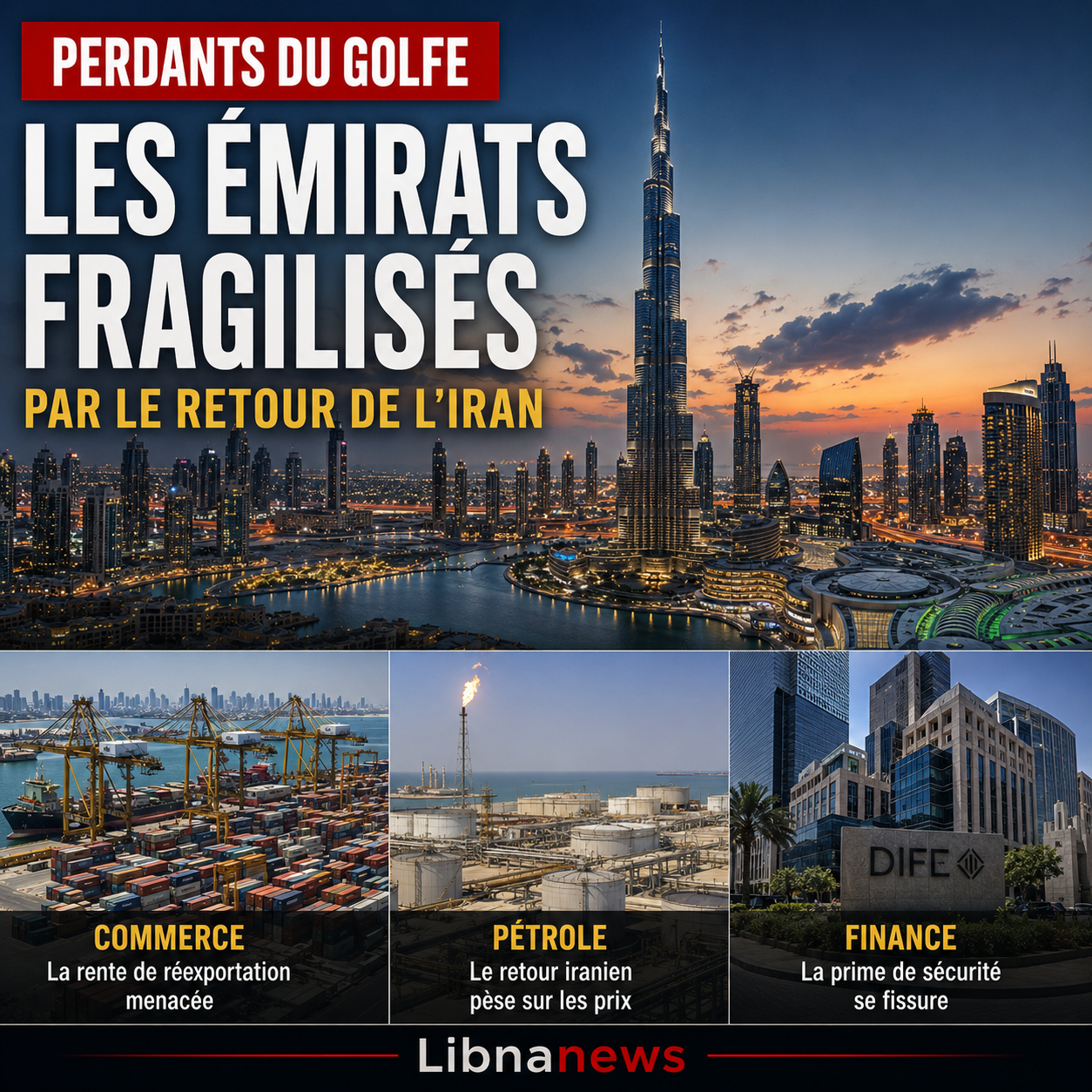
The temporary cessation of hostilities between Washington, Israel and Tehran does not only redistribute military maps in the Middle East. It also weakens an economic model based on a simple promise: the United Arab Emirates should remain the safe haven of the Gulf. This status had enabled Dubai to capture capital, regional headquarters, private wealth and part of Iran’s trade flows under sanctions. He had also strengthened Abu Dhabi in his role as a prudent oil power, allied with the United States, but able to speak to all camps.
This framework has changed. The United Arab Emirates is affected on three fronts. The first one is commercial. For years, sanctions against Iran have given Dubai an intermediary role. Goods entered legally, then returned to Iran, sometimes via opaque circuits. This re-export trade has fed ports, free zones, carriers, banks, exchange houses and trading companies. If sanctions are eased, part of this intermediation can disappear, as foreign companies will need less to go through the Emirates to reach the Iranian market.
The second shock comes from oil. A re-opening of the Iranian market, even a gradual one, would weigh on crude oil prices. It would expand the supply available as Gulf-producing countries seek to finance their diversification. The UAE has a lower budget threshold than some neighbours, but its strategy is still based on high oil revenues, DNAOC dividends and the value of its energy assets. A sustained fall in prices would not have the same effect as a brutal collapse. However, it would reduce Abu Dhabi’s room for manoeuvre and complicate major investment programmes.
The third shock is deeper. It’s about trust. Dubai and Abu Dhabi built their ascent on the idea that they were close to crisis areas without ever becoming themselves crisis theatres. The conflict cracked this perception. Financial groups have triggered continuity plans. Employees were allowed to work outside the country. Asian fortunes have studied transfers to Singapore or Hong Kong. Law firms reported more requests for diversification. It is not a documented mass exodus, but a weak signal that has become visible: the security premium of the Emirates is no longer acquired.
Emirati model built on commercial neutrality
The economic success of the United Arab Emirates was based on an old formula. The country sells oil, but it also sells connectivity. Dubai has transformed its port, airport, free zones and business law into attractive instruments. Abu Dhabi, for his part, used its energy revenues to build sovereign wealth funds, infrastructure and regional influence. The result is a two-engine federal state: one commercial, financial and real estate; The other oil tanker, sovereign and strategic.
This architecture works because it reduces friction. The Emirates offers visas, banks, lawyers, warehouses, insurance, air links and a favourable fiscal environment. They allow actors from Asia, Europe, Africa, Russia, Iran or the Arab world to do business without locking up in a single political bloc. This plasticity has long been a decisive advantage. It enabled the Emirates to cooperate with the United States, normalize its relations with Israel, reconnect with Iran, talk to Russia and maintain strong ties with China.
But this position becomes more expensive when the front lines approach. A hub doesn’t just live by its laws. He was confident that the contracts would be executed, that the aircraft would take off, that the terminals would operate, that the banks would remain open and that the wealthy families would be able to stay there without fear of escalation. The war has made visible what many prefer to ignore: the Emirates are not outside the Middle East. They are in the heart of the Gulf, a few dozen kilometers from Iran, on an energy road that Tehran can threaten.
Emirati authorities have real assets. The country has considerable financial reserves, controlled public debt, effective economic institutions and agile diplomacy. The International Monetary Fund continued to stress the resilience of the Emirati economy, driven by tourism, finance, real estate, construction, logistics and services. The central bank also anticipated strong non-oil growth. These figures describe a robust economy, but they do not neutralize the political issue. The question is no longer just whether the Emirates can grow. It is to know at what cost of security, reputation and assurance this growth will continue.
The discreet rent of trade with Iran
The first impact concerns the trade relationship with Iran. Western sanctions have often isolated Tehran from conventional banking and industrial channels. They never removed the needs of the Iranian economy. Iranian households continued to consume. Companies continued to import machinery, spare parts, electronics, intermediate goods, licensed medicines, consumer goods and services. Some of these flows transited through the Emirates, particularly through Dubai.
Commercial data give the measure of this dependence. Iranian customs statistics presented the Emirates as one of the country’s leading suppliers. For the Iranian year ended in March 2025, Emirati exports or re-exports to Iran were estimated at approximately $21.9 billion, while Iran’s non-oil exports to the Emirates amounted to approximately $7.2 billion. The World Trade Organization also reported that the Emirates accounted for nearly 30.6 per cent of Iranian imports in 2024, or about $21 billion.
These figures do not mean that all flows were illegal. A large part of this was authorized trade, regional trade or tolerated circuits. But they illustrate the interface role. When an Asian, European or local company could not deal directly with Iran, it often used Dubai-based companies. The goods entered the free zones. They sometimes changed ownership, documents, packaging or final destination. They then returned to Bandar Abbas, Kish, Qeshm, Bushehr or other Iranian entry points.
This activity has fed an entire ecosystem. Ports were paying for costs. Insurers charged blankets. Freight forwarders arranged the cargo. Banks processed payments when they could. Exchange houses and informal networks offset financial restrictions. Wholesalers, commissionaires and service companies benefited from regulatory complexity. As sanctions made access to Iran difficult, the value of the intermediary increased.
Partial or complete lifting of sanctions changes this equation. If companies can sell directly in Iran, open accounts, secure deliveries and deal with recognized banks, they reduce their dependence on intermediary platforms. The Emirates would retain an important commercial role, as its logistics remains efficient and its proximity to Iran remains useful. But the price of intermediation would fall. Margins related to regulatory scarcity would erode. Stakeholders benefiting from opacity should reinvent themselves in a more transparent environment.
This movement would not be immediate. American, European and UN sanctions do not all disappear at the same pace. Banks remain cautious for months, sometimes years, after an agreement. They fear the return of sanctions, fines and political changes in Washington. Large groups often prefer to test the terrain in stages. Dubai could therefore remain a gateway. But the nature of trade would change. The hub would no longer be indispensable because Iran is closed. It should prove that it remains useful as Iran reopens.
The normalisation of Iran reduces the value of opacity
Dubai’s added value in Iranian trade has long been based on a combination of legality, flexibility and grey areas. Sanctions created friction. Emirati actors knew how to circumvent them without always explicitly violating them. This competence had a market value. It attracted Iranian importers, Asian traders and long-standing diasporic networks in the emirate.
When Iran becomes more accessible again, this competence loses part of its scarcity. Flows can move to direct circuits. Shipping companies can restore more visible lines. Regional banks may consider supervised correspondence. Industrialists can negotiate with Iranian distributors without systematically going through a third party. Dubai remains fast, but it is no longer necessary in any case.
The shock is also political. The Emirates had an objective interest in maintaining a sufficiently open relationship with Tehran to preserve this trade. They also had a strategic interest in containing Iran alongside the United States and Israel. This tension was manageable as long as the confrontation remained indirect. It becomes more difficult if Iran emerges from conflict with a recognized pressure capacity and enhanced regional legitimacy. Iranian companies will be able to demand better conditions. Tehran may also seek to repatriate some of the flows to its own ports and free zones.
Competition will not only come from Iran. Oman, Qatar, Turkey, Iraq, India and China can capture some of the transactions. The land and sea corridors promoted by Tehran could gain in interest. The North-South international corridor, which links India, Iran, the Caspian Sea and Russia, remains complex, but it embodies this ambition. Each alternative road reduces the centrality of Dubai a little. Even if the Emirates remains a major player, it can no longer rely mechanically on the bypass rent.
Iranian oil, silent threat to Abu Dhabi
The second impact is oil. The United Arab Emirates has been producing several million barrels a day and has been seeking to increase its capacity for years. Abu Dhabi National Oil Company has invested heavily in upstream, infrastructure, gas, petrochemicals and exports. The country has Habshan-Fujairah pipeline, which makes it possible to export part of its crude oil by avoiding the Strait of Ormuz. This infrastructure is a strategic advantage. It does not remove the country’s exposure to world prices.
The arrival of additional Iranian volumes exerts a downward pressure. Iran has significant reserves and can increase exports if financial, insurance and logistical barriers decrease. During the sanctions periods, some of its oil continued to come out, especially to Asia, often with complex discounts and mountings. Standardization would make these flows more visible. It could also free up floating stocks and attract new buyers.
Oil markets react less to political declarations than to anticipated flows. When operators think that the offer will increase, they adjust prices even before all barrels arrive. The Middle East crudes, including Dubai, Oman and Murban Emirati, can then see their premiums eroded. For the Emirates, the result is measured at several levels: export earnings, public dividends, asset valuation, investment projects and capacity to finance diversification.
The Emirates is better placed than other Gulf producers. Their budget balance price remains relatively low compared to that of several neighbours. The country has diversified its revenues. Abu Dhabi has considerable sovereign assets. Dubai derives much of its service activity. But Emirati diversification is itself fueled by energy rent. SWFs invest through surpluses. Infrastructure is financed by sound public balance sheets. Major projects reassure investors because the state can support them.
A drop in the barrel therefore has not only a budgetary effect. It affects the story. The Emirates wants to accelerate its production to monetize its reserves as long as world demand remains high. If Iran returns forcefully, if global supply increases and prices decline, this strategy becomes more competitive and urgent. Abu Dhabi must sell more, at the best possible price, in a more crowded market. This can lead to a stronger rivalry between regional producers.
A more defensive energy equation
The conflict also highlighted the vulnerability of energy roads. The Strait of Ormuz remains one of the most sensitive points in world trade. A significant part of the oil and liquefied natural gas flows there. The Emirates has invested in Fujairah to reduce their dependency, but they cannot cut themselves off entirely from this geography. Insurers, charterers and refiners now incorporate a more visible risk.
This situation is driving Abu Dhabi to accelerate its bypass and storage infrastructure. Pipeline, terminal, port and logistical redundancy projects become less options than guarantees of economic survival. Their cost is high. It adds to the necessary investments in air defence, cybersecurity, electricity networks, airports and ports. The security bill goes up when the price of oil could fall.
The fall in prices may also affect Dubai indirectly. The emirate is not dependent on oil like Abu Dhabi, but depends on regional liquidity. When the Gulf states accumulate surpluses, real estate projects, stock market introductions, tourism spending and asset purchases increase. When prices fall, discretionary spending becomes tighter. Investors remain present, but they become more selective. The real estate market, which is very sensitive to international confidence and flows, can return quickly.
Recent figures illustrate this ambivalence. Emirati equity markets bounced back with the announcement of an agreement between Washington and Tehran, a sign that investors want to believe in a de-escalation. The Dubai Financial Market has even crossed a symbolic capitalization threshold. But these short-term reactions are not enough to eliminate the structural risk. Emirati assets rise when war moves away. They fall when the war approaches. Their valuation now depends more explicitly on a geopolitical parameter that Dubai tried to keep at a distance.
Dubai against the challenge of its refugee status
The third impact is the most delicate, because it affects Dubai’s most valuable intangible asset: trust. Over the past two decades, the emirate has established itself as a regional refuge. Russian, Indian, Chinese, Iranian, African, European and Arab entrepreneurs have found a relatively stable, tax-reduced, well-connected and more predictable environment than many neighbouring countries. The city has attracted banks, funds, wealth managers, family offices, lawyers, consultants, cryptocurrency companies and technology platforms.
This status is not only based on tax rates. Singapore, Hong Kong, Zurich, London, Jersey, Luxembourg or Miami can offer other advantages. Dubai won because it combined administrative speed, quality of life, air connectivity, proximity to emerging markets and a sense of security. The war has reached this last pillar. A financial centre can withstand distant political tensions. It is less resistant to drones, missiles, temporary air space closures, telework instructions and evacuation plans.
Several press reports have shown that international banks and financial companies have adopted precautionary measures. Some have allowed their employees to work temporarily outside the Emirates. Others have strengthened security controls, limited travel or moved certain meetings. Cash managers reported requests from clients wishing to transfer some of their assets to Singapore or Hong Kong. Entrepreneurs have sought to move limited amounts, sometimes in the order of a few hundred thousand dollars, to diversify their risk.
We have to stay precise. The available data do not prove a massive and lasting flight of capital. Nor do they demonstrate that the big banks have abandoned Dubai. On the contrary, several players continue to recruit, develop their teams and target wealthy Gulf customers. DIFC recorded strong growth in its active businesses and wealth management companies in 2025. The Emirates retains major regulatory and tax advantages.
But confidence is not only measured at the stock of registered companies. It is measured against marginal decisions. A family office that hesitates between Dubai and Singapore can now choose Singapore. A fund that was to base a trading team in Dubai may prefer Jersey or Geneva. A bank that was considering concentrating its regional operations in the Emirates can maintain more redundancy in London, Zurich or Hong Kong. These decisions do not empty Dubai. They slow down its progress.
Insurance price increases
Geopolitics acts as an invisible tax. It increases the cost of insurance, travel, security plans, salary premiums, force majeure clauses and emergency systems. A company based in Dubai must now prove to its employees, customers and regulators that it can continue operations in the event of a regional crisis. This requires alternative sites, redundant servers, mobile teams and emergency protocols.
These costs mainly affect sectors with high levels of confidence. Wealth management requires stability. Fortune clients are not just looking for tax returns. They want to sleep. They want to know that their assets are accessible, their families can travel, schools remain open and banks will not be disturbed. If Dubai no longer offers this absolute certainty, it must compensate with other benefits.
The real estate market illustrates this sensitivity. The city experienced a strong expansion after the pandemic, supported by the arrivals of foreign residents, Russian, Indian, European and Asian capital, as well as long-term visas. The luxury segment benefited from spectacular sales. But high prices make the market vulnerable to any mood change. Recent information reported a marked slowdown in sales in some categories after the outbreak of the regional war. Although some of these data should be read with caution, they recall that Dubai’s real estate depends on mobile buyers.
The effect can be asymmetric. Residents, local businesses and long-term investors remain. Opportunistic capital goes faster. But Dubai has benefited greatly from these mobile capital. They buy apartments, rent offices, open accounts, consume services and feed valuations. If their arrival slows down, growth does not stop. It becomes more difficult to sustain.
Figures showing the emirati exposure
The Emirate economy remains strong, but its strength also reveals its points of dependence. GDP exceeds $500 billion. The non-oil sector accounts for the bulk of activity. Financial services, trade, real estate, construction, tourism, logistics and industry support growth. The central bank projected a growth in non-oil GDP of around 4.5% in 2025 and 4.8% in 2026. The IMF also referred to an expansion driven by non-hydrocarbon sectors.
This diversification is real. It distinguishes the UAE from several more rigid, integral economies. But it does not mean independence. Banks benefit from public and private deposits from the regional rent. Real estate depends on foreign capital flows. Ports depend on regional trade. Airlines depend on the perception of safety. Free zones depend on the ability to attract companies that can choose other jurisdictions.
The banking sector is central. Bank assets exceeded Dirham 4,700 billion in the spring of 2025, according to data from the central bank relayed by the economic press. This mass reflects considerable financial depth. It also shows that any movement of distrust, even if limited, can have significant effects. Non-resident deposits, international business accounts and funds from wealthy clients are more mobile than domestic deposits. They do not disappear in one day, but they move if the perceived risk increases.
DIFC illustrates the other side. The financial centre announced record results for 2025. New registrations have increased significantly. The total number of active enterprises has increased. Wealth and asset management companies continued to operate. The square has even launched considerable expansion projects by 2040. These figures show that Dubai does not collapse. They also show why the shock of confidence counts: the more open the model, the more exposed it is to the rapid arbitrations of international actors.
| Indicator | Recent data | Economic reading |
|---|---|---|
| Iranian imports from the United Arab Emirates | Approximately $21 billion in 2024 | The Emirates remains a major gateway to Iran |
| Emirati exports or re-exports to Iran | About $21.9 billion over the Iranian year ended in March 2025 | Re-export rent is significant |
| Iranian non-oil exports to the Emirates | Approximately $7.2 billion over the same period | The relationship remains unbalanced in favour of the emirati hub |
| Projected non-oil growth in the Emirates | Approximately 4.5% in 2025 and 4.8% in 2026 | Diversification remains dynamic |
| Assets of the Emirati banking system | Over 4,700 billion dirhams in spring 2025 | The country depends on high financial confidence |
| Companies active in DIFC | Nearly 8,840 at the end of 2025 according to the center’s announcements | Dubai remains attractive despite regional risk |
| Dubai Financial Market Capitalization | Over 1 trillion dirhams in June 2026 | Markets can bounce fast after a de-escalation |
| Fiscal balance price of oil | Around $50 a barrel for 2025 according to IMF series taken up by the Fed of Saint-Louis | Abu Dhabi has a margin, but not immunity |
These data require nuanced reading. The Emirates is not a loser in the sense of an economy in immediate crisis. They remain rich, liquid, organized and able to adjust. Rather, they lose a relative position. They took advantage of Iran under sanctions, oil supported by tensions and an image of a financial sanctuary. The conflict and its outcome threaten these three benefits at the same time.
Israel, the Abraham Accords and the cost of visibility
The partnership with Israel adds a political dimension. The Emirates signed the Abraham Accords in 2020, paving the way for diplomatic, commercial, technological and security standardization. This choice met several objectives: to access advanced technologies, to strengthen US support, to cooperate against Iran, to attract investment and to present itself as a modernizing power. Bilateral trade has increased, even after the Gaza war, indicating that the relationship has resisted public tensions.
But the war against Iran makes this normalization more expensive. As long as cooperation remained economic or technological, Abu Dhabi could present it as a sovereign decision, focused on innovation and stability. If it becomes military or security in a direct conflict with Tehran, it exposes the Emirates to reprisal. Press reports referred to Emirati security delegations in Israel during the war. Others reported Israeli air defence assistance. These elements should be treated with caution, as not all information is officially confirmed. However, they reflect a regional perception: the Emirates is no longer only a discreet partner of Israel, but an actor potentially involved in the anti-Iranian security architecture.
The rumours of secret bases or military devices linked to Israel are an even more sensitive record. They cannot be presented as established facts without sound public evidence. However, their existence in the regional debate is sufficient to produce a political effect. Iran and its allies can use them to justify increased pressure. Arab public opinion may see this as a contradiction with official positions on Palestine. Investors can see this as an additional source of risk.
Abu Dhabi must therefore manage a difficult equation. To give up cooperation with Israel would weaken part of its defence and innovation strategy. Too clearly displayed would increase the political and security cost. The likely compromise is to maintain the links, but to make them less visible. This discretion can work in calm weather. It becomes less credible when a regional conflict forces each State to show its alignments.
Bahrain and the Emirates in the same risk zone
Bahrain shares part of this exhibition. The kingdom has also normalized its relations with Israel and hosts an important American military presence. Its scope is more limited than that of the Emirates. Its economy is smaller, its internal situation more fragile and its dependence on stronger Saudi support. But the signal is valid for the entire Gulf: American security architecture has not prevented climbing. It has sometimes even transformed host countries into potential targets.
The Emirates had long thought it could separate their registers. Cooperate militarily with Washington, trade with Tehran, invest in China, normalize with Israel, speak in Moscow and attract the fortunes of the global South. This portfolio diplomacy remains possible, but requires greater finesse. Iran’s relative political victory, or at least its ability to emerge from the conflict without capitulation, makes this game more constrained.
Tehran can now remind the Gulf neighbours that no American umbrella is absolute. It can also use trade as an instrument for standardization. The Emirates, for their part, must avoid appearing defeated while reconnecting with Iran. They must reassure Israel without provoking Tehran. They must reassure Washington without giving the impression that their safety depends on an ally who did not prevent the war from reaching the Gulf.
The American withdrawal and the security umbrella crisis
The most strategic point concerns the United States. The Emirates built their security around a close relationship with Washington. The Al-Dhafra base, air cooperation, arms purchases, intelligence and military interoperability have long guaranteed an advantage. The Emirati ports, including Jebel Ali, also served as points of support for the American naval presence. This relationship has not disappeared. It remains structuring. But its political effectiveness is contested.
The conflict has shown that the United States can be present without preventing its allies from being exposed. They can provide defence systems, intelligence and partial deterrence. They cannot guarantee total invulnerability in the face of missiles, drones, cyber attacks, sabotage and maritime disruption. For a State like the Emirates, whose wealth depends on continuity, this limit is major.
The American withdrawal does not always mean military departure. Rather, it refers to a lesser provision to pay the political cost of an unconditionally guaranteed regional order. Washington can negotiate directly with Tehran, even if Israel or some Gulf partners oppose it. He can try to reduce his exposure. It can favour the Indo-Pacific. It can alternate maximum pressure and rapid compromise depending on the administrations. This unpredictability reduces the value of the American umbrella.
The Emirates has already tried to diversify its partnerships. They buy technology from different suppliers. They cooperate with France, China, India and other powers. They develop their defence industries. They invest in artificial intelligence, drones, space and cybersecurity. But hard security remains dominated by the United States. If this guarantee seems less reliable, the cost of diversification increases.
Iran imposes new regional grammar
Iran does not need to dominate the Gulf militarily to influence the Emirates. He just has to show that he can disturb. This nuisance capacity becomes a form of power. It affects insurance, risk premiums, oil prices, investment decisions and diplomatic calculations. Gulf power can possess modern aircraft, anti-missile systems and sovereign funds. It remains vulnerable if its model depends on permanent normality.
The Iranian victory mentioned by many observers must therefore be understood with caution. Iran has incurred heavy costs. Its economy remains fragile. Its infrastructure may have been affected. Its population pays the price of sanctions and militarization. But at the regional political level, Tehran can claim a result: it has shown that it cannot be neutralized without consequences for its neighbours. He forced the Gulf capitals to reconsider their red lines. He put the Ormuz Strait and energy security at the centre of the game.
For the Emirates, this reality requires an adjustment. The old doctrine was to maximize the gains of globalization while outsourcing security to Washington. The new doctrine will have to internalize more risks. It should include the fact that the relationship with Iran is not a secondary issue, but a condition of economic stability. It must also recognize that standardization with Israel, even technologically useful, can become a burden if it is associated with a frontal confrontation with Tehran.
The bill for Dubai: finance, real estate, aviation
Dubai is the most exposed emirate to perception shock. Its economy depends little on oil, but much on movement. Aircraft, tourists, trade shows, capital, expatriates, economic influencers, private bankers and real estate developers are making the city work. It works when the world circulates. It becomes vulnerable when the world hesitates.
Finance is the first channel. An international bank does not leave a financial position at the first shock. It reduces travel, activates teleworking, temporarily moves certain employees, strengthens relief plans and calls for guarantees. These gestures seem minor. Yet they send a message to clients: there is a risk. Dubai’s competitors know how to use this message. Singapore can highlight its geographical distance, rating, legal framework and neutrality. Jersey can attract teams looking for a stable tax framework and a less missile-friendly environment. Geneva and Zurich can recall their banking depth. London can play on its law and liquidity.
The second channel is real estate. Dubai prices have risen sharply thanks to foreign buyers. This growth was driven by the supply of luxury residences, gilded visas, tax advantages and the transformation of the city into a global base for mobile entrepreneurs. But a real estate market driven by international capital depends on trust. An investor can postpone a purchase of several million dollars if he fears a further escalation. A promoter can maintain his plans, but sell more slowly. Agencies can survive, but their margins are shrinking.
The third channel is aviation. Emirates, flydubai and Dubai’s airport ecosystem depend on an open sky and a reputation for safety. Detours, cancellations, insurance premiums and point closures of airspace are expensive. Passengers choose their hubs based on price, quality and time. They also take into account the perception of risk. Doha, Istanbul, Riyadh, Addis Ababa or Singapore can capture flows if Dubai becomes associated with an active tension zone.
Dubai has already overcome crises: debt of 2009, pandemic, regional tensions, Russian sanctions, real estate cycles. Its adaptability is real. But the conflict with Iran touches its core. This is not just a drop in demand. It is a doubt that Dubai would be a safe enclave in an unstable region.
Abu Dhabi: Rich power, narrower margin
Abu Dhabi addresses the crisis with other assets. The Emirate controls most of the country’s oil reserves. It has major sovereign funds, strategic administration and a stronger industrial policy. His exposure to tourism and speculative real estate is less than that of Dubai. It can absorb more shocks. But it also bears responsibility for national security and relations with the great powers.
The drop in oil, if confirmed, reduces future revenues. It does not put Abu Dhabi in immediate difficulty, but requires prioritizing. Investments in ADNOC, artificial intelligence, renewable energy, industry, ports, space, defence and infrastructure are expensive. Military and security spending is likely to increase. SWFs can compensate, but they are also committed to long-term global strategies.
Abu Dhabi must also manage the relationship with Iran. Unlike Dubai, whose link with Iran is initially commercial and diasporic, Abu Dhabi sees Tehran as a security issue. Territorial disputes over the islands of Abu Moussa and the Tumbs remain a substantive issue. Iran’s ballistic capabilities are directly related to the energy and military infrastructure of the Emirates. Cooperation with Israel responds to this concern, but it can also exacerbate it.
The most likely strategy is to reduce the visibility of alignments while increasing diplomatic channels. The Emirates has already shown its ability to move from confrontation to de-escalation. They can maintain Abraham’s accords, but avoid overexposed military symbols. They can strengthen defences, but seek guarantees of non-aggression with Tehran. They can cooperate with Washington, but ask for more autonomy. This line is rational. It is also fragile because it depends on unpredictable external actors.
The end of a geopolitical rent
The Emirates has long benefited from three geopolitical rents. The first was the penalty rent. Closed Iran needed a door. Dubai was that door. The second was the oil supply. Regional crises often supported courses without directly affecting Emirati territory. The third was the security annuity. Capital fled from the surrounding crises to seek refuge in the Emirates.
The conflict partially reverses these three mechanisms. If Iran reopens, the penalty rent decreases. If Iranian oil comes back, the oil rent goes down. If the Emirates becomes exposed themselves, the security pension will be reduced. This triple pressure does not necessarily cause a crisis. Rather, it marks the end of a period when the Emirates could take advantage of tensions without paying the price directly.
The comparison with Singapore is enlightening. Dubai has often wanted to become the Singapore of the Middle East. It has adopted certain methods: port, finance, administrative efficiency, security, attractive taxation, air hubs, policy of welcoming talent. But Singapore is not located in the Strait of Ormuz. It is not within immediate reach of a war between Israel, Iran and the United States. It faces its own tensions in Asia, but its regional risk is not expressed in the same way. For mobile capital, this difference counts.
Jersey plays another role. The island does not offer Dubai’s commercial power, but it offers a stable, specialised, fiscally attractive and connected to European markets. For some funds or family offices, it can be used as redundancy. It does not replace Dubai as a regional hub. It captures what Dubai risks losing: the confidence of structures that first seek legal protection and distance from military risk.
How the Emirates can respond
The Emirati response must be economic, diplomatic and symbolic. Economically, the country must reduce its dependence on rents. This means developing activities that are not based on sanctions, on opacity, or on simple tax optimisation. Financial services will need to gain in regulatory depth. Asset management will have to convince through the quality of law and supervision. Free zones will have to attract companies that produce, innovate and export, not just transit structures.
In terms of energy, Abu Dhabi will have to accept a more competitive environment. The capacity increase target can remain relevant if the Emirates wants to monetize their reserves before the energy transition. But this strategy must coexist with a more present Iran. It will require more long-term contracts, commercial flexibility, petrochemicals, gas and investment in alternative roads. Fujairah will become even more strategic.
In financial terms, Dubai will have to reassure without denying. The worst answer would be to pretend that nothing has changed. Investors know what they saw. They expect credible continuity plans, transparent communication, resilient infrastructure, liquidity guarantees and enhanced international cooperation. The authorities can turn the crisis into an argument if they show that markets, banks, courts, ports and airports have continued to function despite the shock.
Diplomaticly, the Emirates will have to speak to Iran more directly. This conversation will not be a sign of weakness. It will be a condition of stability. The Emirates can defend its alliances while negotiating mechanisms for maritime de-escalation, aviation safety and infrastructure protection. They can use trade as a shock absorber, but they will have to accept that Tehran has a stronger lever than before.
Israeli discretion will probably become the rule. Trade and technology can continue. Security cooperation too, but their public exposure will be expensive. The Emirates should avoid appearing as an advanced platform for an anti-Iranian coalition. They will also have to manage Arab views, which are still marked by the war in Gaza and Israeli operations in the region. Standardization does not disappear. It gets heavier to wear.
An Iranian victory that forces realism
The Iranian victory term must be handled rigorously. A total military victory is not established. Iran has suffered considerable strikes, sanctions, economic losses and pressure. But he achieved a strategic objective: he recalled that his security could not be treated as an isolated file. He showed that a war against him could reach the economic interests of the Gulf. He forced the United States to compose. He forced Washington’s Arab partners to face the American umbrella limit.
For the Emirates, this is a hard lesson. The country had built an image of agile power, capable of enjoying all worlds. This agility remains an asset. But it is no longer enough if each relationship becomes a risk. Trade with Iran earns, but it exposes. The partnership with Israel protects in some respects, but it targets others. The American alliance reassures, but it does not guarantee. International finance enriches, but it leaves quickly if fear settles.
The challenge in the coming months will be to restore a hierarchy of risks. The Emirati authorities will have to convince that the conflict was an exceptional sequence, not a normal new one. They will have to prove that trade routes are safe, the banking system remains liquid, foreign capital will not be trapped, contracts will be executed and critical infrastructure protected. They will also have to accept a more balanced relationship with Iran, as the old power ratio has changed.
So the central question is not whether the Emirates will collapse. They don’t collapse. Their economy is too robust, their reserves too large and their state apparatus too efficient for such a conclusion. The question is whether their hub premium will remain so high. A hub is worth its position, but above all the confidence it inspires. If this confidence is fragmented, even partially, margins are reduced, flows are diversifying and competitors are gaining space.
The next indicators will be concrete: re-export volumes to Iran, new DIFC entries, non-resident deposits, luxury real estate sales, maritime insurance premiums, air traffic, business financing costs, deep-sea decisions and the pace of ADNOC investments. It is in these figures, more than in diplomatic communiqués, that the real cost of the conflict for the United Arab Emirates will be read.