




Emmanuel Macron took advantage of his interview on France 2, on June 18, to clarify the French position after the signing of the Memorandum of Understanding between the United States and Iran. The French President welcomed the opening of a dialogue phase, while refusing to talk about a war already over. He stressed the need to verify the agreement within 60 days of negotiations, to ensure that Iran does not come out of the sequence more dangerous, to stabilize the Lebanese front and to bring Israel to act with « responsibility » and « rationality ». The Head of State also linked the agreement to its economic consequences, notably on the Strait of Ormuz and energy prices, as well as to the G7’s announcements on artificial intelligence, protection of minors, Ukraine and industrial transitions.
» I don’t think we can say that this war is totally over. »
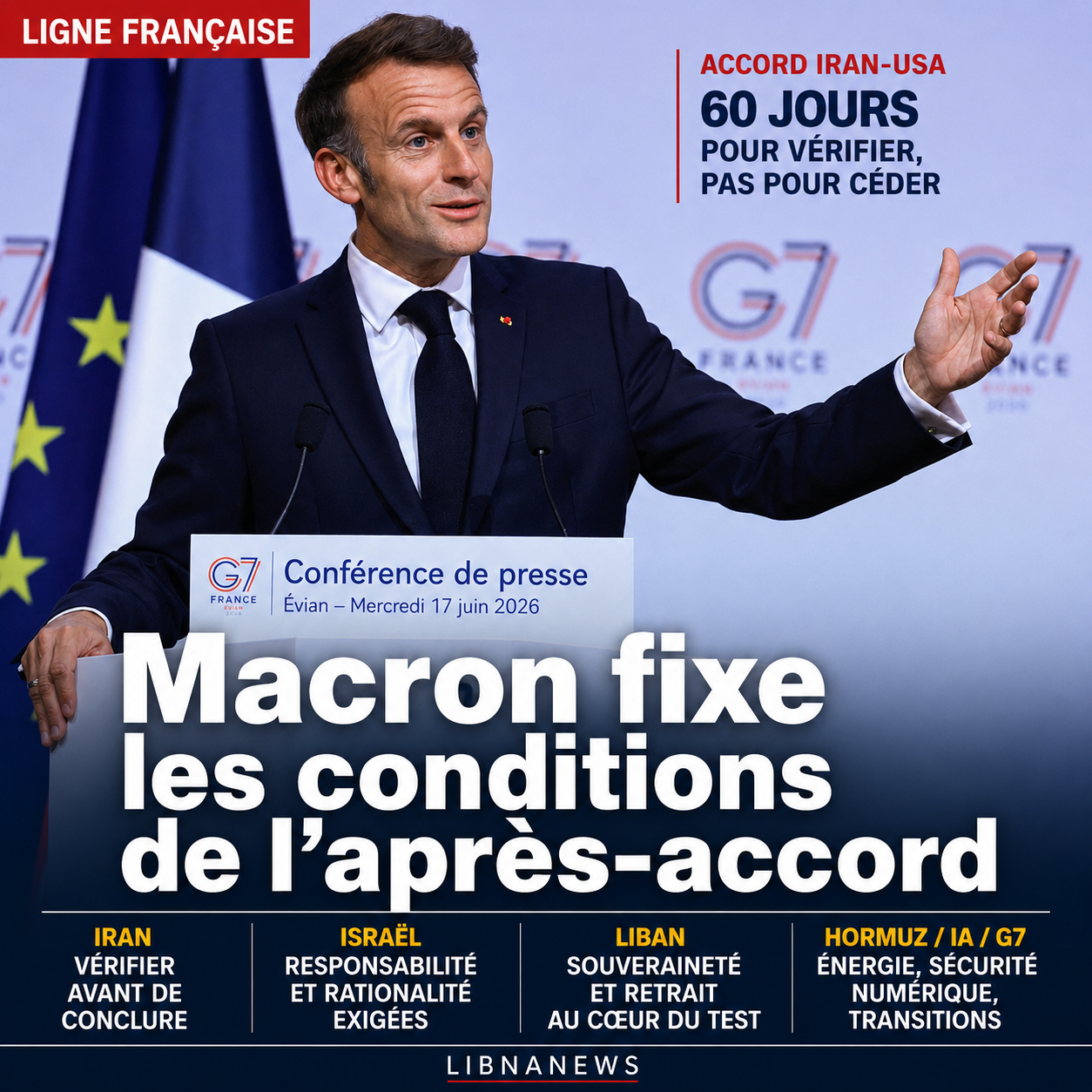
When asked about France 2 after the signing of the Memorandum of Understanding between Washington and Tehran, Emmanuel Macron refused any triumphalist reading. The president said he did not think that it could be said that this war was « totally over ». He added that it is after the 60 days of negotiations that it will be necessary to see whether Iran has become « less dangerous than before ». This formula sets the tone for the French position: Paris welcomes the agreement as a step forward, but does not yet consider it as an acquired peace.
The French President also justified support for the American approach in simple terms. He felt that an agreement is always better than war, especially when there are risks of escalation. He described the new phase as cooperation and dialogue, which he considered preferable to the continuation of the conflict. This statement allows Macron to place himself in a prudent line of support: it does not validate everything in advance, but it defends the principle of a diplomatic exit.
The mention of the sixty days is central. The memorandum signed between the United States and Iran opens a negotiating period prior to a final agreement. During this period, the most sensitive issues will need to be clarified: Iran’s nuclear power, sanctions, oil, Hormuz Strait, IAEA role, regional security and the implementation of the ceasefire on the associated fronts, including Lebanon. France therefore wants to be in the implementation phase, not only in the commentary.
Macron also recalled that the signing of the protocol had taken place under special conditions, in Versailles, in the presence of Donald Trump. According to the story reported in the French press, he explained that the signature was made in a « spontaneous » way and that it was good that it did not wait, so that a new moment would begin. This clarification allows the French President to stress that France has served as a framework for a major diplomatic episode, even though the text was first negotiated between Washington and Tehran.
Versailles, a symbol assumed by Macron
The signature at Versailles was not presented as mere protocol chance. The agreement was initially to be signed in another framework, but Donald Trump finally signed it at the dinner held at Versailles Castle, in front of Emmanuel Macron. According to the Associated Press, the document was brought to dinner, reread by US and French diplomatic officials, and then signed by the US President in a sequence that surprised several participants.
Macron wanted to make this signature a moment to open. The French president cannot claim the authorship of the text, but he can claim the role of France as a place of change. Versailles adds a historic and symbolic dimension to an agreement that affects the Middle East, Iran, Israel, Lebanon and the world economy.
France is thus seeking to take up a place in a process where Europeans risked being marginalized. Since the US withdrawal from the 2015 nuclear agreement, Paris, Berlin and London have often tried to maintain a diplomatic framework with Tehran. The new Washington-Téhéran protocol puts the United States back at the centre. By welcoming the G7 to Évian and signing in Versailles, Macron attempted to enroll France in the next phase.
The French President therefore presented the agreement as a necessary step forward in a fragmented world. According to the Parisian direct, he had already indicated that the agreement had been welcomed by the leaders present in Evian and that he was in a very difficult context of international fragmentation.
Iran judged « militaryly and nuclearly weaker »
On the balance sheet of the war, Emmanuel Macron put forward an important formula: according to him, Iran is now « militaryly and nuclearly weakened ». This statement answers the question of the report of force after several months of conflict. It allows the French President to support the agreement without giving the impression that Tehran would come out strengthened without compensation.
The formula is conservative. She doesn’t say Iran is neutralized. She doesn’t say the danger has disappeared. She said Iran was weakened on two essential points: military and nuclear. Macron therefore links the dialogue phase to an already modified balance of power. The message sent to critics of the agreement is clear: it is not about rewarding an intact Iran, but about negotiating after a sequence that has reduced its capabilities.
The G7 adopted a similar line. Leaders welcomed the announcement of an agreement between the United States and Iran, expressed their readiness to contribute to its implementation and reaffirmed that Iran should never obtain nuclear weapons. This formulation, reiterated by the European Council in its report on the summit, sets out Western doctrine: support for the agreement, but absolute firmness on non-proliferation.
France therefore intends to follow the nuclear issue closely. The interim agreement will only be deemed credible if it allows for real verification. In particular, Paris awaits the role of the IAEA, the fate of enriched uranium stocks, the limitation of future enrichment and Tehran’s guarantees of the absence of militarization. Macron does not present the agreement as a definitive solution. It is part of a monitoring phase.
This caution also concerns sanctions. The agreement provides for a gradual reduction of certain measures, but France does not want the lifting of financial constraints to enable Iran to strengthen its regional networks. The G7, for its part, speaks of a contribution to implementation, which means that Westerners will seek to influence the technical and political conditions of the final agreement.
Lebanon: Macron calls Netanyahu to « responsibility » and « rationality » · Global Voices
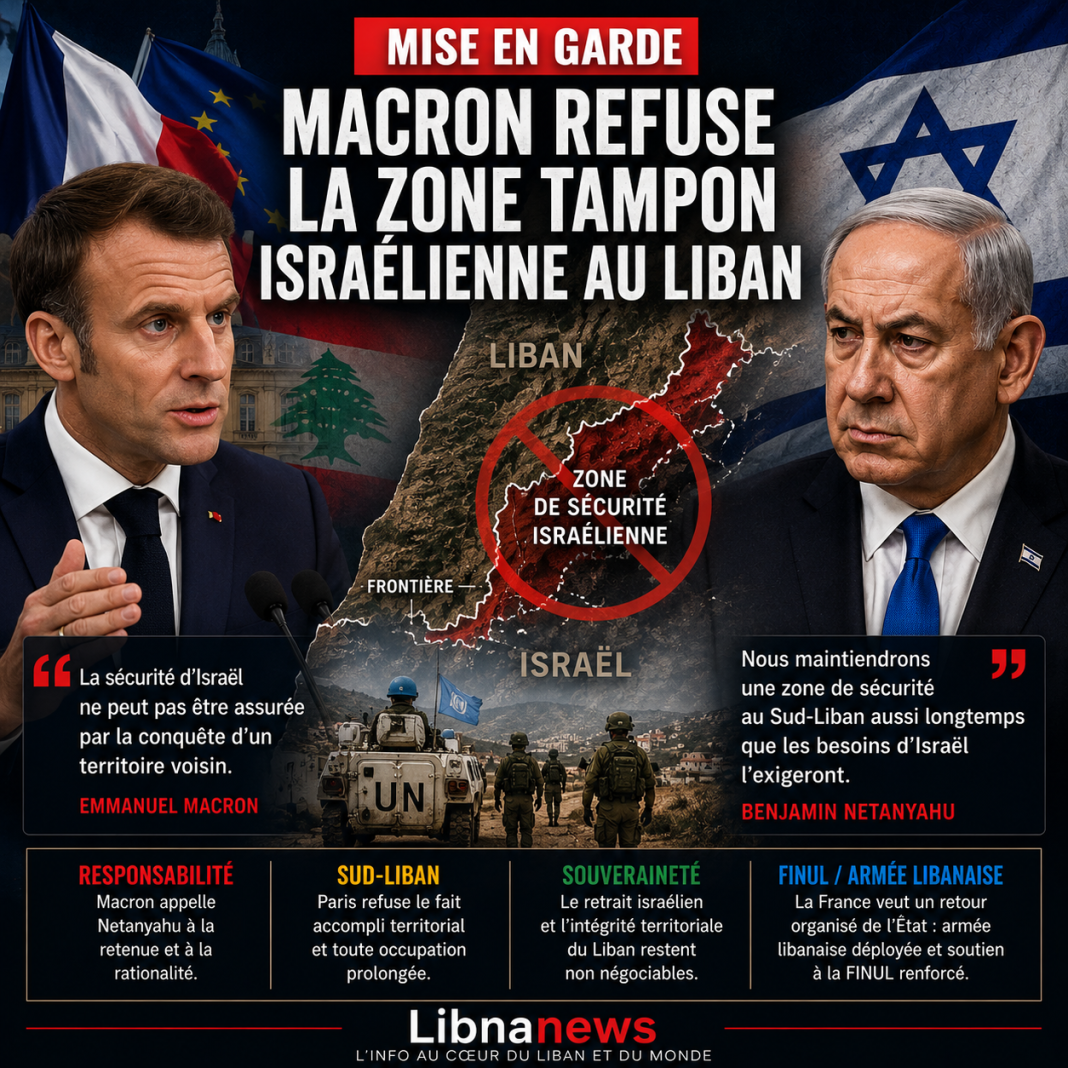
The passage most directly related to Lebanon concerns Benjamin Netanyahu. When asked about the situation in the Middle East, Emmanuel Macron called on the Israeli Prime Minister to show « responsibility » and « rationality ». He added that Israel’s security cannot be ensured by the conquest of a neighbouring territory. This sentence directly refers to the Israeli position on southern Lebanon and the maintenance of a safe area.
The wording is strong. Macron recognizes the issue of Israel’s security, but he rejects the idea that it can be guaranteed by the occupation or long-term control of Lebanese territory. It is the heart of the French line: Israel’s security, yes; territorial achievements in Lebanon, no.
This position comes at a time when Israeli strikes left southern Lebanon dead again on 18 June, despite the regional agreement. The Parisien recalls that three people were killed in Israeli strikes on southern Lebanon while the Memorandum of Understanding provides for the end of the war on several fronts. This persistence of strikes reinforces the difficulty of the sequence: the agreement exists, but its application in Lebanon remains contested by Israel.
France therefore wants the Lebanese front to be treated as a test of the agreement. The G7 supported a robust ceasefire in Lebanon, the efforts of the Lebanese authorities to achieve the disarmament of Hezbollah and the State monopoly of arms, as well as the protection of the territorial integrity and sovereignty of Lebanon. This formulation is important because it does not reduce the Lebanese file to Hezbollah’s weapons; it also includes Israeli withdrawal and respect for Lebanese territory.
What France wants to do for Lebanon
The French line on Lebanon has several concrete elements. First, Paris supports a robust and lasting ceasefire. Secondly, France calls for respect for Lebanese territorial integrity. It also wants the Lebanese State to gradually regain the arms monopoly, with a central role for the Lebanese army. Finally, it intends to maintain an international role in the South, including through UNIFIL and monitoring mechanisms.
These elements are not new, but they gain additional weight after the Washington-Tehran agreement. The Lebanese front is now included in regional de-escalation. If Israel maintains a security zone in the South, the agreement will be weakened. If Hezbollah refuses to discuss its weapons after an Israeli withdrawal, Lebanese sovereignty will remain incomplete. Paris therefore wants to support an orderly sequence: ceasefire, Israeli withdrawal, Lebanese army deployment, return of displaced persons, reconstruction and national dialogue.
Jean-Yves Le Drian, the personal representative of the French President for Lebanon, summarized the difficulty of the moment by explaining that the integrity and sovereignty of Lebanon are recognized by the protocol, but that the Israeli authorities do not feel connected to this agreement. He added that the negotiations would open on that basis and that Hezbollah said that it could not accept a ceasefire while Lebanese territory was occupied. This remark describes exactly the node of the sequence.
France can therefore act on three levers. The first is diplomatic: to weigh with the United States, Israel, the G7 and the Security Council for the Lebanese sovereignty clause to be applied. The second is military: to support the Lebanese army, which must become the central actor in the return of the State to the South. The third is civilian: contributing to the reconstruction of destroyed villages, the return of displaced persons and the restoration of essential services.
Macron has already repeated in several sequences that France is at its disposal to contribute to the stabilization between Lebanon and Israel. The novelty is that the Washington-Téhéran agreement can give this availability a more concrete framework. Paris will seek to integrate into the implementation phase, in particular around the Lebanese army, UNIFIL and the monitoring of violations.
Israel: France supports security, not buffer zone
Macron’s position towards Israel is therefore on two levels. It recognizes Israel’s right to security. It does not deny the threat of Hezbollah or Iran’s place in the regional equation. But it refuses to ensure this security by occupation or by an extended security zone in southern Lebanon.
This nuance is essential. She explains why Macron calls Netanyahu to responsibility and rationality rather than a breakup. The French President is trying to convince Israel that its long-term security cannot be built on a military presence without a horizon. Such a presence feeds the story of Hezbollah, makes it more difficult for the Lebanese displaced to return, weakens the Lebanese state and complicates the implementation of the regional agreement.
The G7 reflects this logic in its text. Leaders support Lebanon’s sovereignty, but also the state’s monopoly on arms. This means that France is not simply asking Israel to leave. It also calls on Lebanon to rebuild a public authority, and on Hezbollah to enter into a national political process.
This French position can be difficult to maintain. Netanyahu claims that the Israeli army must maintain a security zone in southern Lebanon as long as Israel’s needs so require. Hezbollah, for its part, refuses any debate on its weapons before the Israeli withdrawal. Paris must therefore push both conditions at the same time: Israeli withdrawal and restoration of the Lebanese state monopoly.
That is where the American role is decisive. Macron can talk to Netanyahu. It can mobilize the G7. He can support Lebanon. But only Washington has the main lever on Israel. France will therefore seek to convince the United States that the implementation of the agreement with Iran also involves pressure on the Israeli government in Lebanon.
Hormuz and fuel: Macron connects diplomacy and purchasing power
The maintenance also covered the Darmuz Strait and the price of fuel. France Télévisions had announced this question among the central topics: can the agreement between Washington and Tehran reopen Hormuz and lower prices?
The G7 explicitly linked the reopening of the Strait to global economic stability. In its report, the European Council recalls that the leaders reaffirmed that the right of passage without restriction or tax is a basis for international trade. The G7 also considered that a speedy return to free and safe transit through the Darmuz Strait is imperative to limit the negative effects on industries, farmers, households and vulnerable countries.
Macron can therefore present the agreement with Iran as a concrete issue for the French. If Hormuz reopens, oil prices can drop. If energy pressures decrease, inflation may be lower. If the war resumes, the markets can go up again. However, the French president felt that it was still too early to estimate the cost of the war to the French economy. He added that France resists better than its neighbours, according to the Parisian report.
This caution avoids an immediate promise on pump prices. The agreement can reduce energy pressure, but it does not guarantee a sustainable reduction. Everything will depend on implementation, maritime security, Iranian volumes, market response and regional stability.
However, France wants to use the sequence to defend its energy sovereignty. The Gulf crises recall that the economies dependent on imported hydrocarbons remain vulnerable. Macron therefore connects the short term, securing Hormuz, in the long term, accelerating the energy transition, developing civilian nuclear power, supporting renewables and reducing dependence on geopolitical shocks.
G7: Macron claims success and « time of unity »
The interview on France 2 takes place after the closing of the G7 of Évian. Macron claimed diplomatic success, in a context where he wanted to show that Western countries could still act together. According to La Dépêche, the Head of State spoke of a « time of unity » after months of disagreement and highlighted advances on Iran, Ukraine and artificial intelligence.
Elysée presents the last day of the summit as structured around two main axes. In the morning, leaders worked on balanced, inclusive and sustainable economic growth with partner countries, IMF and OECD. Next, a working lunch focused on the safe, fast and efficient deployment of artificial intelligence, in the presence of business leaders.
The summit also showed a unit on Ukraine. The G7 leaders reaffirmed their support for Ukraine’s freedom, sovereignty and territorial integrity. They promised to increase air defence capabilities, additional systems and interceptors, as well as long range capabilities. They also confirmed their desire to increase pressure on the Russian war economy, including through sanctions in the oil and gas sectors.
The Ukrainian file is not the center of the interview requested here, but it contributes to Macron’s story. The French president wants to show that the G7 d’Evian has produced a global coordination: Ukraine, Iran, Lebanon, IA, energy, world economy and critical minerals. This accumulation is used to present France as an actor of synthesis.
However, the unit displayed remains dependent on American decisions. On Iran, Trump has the lead. On Israel, Washington holds the lever. On Ukraine, US capabilities remain indispensable. Macron therefore wants to highlight Western unity without hiding that France must deal with American power.
Artificial Intelligence: An Announcement on Minors and Digital Security
Artificial intelligence played an important role in the G7 and in the interview announced by France Télévisions. Elysée said that the third day of the summit included a working lunch devoted to the safe, rapid and effective deployment of AI, with G7 countries, partner countries and business leaders.
The G7 also adopted a common approach to the protection of minors online. The European Council reports that the G7 countries, together with partners like Brazil, Egypt, India, Kenya and South Korea, have committed themselves to providing minors with a secure digital space for their development, education and well-being. The text states that online experiences of children and young people must be safe, enriching and supportive of their development.
For Macron, this announcement is a double priority. The first is to protect children and adolescents from dangerous content, manipulation, cyber-harassment, violent or sexual images and effects on mental health. The second is to show that AI must not develop without rules, especially when large technology companies have considerable power.
But the French president does not just want to regulate. He also wants France and Europe to stay in the race. The AIA requires computing capabilities, data centres, energy, chips, skills and capital. France therefore wants to regulate risks while attracting investment and developing its own actors.
This line joins the energy issue. A massive AI consumes a lot of electricity. Macron has for several years been defending a revival of French civilian nuclear power, precisely because he considers it a tool for sovereignty, decarbonation and competitiveness. The energy transition, AI and industrial sovereignty are therefore linked.
Growth, critical minerals and transitions
The G7 of Evian also addressed the issue of critical minerals. The European Council underlines that leaders have recognised the strategic role of mineral value chains critical to economic prosperity and security, particularly in the digital and energy sectors. They recalled the urgent need to diversify supply chains, reduce vulnerabilities and build collective resilience to market concentration and arbitrary trade restrictions.
This announcement directly concerns transitions. Batteries, electric vehicles, networks, wind turbines, solar panels, chips, data centres and defence technologies depend on strategic minerals. Macron wants to include France and Europe in a logic of industrial sovereignty. This means less dependence on dominant suppliers, secure supply, invest in recycling and mobilize public and private capital.
The G7 launched a non-binding alliance on resilience and critical minerals production. It aims to strengthen diversification, industrial production, financing, transparency, traceability, storage capacity and recycling.
This economic dimension complements the announcements about Iran and Hormuz. In the short term, the Strait must be reopened and tensions on oil reduced. In the medium term, energy and industrial dependence must be reduced. In the long term, digital and climate transitions must be protected from geopolitical blackmail.
Macron therefore presents the Iranian crisis as a reminder. Sovereignty is not limited to armies. It concerns energy, data, minerals, technologies, supply chains and production capacity.
A French line now subject to the 60-day test
Macron’s interview on France 2 clarified the French announcements. On Iran, Paris supports the agreement but calls for strict verification. On Israel, Macron calls Netanyahu to responsibility and refuses to allow Israeli security to pass through the conquest of neighbouring territory. On Lebanon, France wants a robust ceasefire, respect for sovereignty, the return of the Lebanese army to the South and the state monopoly of arms. On Hormuz, she wants a free transit to reduce economic tensions. On the AI, it announces a common G7 framework to protect minors and support a safe deployment. On transitions, it pushes critical minerals, energy and industrial sovereignty.
The opening phase will be implementation. Macron refused to say that the war was completely over. He was right to do it. The strikes in South Lebanon continue. Israel claims a safe area. Iran must prove its commitments. The United States must show that it can keep its agreement. Hezbollah is awaiting Israeli withdrawal. Lebanon wants to prevent its fate from being negotiated by others.
The French President thus obtained a diplomatic moment. He still has to make it a result. The 60 days opened by the protocol will tell whether France can weigh on the post-agreement, or whether it will remain host of a historic signature whose application will be decided elsewhere.