





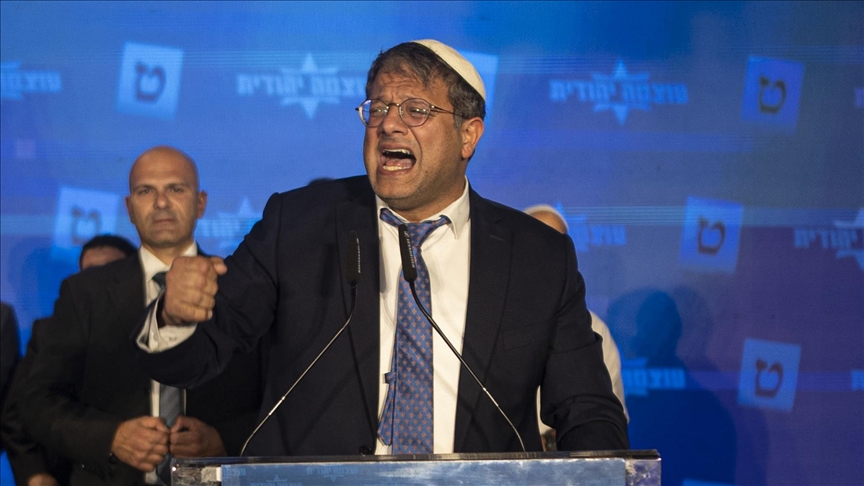
The Israeli minister behind the phrase « all Lebanon must burn » isItamar Ben GvirMinister of National Security and figure of the Israeli far right. His remarks came after the death of four Israeli soldiers in southern Lebanon and when Israeli strikes killed at least 18 Lebanese sides.
Israel’s threats took on a particularly brutal tone against Lebanon on Friday, 19 June, following the death of four Israeli soldiers in the South. Israeli Minister of National Security Itamar Ben Gvir, figure of the far right, wrote that « all Lebanon must burn », after an attack claimed by Hezbollah against an Israeli force near Ali Taher hill. On the same day, Israeli strikes resulted in at least 18 deaths and 33 injuries in Lebanon, according to the Lebanese Ministry of Health.
The sentence immediately resonated in Beirut as a threat against an entire country, not only an armed organization. She added to a series of statements by Israeli officials, including those of Israel’s Defense Minister Katz, who had already warned that the fire could « burn Hezbollah and all Lebanon ». In a Lebanon exhausted by displacement, destruction and political uncertainty, these words are seen as a sign of a strategy of pressure that goes beyond the strictly military field.
Ben Gvir’s statement after the death of four soldiers
The statement issued on Friday comes from Itamar Ben Gvir, Israeli Minister of National Security. Leader of the Jewish Force party, he belongs to the toughest wing of the government of Benyamin Netanyahu. His message, broadcast after the announcement of the death of four Israeli soldiers, is not just calling for a response against Hezbollah. It refers to Lebanon as a global target, with a formula intended to mark the minds.
According to the Israeli press and the French media, the four soldiers were killed in an attack on an Israeli tank or unit in the Ali Taher area, south of Nabatiyah. Hezbollah claimed to have conducted an ambush and destroyed several Merkava tanks using guided missiles. The Israeli army has confirmed the death of soldiers, without all operational details being immediately public.
Ben Gvir’s reaction occurs in an already flammable climate. For several weeks, Israel has maintained increased military pressure in southern Lebanon, despite ceasefire announcements and attempts to mediate. The Israeli authorities portray their operations as actions against Hezbollah’s capabilities. The Lebanese authorities, on the other hand, denounce attacks on villages, relief workers, infrastructure and areas where civilians still live.
In Lebanon, a growing human balance
On Friday, the Lebanese Ministry of Health announced at least 18 deaths and 33 injuries in Israeli strikes in southern Lebanon. The bombings involved several locations in the Nabatiyah area. News agencies reported that the intensity of the strikes had complicated relief and evacuation operations. In some areas, intervention teams had to wait until bombardments stopped to reach the wounded.
For southerners, this sequence is not an isolated episode. It is part of a war of wear and tear that has emptied villages, destroyed houses and cut off roads. Displaced families live between schools transformed into shelters, temporary housing and intermittent returns to communities still at risk. Daily life depends on the noise of drones, local alerts and new arrivals from hospitals.
The Lebanese authorities fear, above all, that the targeting of the entire territory will be trivialized. When Israeli officials threaten « all Lebanon », the message goes beyond confrontation with Hezbollah. It feeds the fear of a broader campaign against infrastructure, institutions and the population. In a country whose economy remains fragile, this prospect revives the memory of previous wars and the long unfinished reconstructions.
Threats to Lebanon: A Word of Punishment
Ben Gvir’s formula is part of a rhetoric already established within the Israeli executive. At the end of April, Defense Minister Israel Katz threatened Lebanon with a fire that could ignite its cedars. He had linked Hezbollah, its secretary general, Naïm Kassem, and the Lebanese government in a single warning. For Beirut, this assimilation is a central problem: it erases the distinction between an armed party, the State and civilians.
The vocabulary used is not trivial. To talk about a country that must burn is to make national space a symbolic target. In Lebanon, the cedar represents the collective identity. He’s on the flag. It embodies a fragile permanence in the midst of crises. Threatening him, even through a political formula, touches a deep register of national memory.
In chanceries, this may also complicate de-escalation efforts. A mediation involves the possibility of compromise, or at least restraint in the stated objectives. However, the idea of a Lebanon fully exposed to the Israeli response weakens Lebanese actors who advocate a diplomatic solution. It gives Hezbollah a powerful political argument: that of a country as a whole threatened by Israel.
Lebanese State caught in an unsustainable equation
Lebanon is faced with an old contradiction, but today it is more dangerous. On the one hand, part of the international community demands that the State alone exercise the monopoly on arms and the decision to war. On the other hand, Israel is conducting operations on Lebanese territory and claims to maintain its freedom of military action as long as Hezbollah remains armed.
This equation places Beirut in an almost impossible position. The Lebanese army does not have the military, financial and political means to quickly impose a new internal balance. The government remains weakened by years of economic crisis, institutional paralysis and popular distrust. At the same time, the continuation of the Israeli strikes further weakens the institutions supposed to embody sovereignty.
The debate on Hezbollah’s weapons exists in Lebanon. It strongly divides the political class and society. But the Israeli threats against the whole country are moving this debate. They allow the Shiite party to present its weapons as a response to an external threat, at a time when its internal opponents would like to discuss their integration or withdrawal within a national framework. Each threat of general destruction thus reduces the space for Lebanese debate.
Confusion between Hezbollah, State and Population
The Lebanese view focuses on this confusion. Israel claims to target Hezbollah, its fighters and infrastructure. But strikes also affect places of life, roads, agricultural land and sometimes emergency structures. Civil defence centres and medical personnel have already been affected since the outbreak of the conflict. For the inhabitants, the distinction displayed by Israel becomes difficult to perceive when the war reaches their home or neighbourhood.
This confusion has political consequences. It weakens those in Lebanon who seek to distinguish national sovereignty from Hezbollah’s military choices. It also feeds a sense of injustice in bombed areas, where civilians feel punished for decisions they do not control. Even in Hezbollah’s critical circles, the threat against « all Lebanon » is seen as an attack on the population.
The question of international humanitarian law then arose forcefully. The principles of distinction, proportionality and precaution oblige the parties to avoid treating a civilian territory as an automatic extension of a military objective. A minister can say that he speaks with emotion or anger. But when it belongs to the government, its words have an effect. They can be understood as a political authorization to strike wider.
First responders and internally displaced persons
In southern Lebanon, the first victims of this escalation are not political leaders. These are the inhabitants, the first aid workers and the displaced families. In Nabatiyah, civil defence teams have already worked in extremely dangerous conditions. Premises were damaged or destroyed. Rescue workers have been killed or injured since the beginning of the new phase of the conflict.
The displaced form another fracture line. Many have left border villages for months. Some come back briefly to collect papers, feed animals, check the condition of a house or see the damage. Others no longer have housing. In host cities, schools, relatives and local associations absorb a social crisis that adds to the economic crisis.
The threat of Lebanon « burning » then acts as an additional violence. It establishes the idea that the return is not only risky, but that the entire country could be dragged into a new wave of destruction. For a population already marked by the explosion of the port of Beirut, the banking collapse and previous wars, this vocabulary is not just a campaign provocation.
A border between ceasefire and open war
Friday also shows the ambiguity of the current military framework. The mediators refer to ceasefires, security arrangements and withdrawal mechanisms. On the ground, strikes and ambush continue. Israel claims to be responding to Hezbollah violations. Hezbollah claims to respond to the occupation, strikes and continued Israeli forces in Lebanon.
This creates a dangerous grey area. Lebanon is neither fully at peace nor formally engaged in a conventional war declared between States. However, the population is suffering from intense conflict. Roads are closing, relief is under threat, schools are interrupting their activities and hospitals are receiving the wounded. Diplomacy is running behind the field.
The United States and several international actors are seeking to preserve a framework for de-escalation. But the persistence of Israeli troops in certain areas of the South and the attacks by Hezbollah against these positions make any agreement fragile. Statements by Israeli officials such as Ben Gvir or Katz add political pressure to military pressure. They suggest that the response could expand if Israeli casualties increase.
The political weight of the Israeli far right
Itamar Ben Gvir is not Minister of Defence. He doesn’t run the army. But he holds an important position in the Israeli government and his political influence goes beyond his portfolio. His party is essential to the Benyamin Netanyahu coalition. His statements reflect the pressure exerted by the Israeli far right to harden the war on several fronts.
From the Lebanese point of view, this fact counts. It means that threats against Lebanon do not come solely from military officials or tense spokespersons. They also come from a political component that regularly advocates radical responses. This radicality weighs on Netanyahu’s margin of manoeuvre, especially when an attack by Hezbollah causes death in Israeli ranks.
Ben Gvir’s sentence can therefore be read as an internal political declaration, intended for an Israeli electorate traumatized by military casualties and in favour of a harsh response. But it has a regional effect. In Lebanon, it transforms an Israeli domestic policy message into a direct threat against civilians, cities and institutions.
Beirut seeks a diplomatic response
In response, the most expected Lebanese response remains diplomatic. Lebanon can call on the United Nations, Western capitals and Arab States to condemn threats against all its people. It can also document strikes, destructions and attacks on rescue workers in order to support possible international approaches.
This path remains difficult. Lebanon suffers from a loss of institutional credibility. Its leaders are often accused, within the country itself, of not having been able to protect the State or to reform institutions. But on the issue of threats against civilians, Beirut has a clear argument: no internal weakness justifies a foreign minister calling for the burning of an entire country.
The Lebanese government must also avoid letting Hezbollah monopolize the political response. While merely denouncing Israel without opening the debate on the sovereignty of military decision-making, it leaves intact one of the root causes of national vulnerability. If he does not strongly denounce Israeli threats, he gives the impression of abandoning the population of the South. The line is narrow, but it exists.
A country threatened beyond its divisions
Lebanon remains deeply divided on Hezbollah. Some see it as a resistance force against Israel. Others consider it a state in the state, which exposes the country to wars decided outside the national framework. Between these two readings, a common fatigue occurred. The Lebanese want to avoid further destruction, rebuild the affected areas and restore minimum stability.
Ben Gvir’s threat does not remove these divisions. She’s going through them. It recalls that when an Israeli official targets « all Lebanon », internal distinctions become less audible outside. Neighborhoods that have not chosen war can be struck. Families who criticize Hezbollah can be displaced. Public services already weakened can still deteriorate.
It is this point that dominates today the Lebanese reading of the sequence. The country cannot be reduced to Hezbollah. Nor can he deny that Hezbollah is weighing its sovereignty. But between these two observations, a rule remains: civilians must not become hostages to a language of fire. On Friday evening, the relief services continued their operations in the South, while the families of the victims waited for the identification of the bodies and the mediators were still trying to prevent an extension of the war.