

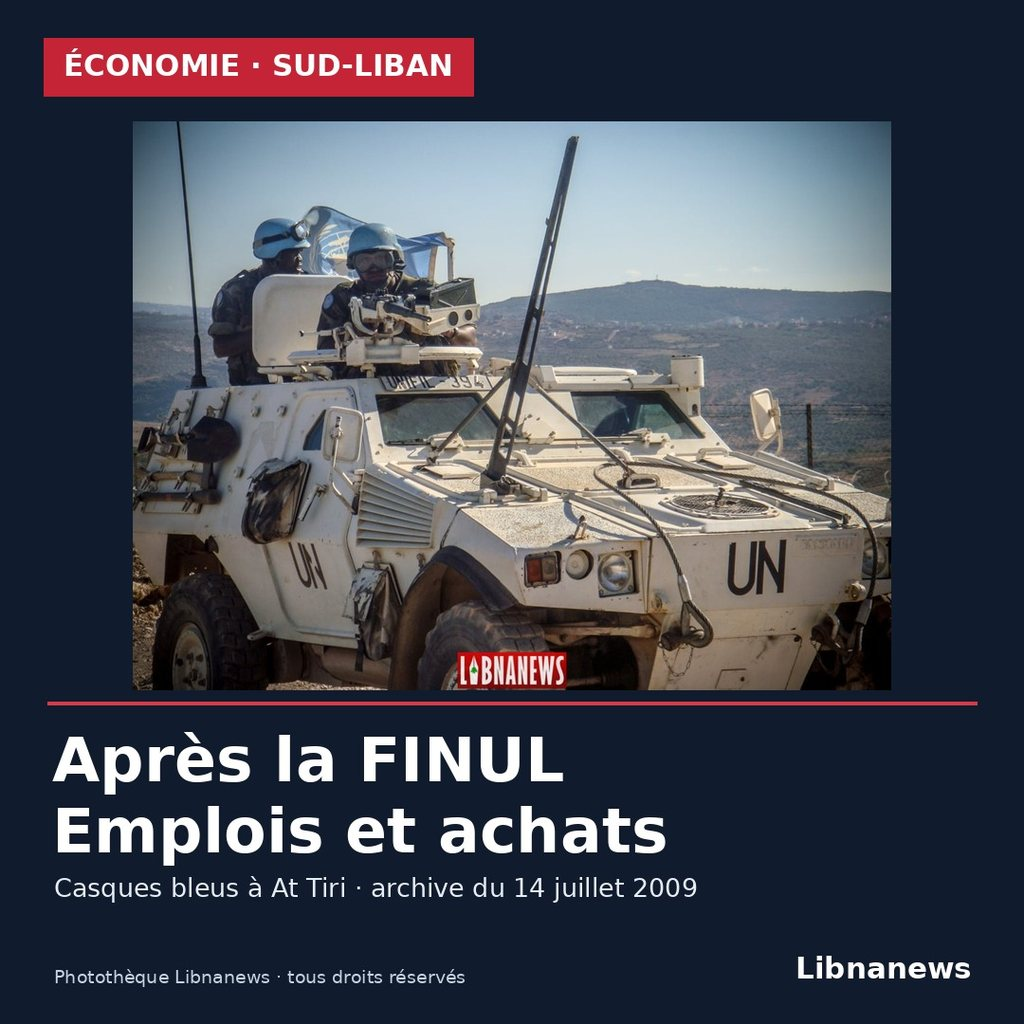
UNIFIL must cease operations at the end of December. The United Nations budget documents show what changes next: the number of national civilian posts must be reduced in stages and new procurements are already limited. However, the appropriations voted for the mission do not say how much money will remain in the villages of the South.
The United Nations Interim Force in Lebanon stated on 20 November that its operations would continue until the end of its mandate. It distinguishes the current staff rotations from the actual withdrawal, which it says should begin on 1 January 2027. Security Council resolution 2790 provides for a withdrawal within one year of the termination of operations. This schedule is not that of all contracts: the Mission budget already separates the months of activity and the first phase of departure.
A mission budget is not a budget for the South
For the period from 1 July 2026 to 30 June 2027, the General Assembly appropriated $446.43 million for the UNIFIL account. Of this total, $407.63 million relates to the maintenance of the Force. The balance includes contributions to the peace support account and two United Nations structures located in Brindisi, Italy, and in Entebbe, Uganda. Even the UNFICYP line includes costs that are not a recipe for municipalities or their businesses.
This distinction is important when assessing the effect of withdrawal. The salaries paid to an employee recruited in Lebanon, the invoice paid to a company by the mission and the purchases made by contingent members do not appear in the accounts in the same way. Neither the General Assembly vote nor the detailed draft budget give a breakdown of these common flows by commune. Therefore, the voted amount cannot be converted into a loss of income for the South.
Local posts maintained during the transition
The Secretary-General’s proposal provides for 415 national civilian posts for the period up to 31 December 2026, then 370 between January and June, and 307 at the end of June 2027. These figures add together National Professional Officers and National General Service staff; temporary assistance positions are covered by a separate line. The documents indicate that some posts proposed for abolition were already vacant. The difference between two columns in the table therefore does not correspond to a number of redundancies.
The Mission plans to retain staff to complete administrative and financial tasks, including closing contracts and final payments. The Budget Committee reported that 11 training courses were planned to help national staff prepare for the future, particularly in job search or job creation. There is no data in his report on how many employees will have found another job at the time of their departure.
Suppliers and villages do not depend on the same window
The Budget Committee indicated that the Mission had discontinued its discretionary procurement of equipment and supplies. Short-term essential needs remain to continue its activities and accompany the withdrawal. This does not mean that all local orders have come to an end: services may be needed to close installations even though the ordinary investment is shrinking. The report does not break down such commitments according to the nationality of the suppliers or the place where they exercise them.
Aid to municipalities follows another logic. The proposed budget provided $350,000 for quick-impact projects in 2026–27, compared with $1 million in the previous biennium. This is a proposed line, not the amount received by the municipalities or the value of all the quotas. On 17 November, UNIFIL reported increased humanitarian support, including medical, veterinary and school assistance. A mission can reinforce aid on an ad hoc basis while reducing its purchases: it is neither the same beneficiaries nor the same expenses.
The cost for a municipality is not only included in the list of equipment. In consultations conducted by the United Nations humanitarian coordinator, communes in the South described difficulties in paying their staff, operating their vehicles and providing fuel for water systems. In Saouaneh, the persons consulted described difficulties in financing the fuel needed to operate the wells. It is a need for operation, distinct from a repair or donation. In order to measure the post-FINUL period, future balance sheets will have to provide separate information on the actual posts occupied, the orders charged to local suppliers and the budgets for the sustainability of civilian services.





Comments