

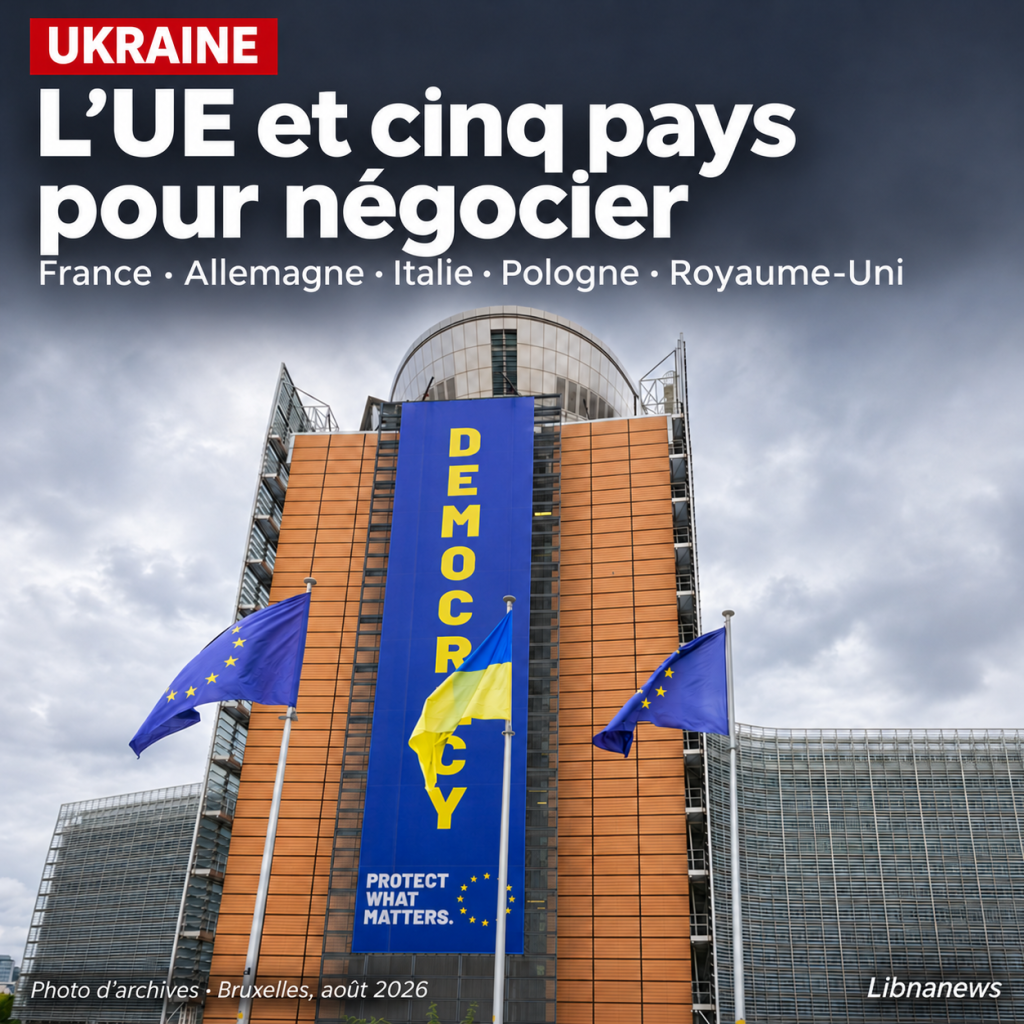
European leaders have agreed on the composition of their team for the peace negotiations in Ukraine. In Dublin, Friday 13 November 2026, António Costa announced a format bringing together the institutions of the European Union and five countries of the Coalition of Volunteers: France, Germany, Italy, Poland and the United Kingdom. The announcement specifies who should carry the European contribution, after the week’s discussions on wider participation in the talks.
The President of the European Council presents this organisation as an agreement between the leaders meeting in the Irish capital. It is not a peace agreement with Russia. No negotiating schedule or nominative list of negotiators shall accompany his statement.
A European team for negotiations on Ukraine
The announced format combines the EU institutions with five capitals, including London, outside the Union. The summit report states that this team must coordinate the European contribution to diplomatic efforts. It must work with all Member States to maintain a common position.
The role of this team is not to decide instead of Kyiv. Costa recalls that Ukraine remains the only legitimate country to resolve issues affecting its territory and sovereignty. It also distinguishes responsibility: the EU must intervene on the European future of the country, its reconstruction and prosperity. Security assurances must be discussed in the Coalition of Volunteers, in coordination with NATO.
From indirect participation to an identified format
The question of European representation was already going through the Dublin meetings. On Thursday 12 November, in front of the European Political Community, Volodymyr Zelensky described an incomplete situation: Europeans participated in the exchanges, but not directly at the meetings where the Russians were present. The Ukrainian president asked that they become regular participants.
Zelensky had also alerted his partners about the scope of discussions between Washington and Moscow. According to him, the exchanges on security guarantees went beyond Ukraine and involved a broader framework between Europe and Russia. He therefore called on the European capitals to follow the details of these negotiations, which were still awaited.
In another meeting held on Thursday, the Ukrainian President had brought together the advisers of the United Kingdom, Germany, France and Italy. The Commission and the European Council were represented. The participants had examined the recent exchanges between Brussels and Abu Dhabi, and then prepared the meeting with US envoys Steve Witkoff and Jared Kushner, after their visit to Russia.
This first coordination group was designated as the E4 by the Ukrainian Presidency. The format presented by Costa on Friday also includes Poland. The announcement thus brings a new institutional precision, beyond the principle of an increased European presence already mentioned the previous day.
Guarantees remain at the centre of discussions
On 10 November in Abu Dhabi, European, Ukrainian and American representatives had already worked on the conditions for lasting peace. Their joint statement stressed respect for sovereignty, territorial integrity and freedom of decision-making, as well as credible guarantees for Ukraine.
The discussions also focused on post-war European security, risk management and ways to avoid dangerous escalation. Participants reaffirmed the central role of a strong NATO for Euro-Atlantic collective defence. They announced further coordination for broader multilateral discussions including European partners.
In Dublin on Friday, Costa maintained a cautious appreciation of the prospects for peace. He believes that the next few weeks will enable the Russian will to end the war to be assessed. He accuses Moscow of continuing the strikes against Ukrainian civilians.
According to him, financial and military assistance remains the immediate priority. European leaders must examine Ukraine’s funding needs for 2027 and beyond 26 and 27 November, on the basis of proposals expected from the Commission.
Cover: European and Ukrainian flags in front of Berlaymont, Brussels, 21 August 2026. Photo archive, separate from the Dublin summit. Xavier Lejeune / European Commission, © European Union, 2026, CC BY 4.0 (https://creativecommons.org/licenses/by/4.0/). Boxing and typographical dressing assisted by IA.





Comments