

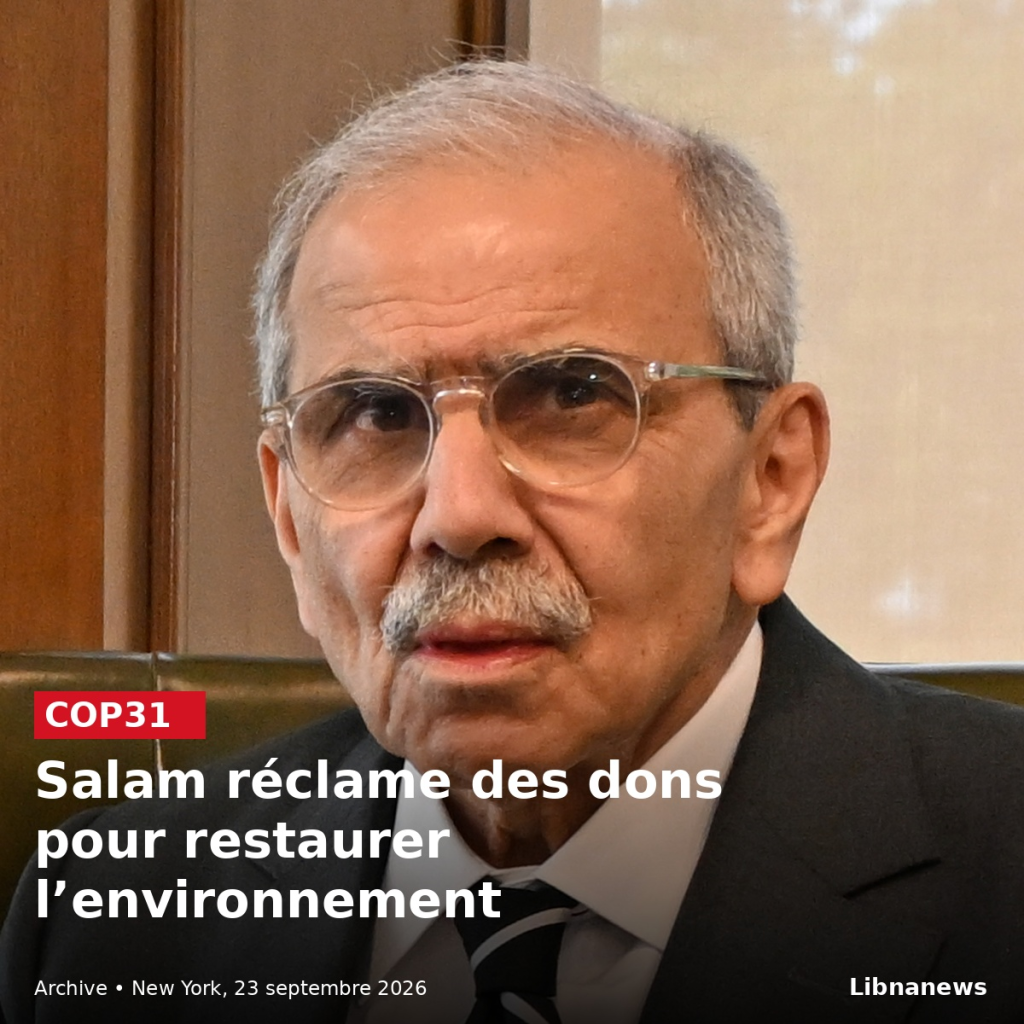
The reconstruction of Lebanon must also repair land and ecosystems. In Antalya, on 12 November, Nawaf Salam presented this request to the COP31 Leaders’ Summit. The Prime Minister called for more public funding and donations, as well as simplified access to international mechanisms for countries weakened by wars and crises.
Its intervention goes beyond road and housing rehabilitation. It places the restoration of agricultural land, forests and livelihoods at the same site. Salam stressed that the financial crisis had weakened public institutions and services, while successive conflicts had destroyed infrastructure and natural environments.
$512 million: a balance sheet of 2023-2024
The Head of Government mentioned environmental damage in excess of $512 million for the years 2023 and 2024, plus the damage of 2026. He did not give an amount for the last year in the elements of his speech made public. The $512 million is therefore not an estimate of the environmental cost of the 2026 war.
A World Bank evaluation published in March 2025 makes this figure clear. For the environment and debris management sector, $512 million in damage, 790 million in loss and 444 million in recovery needs. These categories are not interchangeable: damage measures destruction, loss of impact on activities and services, and the cost of interventions.
This assessment covers the conflict from 8 October 2023 to 20 December 2024, not subsequent destruction. It was carried out at the request of the Lebanese Government with the technical support of the National Council for Scientific Research and covered ten sectors. The total reconstruction and rehabilitation needs were estimated at $11 billion.
Restoring the functions of natural environments
The environmental aspect of the report is not limited to replacing trees. It includes improvements in soil and water conditions, erosion control and invasive species, and habitat restoration. The challenge is to restore useful functions for the inhabitants: water quality, soil fertility and soil protection.
At COP31, Salam called for environmental recovery and adaptation to climate change to be integrated into reconstruction, along with the restoration of stability and sovereignty. He also denounced Israeli environmental violations as violations of international humanitarian law. This qualification falls within the position expressed by the Prime Minister.
Mechanisms exist, donations still to be mobilized
Funding for reconstruction already has a separate framework for this diplomatic appeal. In its presentation of the LEAP programme published on February 17, 2026, the World Bank described an extensible package of $1 billion, launched with an initial loan of $250 million approved in June 2025. This framework may receive additional funding in the form of loans or grants. This is not a new envelope announced in Antalya.
The programme includes organized management of rubble: transport to treatment centres, sorting, recovery of reusable concrete and steel, and safe disposal of unusable or hazardous waste. The Council for Development and Reconstruction ensures its implementation, while the Ministry of Environment oversees the debris component and environmental requirements.
Salam’s request therefore relates to additional resources and the conditions under which they can be met. His speech is not worth a donor’s donation or a donor’s commitment. However, it places a specific objective in international discussions: to finance the restoration of lands and ecosystems, not just the reconstruction of buildings.





Comments