

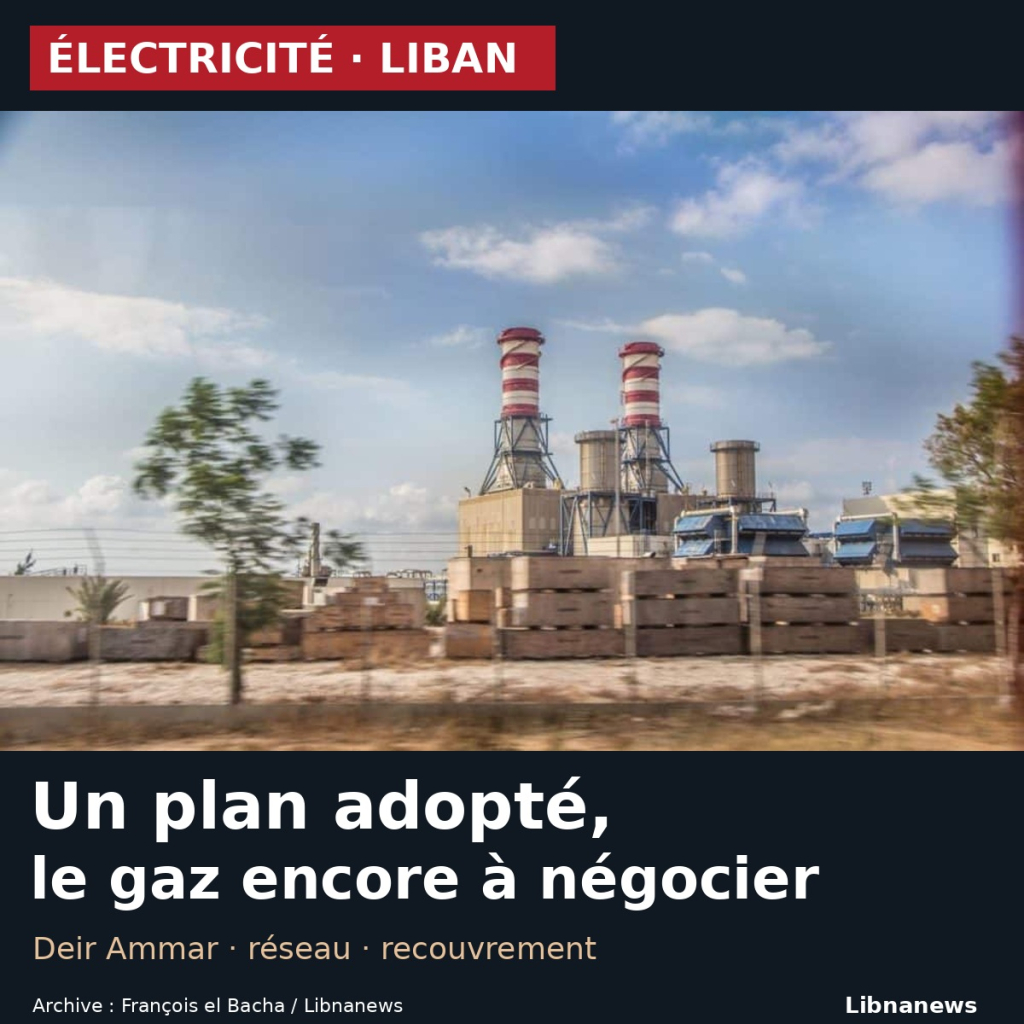
The Lebanese government approved its electricity plan on 13 November, while continuing discussions with Qatar. At the end of the Council of Ministers, Adel Nassar announced this decision. Joe Saddi said that no final agreement with the Qatari side was yet announced. On the same day, the law opening 8,950 billion pounds for public unpaid payments to Electricity of Lebanon was published in the Official Gazette.
These two decisions address different problems. The plan covers fuels, production, networks and recovery. The budget appropriation is used to pay some of the invoices already accumulated by public administrations and institutions. It does not constitute an envelope for the construction of the announced power plants.
Electricity: Gas in the centre of the approved plan
Paul Morcos, Minister of Information, presented the guidelines adopted after the meeting. He stressed an integrated approach: natural gas supply, production, transportation, distribution and collection of invoices. The announcement is therefore not limited to the addition of electrical capacity.
In the short term, the government wants to deliver natural gas through the Arab gas pipeline to the Deir Ammar power plant. The Minister described the switch from diesel to natural gas as a means of significantly reducing the cost of production. However, it did not provide purchase prices, savings per kilowatthour, or delivery dates.
This presentation sets an industrial orientation. It does not prove that supplies are contractually secured or that the plant is already operating with that fuel. In order to measure the effect on costs, it will be necessary to know the conditions for the purchase and transport of gas and then the actual operating modalities.
Paul Morcos also mentioned the import of liquefied natural gas to feed Deir Ammar, Zahrani and Zuk. Pipeline gas and LNG are two separate supply routes. The report does not detail their technical articulation, the necessary infrastructure or the corresponding financial commitments.
A target of 3,000 to 3,500 megawatts
The Minister has set production ambition at at least 3,000 to 3,500 megawatts in the coming years. He said most of this capacity should come from renewable energies. No annual timetable or specific sharing between technologies has been made public in these statements.
It is a power objective, not an already available production. Megawatts describe a capacity; they do not alone give the volume of electricity actually delivered to subscribers. The advertisement therefore does not allow to deduct an additional number of hours of current per day.
The transport network is also included in the programme. Paul Morcos stressed the need to redevelop and invest in it. It must be able to absorb electricity from new plants and renewable projects and then move it to safe places of consumption.
On the distribution and collection of invoices, the government is working on private participation through network operators. The Minister has attached this approach to the framework adopted by the Sector Regulatory Authority. The statements consulted do not designate a chosen operator and do not present an awarded contract.
Qatar: negotiations, not yet an agreement
Energy Minister Joe Saddi reported progress with the Qatari side. He nevertheless clarified that several points remained under discussion. It intends to announce the agreement when it is concluded, without revealing the details of the ongoing exchanges.
Paul Morcos, for his part, indicated that negotiations would continue to examine the possibility of accelerating the construction of power plants in Deir Ammar. Approval of the plan and further discussion are therefore established. A final Qatari commitment, its amount and schedule are not included in the available announcements.
The Minister of Energy also announced the inclusion of variable pricing on the next week’s agenda. According to him, it would need three months after its adoption to produce its effects. This deadline remains conditional: it does not begin with its declaration of 13 November.
Regarding the Palestinian camps, Joe Saddi said he agreed with the Chairman of the Lebanese-Palestinian Dialogue Committee on the need to propose a solution within two months. The announced objective is the payment of the sums due for electricity. No settlement formula or division of responsibilities was detailed.
The Public Unpaid Act comes into force
The financial case has taken a separate legal step. The supplement to issue 49 of the Official Journal, dated 13 November 2026, publishes Act No. 72. Its first article opens an additional appropriation of £8,950 billion in the reserve of the general budget of 2026.
The text reserves this sum for the payment of part of EDL’s accumulated claims on public administrations and institutions. It prohibits the use of credit for another purpose. Expenditure remains subject to legal rules, including those on public accounting.
The law provides that the appropriations committed, liquidated, ordered and paid are recorded in the relevant accounts of 2026. It also authorizes, on an exceptional basis and for one time only, the deferral of the credit and amounts transferred, whether committed or not. Article 3 of the Act lays down that it shall enter into force as soon as it is published.
This publication extends the parliamentary vote on 12 November. It does not demonstrate that the funds have already been disbursed to EDL. The credit has yet to be translated into payment transactions in accordance with its purpose; it does not automatically settle all public debts.
The next steps announced are the Qatari negotiations, the review of variable pricing and the implementation of the budgetary appropriation. The dates of delivery of gas, construction contracts and the amounts actually received by EDL remain to be specified.





Comments