


Sending money to your family is not just about the price on a counter or app. A low fee can be offset by a less favourable exchange rate. A quick service may also impose an impractical mode of withdrawal. For a household in Lebanon and its relative living abroad, the useful comparison is two amounts: what the sender pays in total and what the recipient can actually use.
This distinction avoids confusing the volume of transfers received by the country with the price paid for each transaction. It alone does not make it possible to designate a cheaper operator: the result depends on the country of departure, the currencies, the financing and the withdrawal. No individual rate presented here is a commercial estimate.
A commission is not the full cost
In its updated guide on October 29, 2026, the Financial Consumer Agency of Canada distinguishes between transfer fees, exchange rates and any levies at receipt. It recalls that an offer without commission can apply a less advantageous exchange. Amount, method of payment and speed also change the price. Payment by credit card may involve the costs and interest of an advance of funds.
It is therefore necessary to look at the entire course, not to add percentages of a different nature. A fixed commission is an amount; a foreign exchange margin translates into less currency received for the same amount converted. Any withdrawal costs are still incurred elsewhere. When both sides of the transaction remain in dollars, the comparison can be done without conversion, but not the control of commissions and the amount actually paid.
Why « zero fee » can cost more
Let us take a purely pedagogical example, with fictitious rates, unrelated to the courses of 13 November or with an offer available. One person has a total budget of EUR 200. Service A collects 5 euros from this budget and converts the remaining 195 euros to 1.10 dollars per euro. Service B does not charge any commission but converts the 200 euros to $1.06. It is assumed, only to isolate the mechanism, that no fees are charged upon arrival.
| Fictitious example | Service A | Service B |
|---|---|---|
| Total budget | 200 € | 200 € |
| Commission deducted | 5 € | 0 € |
| Converted sum | 195 € | 200 € |
| Fictitious rate, dollars per euro | 1.10 | 1.06 |
| Amount received, without other charges | $214.50 | $212 |
In spite of his commission, A pays an extra $2.50. The difference does not prove anything about market rates: it shows why the « free » promise is not enough to classify two services. If a commission were added to the budget rather than deducted, the calculation would have to be repeated with an identical total expenditure. Compare 200 euros excluding costs to 200 euros all inclusive would immediately distort the result.
What historical comparisons show
World Bank Report No. 54 on Remittance Prices compares the global average cost of a $200 transfer in the third quarter: 6.30 per cent in 2022, 6.18% in 2023, 6.62% in 2024 and 6.36% in 2025. These are the same quarters, no annual averages, and no November 2026 tariffs.
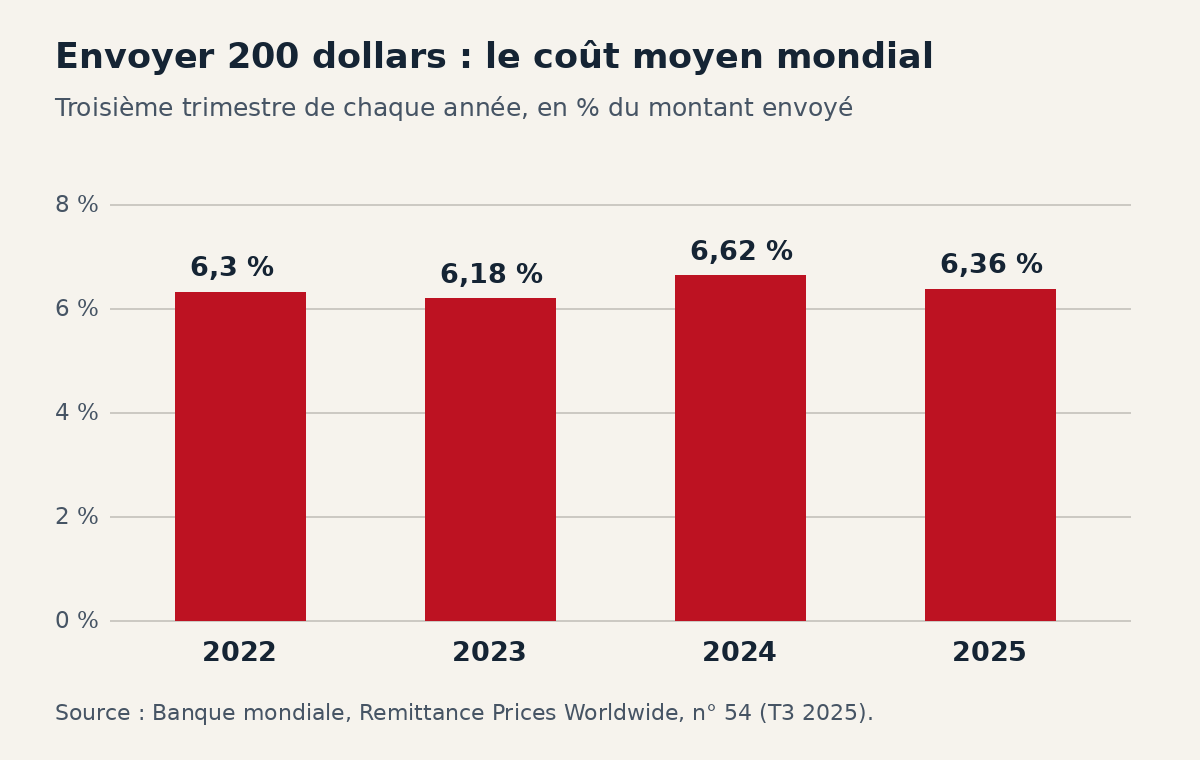
These percentages, applied at $200, amount to $12.60, 12.36, 13.24 and $12.72, respectively. Between the third quarters of 2024 and 2025, the decline is therefore 0.26 percentage points, or 52 cents for this reference amount. The trajectory is not a continuous decline.
For Lebanon, the OECD 2025 report on regional integration in the Union for the Mediterranean has an average cost of US$200 of 6.9% in 2019 compared to 5.2% in 2023, based on World Bank data. This represents, by simple conversion, $13.80 and $10.40. This ancient comparison does not say how much would cost a precise transfer today from Paris, Montreal or Dubai. It should not be connected to the world series as if it were the same market.
From the United States, a tax related to financing
A change that came into effect on January 1, 2026 deserves special verification for shippers in the United States. Section 4475 of the Tax Code provides for a tax of 1 % on the transfers concerned financed in cash, by money order, bank cheque or similar physical instrument. The supplier collects it from the sender. Transfers financed from an account to an institution meeting the legal conditions, or by debit or credit card issued in the United States, benefit from the exceptions provided for in the text.
It is therefore not a uniform tax on all shipments from the United States. On a taxable basis of $200, 1% is $2, to be distinguished from the operator’s commission. However, the choice of a card does not guarantee a lower cost: its own fees can cancel the tax economy. You have to compare the full estimate, not just try to delete a line.
Also compare access to money
The U.S. Office of Consumer Financial Protection recommends checking fees, taxes, currency exchange and the amount expected upon arrival before paying. He explained that some foreign levies could reduce the amount received. The protections and reporting obligations referred to by this authority concern its American framework: they are not automatically applicable to all providers in Lebanon.
For the recipient, an amount announced does not have the same utility depending on whether it is available in cash near the recipient’s home or in an account to which the recipient must otherwise access. A paid trip can absorb a small commission economy. This expense does not necessarily appear in the transfer tariff; However, it is part of the family budget. The conditions for withdrawal and the supporting documentation must therefore be verified before dispatch.
Another simple calculation sheds light on small amounts: a fixed fee of $5 represents 5% of a $100 shipment, but 1% of a $500 shipment. This explains a large effect, without justifying delaying an urgent expense or exceeding the legal limits of a service. For an invoice due tomorrow, the delay can count more than a few dollars saved.
The right estimate holds in a few questions
Before confirming, ask for the total debited, the currency and the net amount received, the time at which the rate is fixed, any fees on arrival and the availability date allow comparison of transactions actually equivalent. In particular, the Canadian guide focuses on whether the rate is stopped at shipment or withdrawal. It also recommends that the receipt and transaction number be retained.
A photograph of these conditions at the time of payment is more useful than a general advertisement. For regular family support, the correct unit of comparison remains the amount usable in Lebanon for a given total expenditure, at the necessary time. This calculation does not address access gaps or regulatory constraints. It simply prevents taking the visible commission for the whole price.





Comments