

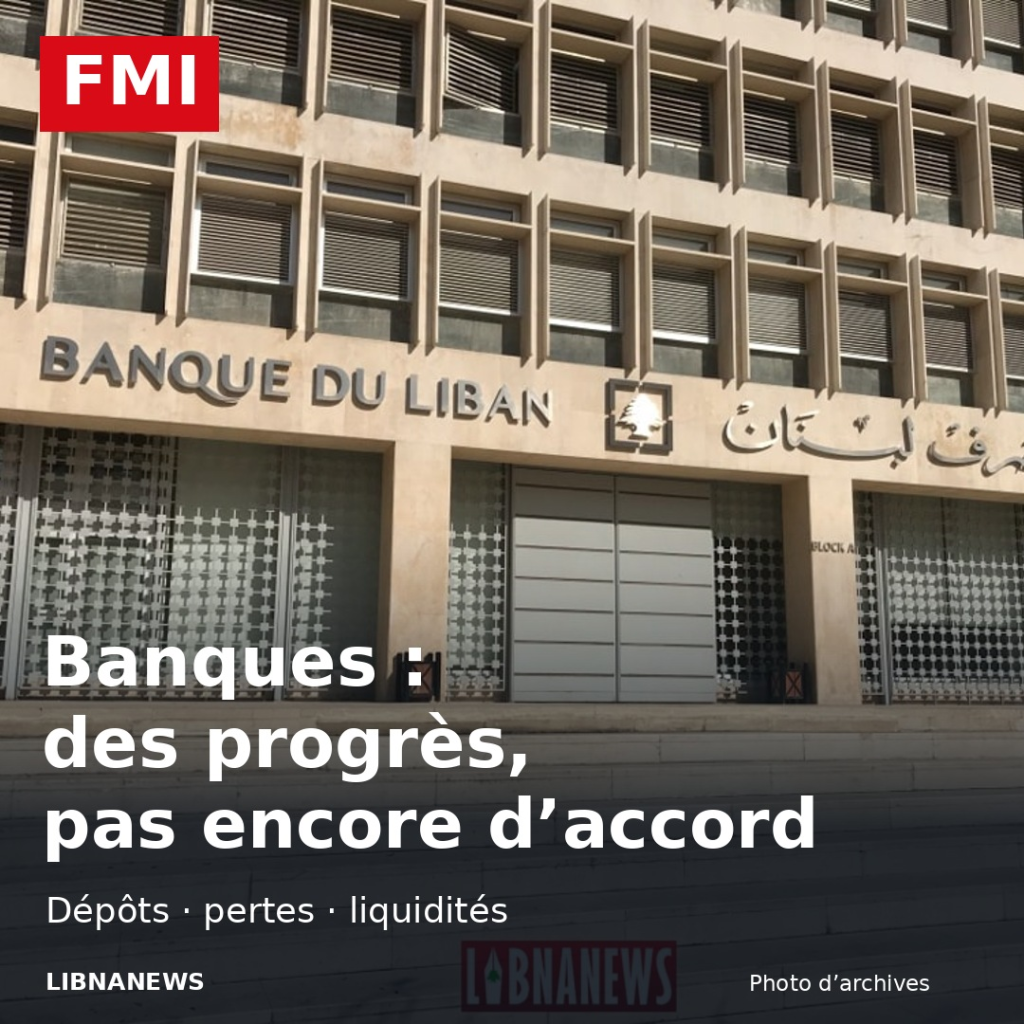
The IMF noted progress, but not yet agreed on bank restructuring in Lebanon. In his closing statement of 13 November 2026, the team led by Ernesto Ramirez Rigo specified the remaining points. It calls for the application of the bank resolution law in all cases, repayments compatible with available resources and respect for the hierarchy of claims. Discussions should continue in the coming weeks.
The mission took place in Beirut from 10 to 13 November. It extends the exchanges initiated after the September visit between the Lebanese authorities and the International Monetary Fund. Their central purpose remains the restructuring strategy of banks and the draft law on financial stabilization and deposit recovery, designated by the English acronym FSDR.
IMF and Lebanese banks: agreement still to be built
The balance sheet published on Friday distinguishes two levels of advancement. The discussions helped to clarify the approaches envisaged by the Government and the Bank of Lebanon. This work constitutes the progress expressly recognized by the mission. However, it is not worth approving a definitive strategy.
Ernesto Ramirez Rigo states that further work is still needed to achieve effective and sustainable restructuring. The aim is to create a strong and resilient banking sector. The communiqué therefore does not present a technical agreement or an approved funding programme.
This clarification comes after the hopes expressed by Yassine Jaber at the opening of the negotiations. On November 10, the Minister of Finance wanted an agreement in principle before the end of the week. The IMF declaration now allows us to measure the results recognized by our own teams: better explained positions, with several essential choices still to be made.
The mission does not set a new deadline. It announces the continuation of engagement with the authorities in the coming weeks. This formulation keeps the negotiation process open, without ensuring its completion at a specified time.
Bank resolution should apply in all cases
The first point put forward concerns the law on banking resolution, called BRL in the press release. The Fund requests its application in all cases. It considers that this framework is essential for the resolution and liquidation of banks under transparent and predictable rules.
The resolution refers to the organised treatment of the difficulties of a bank. The liquidation corresponds to the cessation of its activities under a regulated procedure. However, the press release does not announce any decision concerning a named bank. It lays down a general requirement for the strategy that remains to be agreed.
This insistence concerns the enforcement of the legal framework, not only its existence. In September, IMF services welcomed the amendments to the Bank Resolution Act. They considered them to be an important step towards a system consistent with international good practice. The November 13 message now calls for this framework to apply effectively, without excluding certain cases from the process.
The Fund articulates this law with the FSDR project, still before Parliament according to its statement. It considers their complementary implementation essential for the restoration of financial stability and maximum recovery of deposits. For the second text, this implementation remains conditional upon its adoption.
Pay more, but with what cash?
The second project concerns the criteria for reimbursement. Discussions still need to determine how to maximize the returns to depositors. The IMF sets out several simultaneous constraints: the liquidity of the Bank of Lebanon, the liquidity of the banking sector, the sustainability of the public debt and the restoration of the central bank’s solvency.
These concepts cover different problems. Liquidity corresponds to the resources available to make payments. Solvency concerns the ability to cover liabilities. A repayment strategy must therefore examine not only what can be paid immediately, but also the financial balance that will allow for continued payments.
Public debt adds another limit. The Fund calls for the banking solution to remain compatible with a sustainable debt path. However, the communiqué does not specify the contribution of the State or the resources to be mobilized. It also does not rule out the modalities of any public support.
For applicants, this step does not create an individual schedule. The text does not set a ceiling for reimbursement, a percentage of recovery or a period of payment. Maximizing deposit recovery is a negotiating objective. This is not an announced guarantee of full and immediate restitution.
The loss hierarchy remains a central requirement
The third point concerns the distribution of losses. The IMF considers it essential that the FSDR project respect the debt hierarchy. It explicitly links this requirement to the maximum protection of applicants.
The principle had been clarified during the September mission: depositors must not absorb losses before shareholders and subordinate creditors. The latter hold claims placed behind others in the order of repayment. The requirement therefore relates to the order in which the losses are incurred, and not only the total amount to be distributed.
The November communiqué does not provide a numerical breakdown between the parties. It does not further detail the categories of deposits or their future treatment. However, it confirms that compliance with this hierarchy remains a criterion for compliance with international standards.
The two issues remain interrelated without confusion. Determining who bears the losses allows the allocation of financial responsibilities. Determining what resources are available makes it possible to organize repayments. The Mission’s assessment shows that discussions on these two areas still need to progress.
A technical statement, not a financing decision
IMF clarifies the institutional scope of the document. The findings of a mission represent preliminary assessments of its services. They do not necessarily correspond to the positions of its Board of Directors. This visit will not give rise to any discussion before this council.
No loan amount or disbursement schedule is included in the return. The team reaffirms its commitment to support Lebanon in the design and implementation of a comprehensive reform programme. This support is part of the Fund’s policies and mandate.
Future discussions will therefore need to clarify the criteria for restitution, the application of the resolution framework and the place of different claims in the absorption of losses. The FSDR project remains before Parliament; technical exchanges with the authorities should continue in the coming weeks.





Comments