

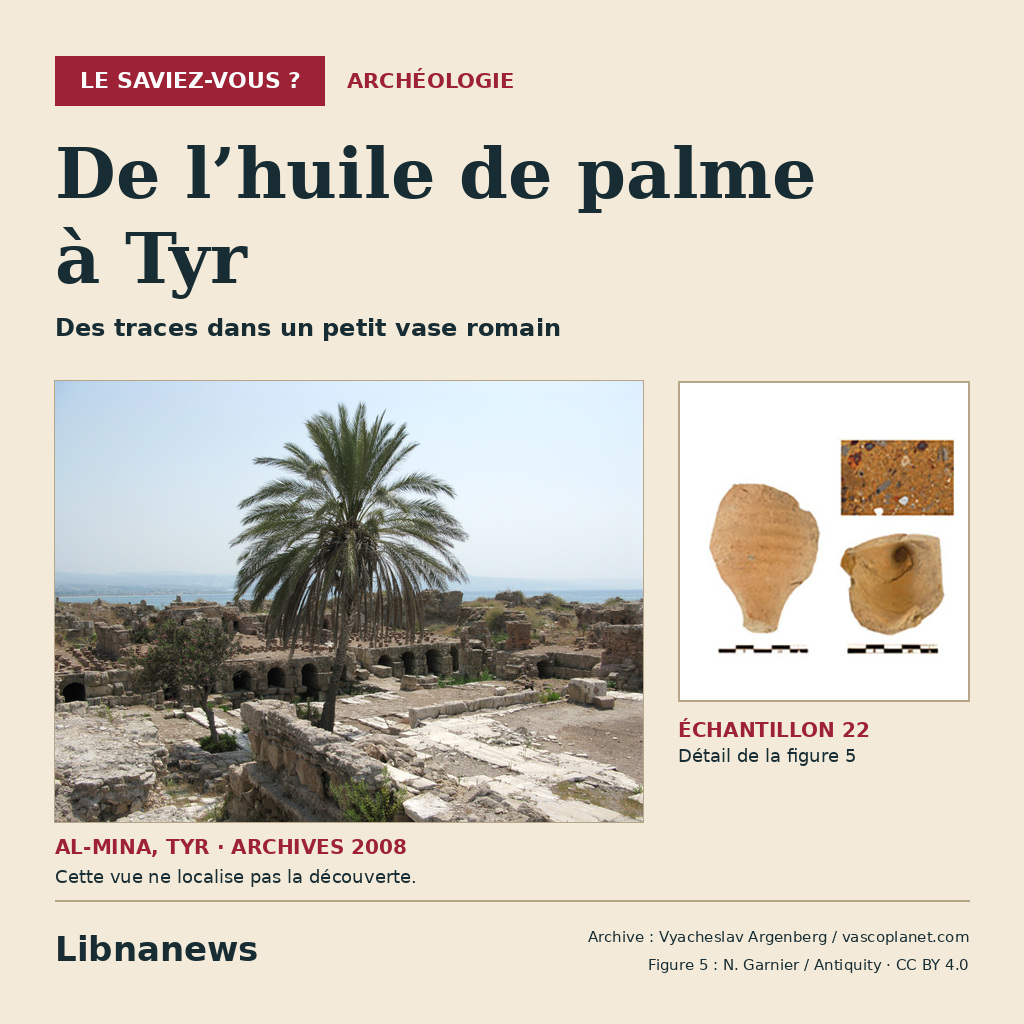
Did you know that? A small amphora from the early Roman era, found in Tyre, gave traces that the researchers attribute to palm oil. The result comes from a study published in November 2025, which covers fifteen ancient containers associated with the production of Tyre. It does not reveal a forgotten recipe or a precise trade route. It shows that a vase often placed among perfume bottles could have contained anything else.
Palm oil in a Tyrus amphora
In the study, the fragment is numbered 22. It comes from the acropolis of Tyre, in a context that archaeologists associate with religious activities. They identify as a amphorisk, a miniature amphora with two handles. Unlike several intact objects examined in the project, this fragment does not establish the capacity of its container.
In this sample, the researchers reported a combination of markers that they attribute to oilElaeis guineensisThe African oil palm. They also detected conifer pitch and evidence compatible with fermented fruit. These are traces of different materials, not evidence that they were poured together. The pitch, for example, could be used to waterproof the wall. Substances absorbed by terracotta can also come from several uses.
The authors see oil as an import index from an area where this palm grows. The result does not identify the place of production of this oil, the succession of intermediaries, or the path to Tyre. It also does not make it clear whether the inhabitants had access to it. It’s an observation on a container, not an inventory of the cargo of the city’s ships.
Fifteen containers, two forms, several contents
The team compared eleven elongated vials, called ungentaria, and four small amphores with two handles. The rooms date from the third century B.C.E. to the second century C.E. Not all of them come from the city of Tyre. The corpus also includes finds of Saida, Chhim, Nea Paphos in Cyprus, and Olbia on the Black Sea. The study is interested in the productions of Tyre and its surroundings, not a single workshop. Some pieces come from burials, other religious spaces or places related to trade and manufacturing.
This choice makes it possible to compare similar vases without necessarily serving the same purpose. In Borj, in a funeral setting in Tyre, one of the small bottles delivered markers of flowering plants. Researchers see it as an aromatic or medicinal trail, without identifying a specific fragrance. In Chhim, a small amphora showed other combinations of plant residues, fruit and pitch. The acropolis vase is distinguished by its palm oil markers, not by a form that alone betrays this content.
What a terracotta wall can keep
Organic compounds can remain in the pores of ceramics while the content has disappeared. To find them, the team collected material from the inner walls. She analyzed the recovered compounds, then looked for sets of markers rather than a single signal. This method helps distinguish an oil, resin or product from grapes. It does not always establish whether it was wine, vinegar or a preparation where the fruit interacted with other ingredients.
The corpus remains too small and too varied to give a unique function to each type of vase. The four pieces of Nea Paphos did not deliver a significant lipid signal with the analysis used on them. This is not enough to say that they were empty in ancient times: the preservation of materials and the method of sampling can explain the result. For the little amphora of Tyre, the trace retained is rather surprising without making him say more: an oil from a palm that is not associated with local crops had left its mark in a terracotta vase.





Comments