

The World Bank had disbursed $4.41 million as at 31 October out of its 250 million emergency loan to Lebanon. The statement published on 20 November places the last draw of the month to 21 October. This balance sheet measures the money out of the loan on that date, not the value of the contracts launched or the progress of the yards.
The line for loan IBRD98410 shows a disbursement of $4,410,785.94 and an undrawn balance of $245,589,214.06. The first amount represents 1.76% of the approved amount. The statement does not indicate what expenses each draw was used for. Nor should the balance be read as money already available to entrepreneurs: the loan remains to be mobilised, according to its disbursement rules.
The loan became effective eight months after its approval
The World Bank register dates three stages. The institution approved the financing on 24 June 2025 and the loan was signed on 25 August. It takes effect on 26 February 2026. The schedule shows why the approval date cannot be used as an automatic starting point for all contracts. It precedes signature and then the time when funding becomes effective.
The emergency assistance programme, known as LEAP, covers the restoration of public services and the repair of infrastructure. The Council for Development and Reconstruction shall ensure its implementation. The World Bank has designed to accommodate additional financing: the framework can reach $1 billion if additional resources are found. The statement of 31 October only concerns the loan of 250 million. It does not count the needs of the country or the contributions of other programmes.
Internet, schools and hospital: markets at different stages
The procurement plan revised on 15 November provides a further reading of implementation. For Ogero, the provision of 30,000 fixed wireless access devices is included in an ongoing procedure. The national opinion, as amended, set for 2 November the opening of tenders. The national sheet consulted did not provide a date of signature or delivery. The quantity therefore refers to the subject of the call for tenders, not to devices that have arrived at subscribers.
The same document lists lots to rehabilitate public schools that have served as shelters. It also provides for two separate purchases for Rafic Hariri University Hospital: magnetic resonance imaging equipment and radiotherapy equipment. The plan classifies these two procedures as ongoing, with no actual contractual amount indicated in the table consulted. An estimate entered before the award is not the final price to be paid; The absence of a signed prize in the plan also does not prove that no expenditure has been incurred since its publication.
Several operations also concern water systems. In a pilot area in the South, the plan identifies a procedure for restoring water services and combines an estimate of $2 million. This amount cannot be added to the $4.41 million disbursed: it measures the value of a transaction, not a payment. The documents consulted do not allow a drawing to be associated with a particular school, hospital or network.
October figure does not offset November implementation
In particular, Anna Bjerde’s visit to Lebanon, announced on 16 November by the World Bank, was to help speed up projects already funded. The loan statement is more recent than this visit by its date of update, but prior to its period: it stops on 31 October. It therefore does not measure the effects of such exchanges. This will require the reconciliation of future statements of award notices, contracts signed and works or equipment received.
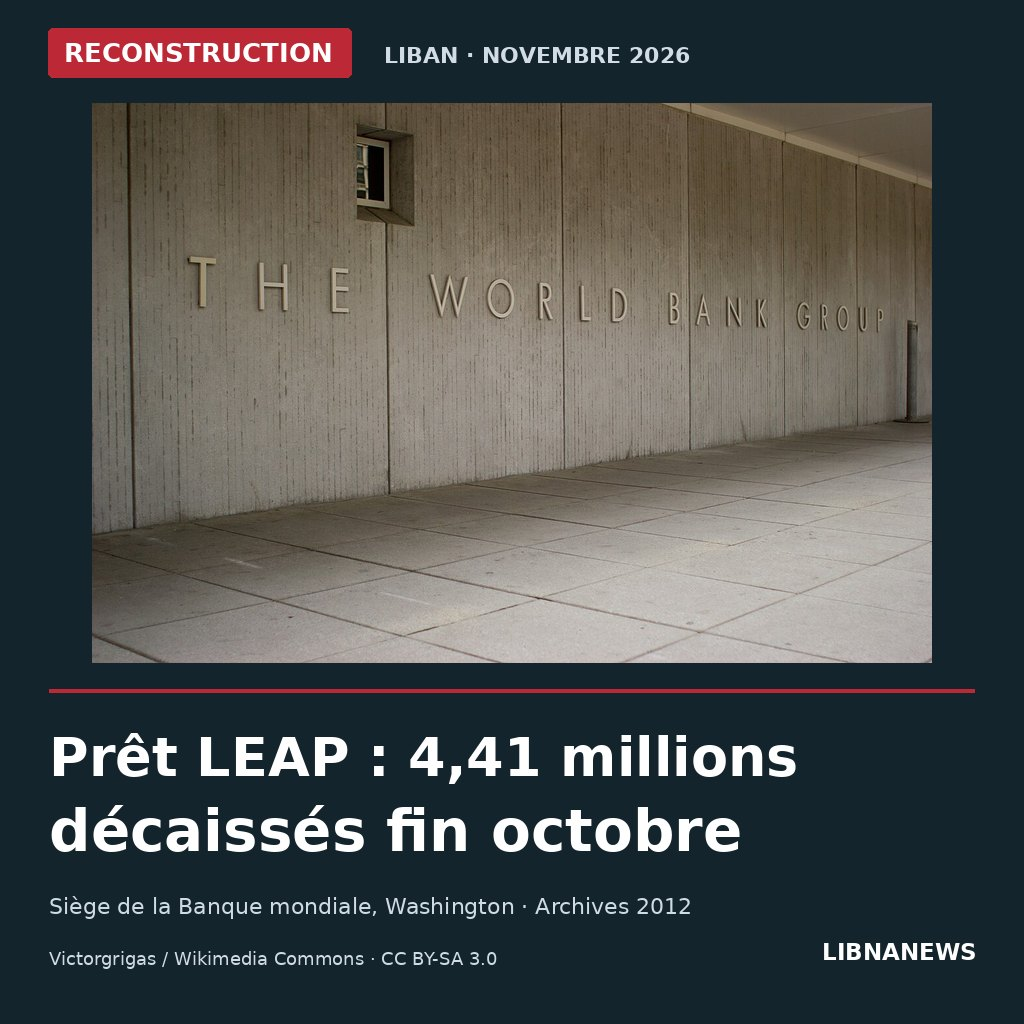
Sign of the World Bank Group headquarters in Washington, D.C., photograph of 16 May 2012. Institutional illustration, without representation of a construction site in Lebanon. Photo: Victorgrigas / Wikimedia Commons, CC BY-SA 3.0. Resized whole photo, Libnanews dressing under the same license.






Comments