

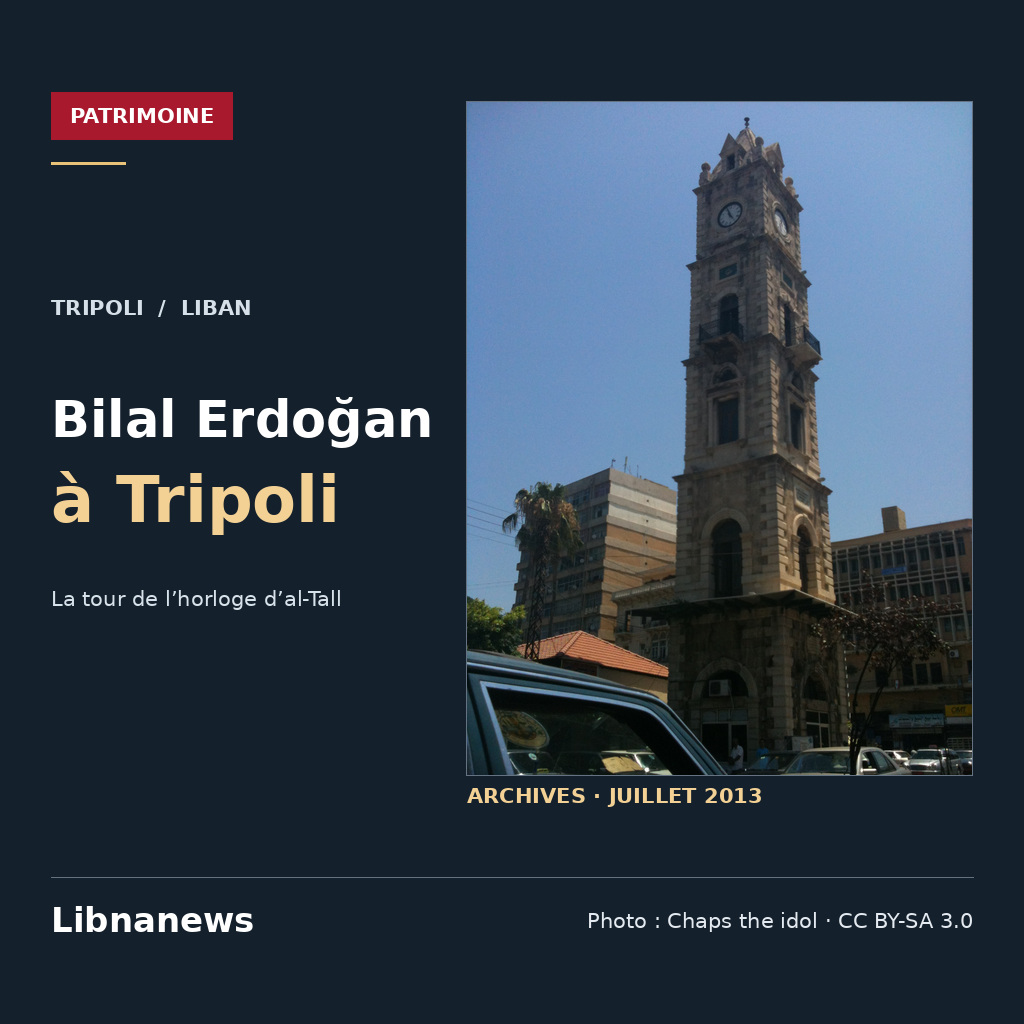
Return to the visit from 12 to 14 November 2026.In Tripoli, Bilal Erdoğan met Salma al-Sibai, descendant of Sultan Abdülhamid II, and visited two restored buildings with the support of Turkey. The stage of 13 November gave a face to the cultural relations that the son of the Turkish President came to discuss with the Lebanese authorities.
In Tripoli, Bilal Erdoğan meets Salma al-Sibai
On Friday, 13 November, Bilal Erdoğan visited Salma al-Sibai (سلمю السباعي), who lives in Tripoli, northern Lebanon. It descended to the fourth generation of Ottoman Sultan Abdülhamid II, who ruled from 1876 to 1909. The meeting preceded, according to an on-site report, a stop at the clock tower of al-Tall Square, which bears the name of the Sultan.
Salma al-Sibai had already told a family story in Tripoli in 2015, which is not a mere memory of the palace. She mentioned the difficulties of the members of the dynasty who went into exile after 1924. His family remembered relatives who had earned their living in Paris as taxi drivers or portefaix. She also kept a wedding gift from a granddaughter of the Sultan. These memories illuminate the meaning of the encounter: in Tripoli, Ottoman memory is read in buildings, but is also transmitted to families whose trajectories pass through several countries.
A restored clock and a former convent became a cultural centre
In al-Tall Square, the Hamidiye Tower is a concrete example of heritage cooperation. The Ottoman authorities had offered in Tripoli to mark the twenty-fifth anniversary of Abdülhamid II’s accession to the throne. Built in the early twentieth century, it lost part of its mechanism during the Lebanon War. A replacement clock was installed in 1990. The Turkish Agency for Cooperation and Coordination, TìKA, announced the completion of the restoration of the tower in 2016. The site therefore does not date back to Bilal Erdoğan’s visit.
He also went to the former convent of the mevlevis derviches near the Abu Ali River. The building, founded in the early seventeenth century, had suffered from floods and war. TìKA completed renovations in 2024, when Tripoli was Arab capital of culture. According to the agency, the place was handed over to its administrator as a cultural and youth centre. This is an important difference with the clock: the construction site was not only intended to preserve a building, but also to give it use.
At al-Mansouri Mosque, an exchange beyond the heritage
At the great al-Mansouri mosque, Tripoli Mufti, Sheikh Mohammad Imam, welcomed the visitor. The Maronite Archbishop Youssef Sueif and the Greek-Orthodox Archbishop Ephrem Kyriakos also participated in an on-site meeting. Erdoğan visited the room where he kept a hair attributed to the prophet Muhammad. Local tradition combines the gift of this relic with Abdülhamid II.
In his intervention at the mosque, Bilal Erdoğan pleaded for closer ties between Lebanon, Syria and Turkey. It was a statement by the visitor, not an announcement of an agreement between the three states. The stage was extended the next day in Akkar: the delegation passed through Halba, then through the villages of Kaouachra and Aidamoun, where Turkmen communities live. In Kaouachra, a Turkish association handed over aid materials to the municipality. The delivery was separate from the avenues of cooperation mentioned in Beirut.
In Beirut, education and culture in the programme
Bilal Erdoğan chairs the Board of Directors of the Turkish Foundation Žlim Yayma. It was in this capacity that the Great Serail presented, while specifying that he had conveyed to Nawaf Salam the greetings of his father, President Recep Tayyip Erdoğan. The presence of the Turkish ambassador, Murat Lütem, in the delegation in the North gave the tour a diplomatic dimension. However, she did not make the President’s son a member of the Turkish government.
Contacts began on 12 November in Beirut, including an interview with President Joseph Aoun in Baabda. At Yunus Emre Institute, Bilal Erdoğan opened an exhibition on traditional archery and met students who learn Turkish. Lebanese academics took part in the discussions. The institute already teaches the language in Beirut: again, the visit highlighted an existing activity, rather than a new programme.
On Saturday, 14 November, Nawaf Salam received Bilal Erdoğan and the President of the Yunus Emre Institute, Selim Argun. The report of the Grand Sérail mentions teaching, culture, university exchanges and social initiatives. It does not mention a signed agreement, a budget or a timetable for implementation. In Tripoli, the achievements that the delegation had been able to visit date back to previous projects. The report of 14 November does not specify what projects would come next.





Comments