

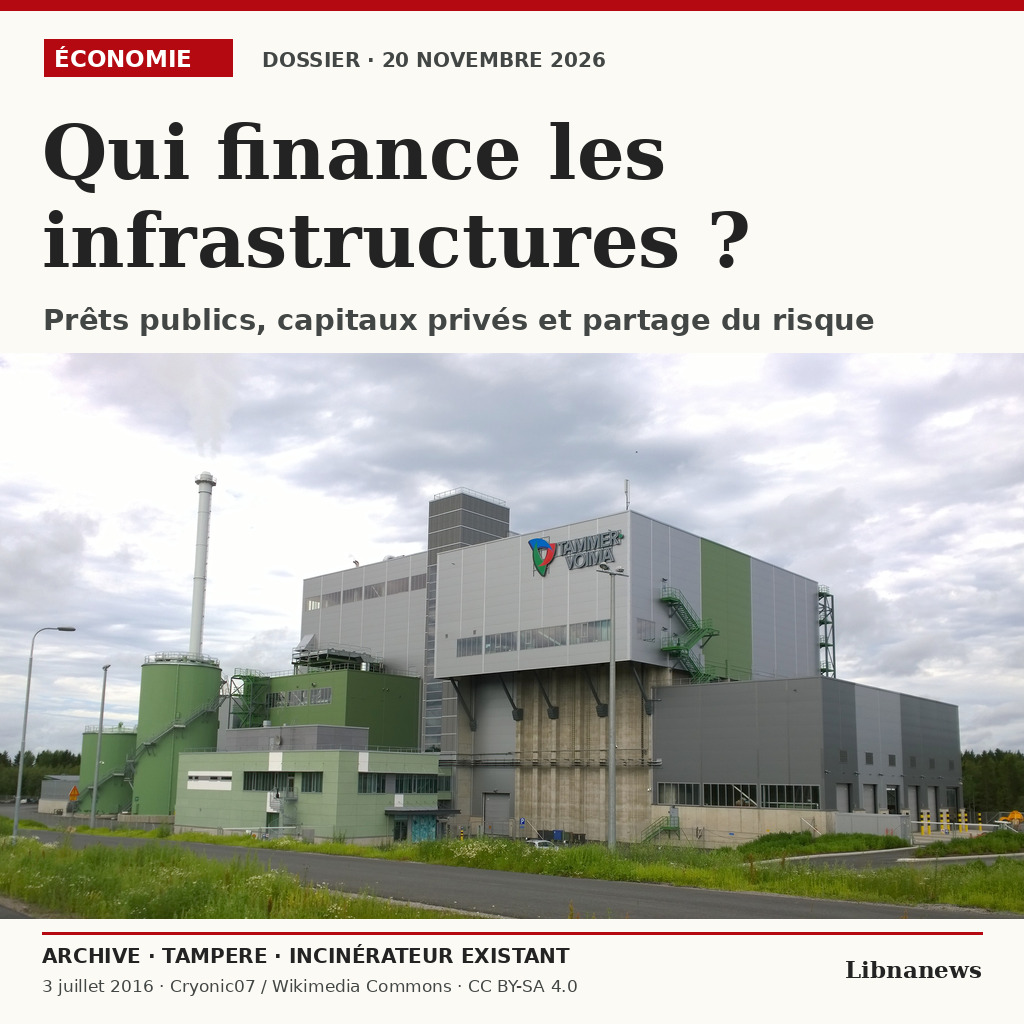
In Finland, Nordic Ren-Gas took its final decision on 20 November to invest more than EUR 300 million in a synthetic methane plant in Tampere. The European Investment Bank provides 60 million, while contracts for electricity, fuel and heat recovery support the project. In Lebanon, some $50 million for the electricity grid remains at the discussion stage. In between, a question: who pays when the work costs more or when the expected revenues are not realized?
In Tampere, the 60 million loan is only part of the financing
The decision announced on Friday by Nordic Ren-Gas allows the transition from development to construction. The objective is to complete the installation in 2029. The European Investment Bank (EIB) will lend EUR 60 million, slightly less than one fifth of an investment announced at more than EUR 300 million. It is the largest lender of the project, according to the EIB, but it does not finance the project alone. Société Générale, Standard Chartered, Nordea and Finnvera are also named among the debt providers. On the capital side include Allianz, Tesi, Japan Hydrogen Fund and Schroders Greencoat. Tesi, who had already invested in the development company, states that its new interest enters the company incorporated to carry out the Tampere project.
These three orders of magnitude should not be confused. The over $300 million describe an investment, not an amount of debt. The EIB’s 60 million represents a tranche of credit, not all public money committed. And the funding ceiling of 680 million announced by Ren-Gas in September concerned its Finnish portfolio of projects, not a second loan of this amount to Tampere. This is a framework within which funding can be scaled up. Adding the portfolio envelope and the Friday loan would raise a ceiling and a specific transaction for two independent contributions. The communiqués do not give the full distribution between debt and capital or the terms of all the instalments.
The public competition takes several forms. The EIB loan is supported by InvestEU; the project promoter also recalls that a Finnish investment subsidy was granted in 2022. The amount of EUR 46 million is included in its previous documents. Finnvera said, in the carrier’s statement, intervene as a lender and bring a counter-guarantee relating to a contract to purchase electricity. A grant granted, a repayable loan and a guarantee whose appeal depends on the contract are not expenses of the same nature. The amount covered by the latter or its distribution among any counterparties is unknown. None of these announcements suggest that the State would take over all the losses of the project in the event of failure.
The expected revenues start with a buyer, not the factory
The main expected recipe is the sale of methane from renewable hydrogen and biogenic CO2 from a local waste-recovery facility. Part of the heat released by the process must supply the district heating network. At full capacity, Ren-Gas and Tesi announce about 190 gigawatt hours of e-methane per year. Up to 200 gigawatt hours of heat could be recovered, depending on the project. These are two separate products and uses, not 390 gigawatt hours of fuel. The heat is destined for Tampere, while the gas must be transported through the European network, in particular to the German market for heavy goods vehicles. None of these volumes is already measured.
In July, Ren-Gas and the avanca group, together with its distribution subsidiary Alternoil, announced a multi-year contract to purchase Tampere’s e-methane. The parties value it at EUR 1 billion over its duration. This amount is neither an annual revenue nor a cheque received at the start of the project. Without detailed prices, firm quantities, delivery clauses and indexing mechanisms, it is not possible to deduct a margin, a cash flow rate or the minimum amount to be paid in case of delay. A press release of 2024 referred to Gasum’s commitment with a perimeter then announced differently; The recent public documentation does not allow these volumes to be added to those of the vancas or to reconstruct the fate of the old contract. Today’s case is therefore based on the commitments that the project still identifies in its recent financial presentation.
Electricity counts as much as the sale price of gas. The developer states that in September he entered into long-term contracts with Helen and another renewable electricity supplier. They cover physical deliveries and the elements necessary for the traceability of electricity. After Ren-Gas, the facility will be able to adapt its consumption to the availability of renewables. This mechanism may limit certain expenses to expensive hours, but it is not enough to guarantee that the plant will find its optimum: if it produces less, it allocates its fixed costs over a smaller number of units. The sales contract is particularly important if the exercise of this flexibility changes the volumes available. The sharing of this gap and the prices actually protected are not included in the daily press release.
Another contract brings the municipal energy service closer together. In January 2025, Tampereen Energia and Ren-Gas announced their agreement on the use of CO2 from the waste and heat recovery plant of the process. This complementarity improves the use of existing equipment: it creates an outlet other than fuel, without requiring the same buyer to take both products. But a recoverable heat volume is not a paid volume. Demand varies during the year and the conditions for selling heat are not published. As for CO2 captured to make a fuel, it is not a permanent storage: carbon can return to the atmosphere when using the gas. The climate balance therefore depends on the whole chain and the replaced fuel; it is not deduced from the only tons captured on the site.
Funding without recourse: who can be called to pay?
Project funding is based primarily on the ability of assets to generate revenue. A dedicated company signs contracts, receives contributions from shareholders and borrows. The lender examines the money that the company can raise after its operating expenses, to pay interest and then repay the principal. When the financing is actually without recourse, it cannot claim the balance from the entire shareholder group if the project no longer pays; its rights focus on the assets, receivables and collateral provided for in the contract. However, a limited remedy may remain for a specific undertaking: completion guarantee, supplementary contribution or other delimited obligation. The project financing qualification in Tampere does not prove that any recourse against shareholders has been excluded. The communiqués do not provide access to the clauses that would enable it to be verified.
Let us take a fictitious company that releases €12 million after its operating expenses and owes 10 million debt service over the same period. It has 2 million margin before reserves, distributions and other possible obligations. If the revenue falls and the operating surplus falls to 8 million, it lacks 2 million to serve the debt, even if the factory still works. The first effects can be to stop distributions to shareholders and use a reserve. Beyond that, the outcome depends on the contracts: an additional contribution can be provided, the lender can reschedule or play the collateral, and a guarantee can be called in the circumstances that it covers only. These figures are an example, not an estimate of Tampere. They show why an order book and an investment amount alone do not provide information on the capacity to repay.
The construction risk has another origin. Prior to commissioning, the work must be paid for without operating revenues. A supplier may carry a portion of the risk if it incurs a cost, date or performance and if its penalties are recoverable. What it does not cover is in principle up to the project company and its financiers, according to their commitments. After delivery, the difficulties change: suppliers must continue to deliver, buyers must honour their contracts and installation to produce long enough to generate its cash flow. The EIB explains that the credit is based on the factory’s future revenue. This is the decisive difference with a financing promise that would be reimbursed from the general resources of an administration, even if public money comes in both cases.
In Lebanon, EBRD discusses a network, not an approved loan
In Beirut, Finance Ministers Yassine Jaber and Economy Minister Amer Bisat discussed Friday with a delegation from the European Bank for Reconstruction and Development (EBRD). According to the report of the Ministry of Finance, they examined an initial possible $50 million for the transportation network, in particular to connect decentralized solar installations to the national network. The meeting is neither approved by the bank council nor signed by an agreement. The report does not specify the borrower chosen, the duration of the financing or the timing of disbursements. Nor does it indicate which companies or regions would be connected first.
The same report refers to another $50 to $60 million for development activities. The Ministry reports that the extension of EBRD interventions is linked to the conclusion of a programme with the International Monetary Fund. The two sums cannot be added together: nothing says that they finance additional commitments or that the largest envelope is an already available allocation for electrical works. The extension of the port of Beirut was also on the agenda. However, no financial commitment for the port is deducted from the 50 million mentioned under the network.
Bringing back more solar production does not reproduce the Tampere model. A plant can sell its production to a particular company. A network must accommodate several producers and serve several user categories, even where the volume sold is not sufficient to finance costly work. Its economic interest may come from the reduction of losses, avoided breakdowns or the replacement of more expensive electricity purchases, not from the sole invoice of a solvent customer. It is necessary to know on which revenue the loan would be backed: the payments of the manager, the transport charges, the public budget or a different mechanism. The documents consulted do not resolve this issue. The same amount of debt therefore shifts the risk very differently depending on whether the borrower is a project company, the electricity operator or the Lebanese Republic.
The choice of equipment also does not address the issue of post-construction expenses. The connection adds value if the plants can inject their electricity when they produce it, if the network is able to absorb these flows and if the revenues allow it to be maintained. If the cost of the network is transferred to the invoices, the question becomes that of the distribution between connected producers and consumers. If the State covers it, arbitration goes through the budget. If the operator alone assumes repayments, its ability to recover its own revenue becomes decisive. These options are analysis scenarios, not decisions announced on Friday. The electrical reinforcement project supported separately by the World Bank since 2024 and the LEAP reconstruction programme do not constitute an authorisation or proof of co-financing of the EBRD file.
The carbon market can change a calculation, not sign a cheque
At their summit in Brussels on 20 November, the European Union and the United Kingdom announced the end of negotiations on the approximation of their emission trading markets. Their joint declaration aims at 2028. The British Government mentions more precisely theandjanuary 2028 as the operational objective. 1andmarch 2028 cited at the same summit concerns another text, the Sanitary and Phytosanitary Agreement. Both dates are not interchangeable and the Friday announcement does not make any of these measures immediately applicable.
A quota trading system caps the emissions covered and gives a price to the right to issue. The industry concerned can buy or sell their quotas according to their needs and their ability to reduce emissions. If both systems are linked as planned, allowances issued on both sides may be recognised to meet certain obligations. Two systems would remain in place, not a single authority deciding all rules. Leaders also provide reciprocal exemptions to their carbon mechanisms at borders for the goods concerned, subject to applicable laws and procedures. This does not abolish existing obligations on the day of the announcement.
For a plant that is considering replacing a high-emitting process, this perspective may weigh in the calculation. Part of the profitability depends on the avoided future compliance costs, but these change with the price of quotas, the sectors covered and the terms of the transition. Mutual recognition potentially gives access to more buyers and sellers; it does not set a guaranteed reference price for the next 15 years. The border exemption may reduce the costs or trade approaches involved, without removing the cost of energy or the risk of an investment falling behind.
It would therefore be premature to link this rapprochement to the profitability of the Tampere site. Its announced outlet is mainly in Germany, not the United Kingdom. Its electricity, gas and heat contracts have their own savings. Both news inform different levers: a contract organizes deliveries and payments between identified parties; a carbon rule changes the framework within which these parties will make their decisions. A financer may take this second dimension into account without treating a planned entry into force as a contractual revenue.
Algeria: A more diversified budget remains responsive to rent
The diagnosis published on 19 November by the World Bank in Algeria sheds light on a third mode of financing: public investment supported by the revenues of an oil-producing State. The World Bank estimates that the economy grew by 3.8 per cent in 2025, with non-hydrocarbon growth of 4.2 per cent. This does not mean that the Treasury has freed itself from oil and gas. The production of a sector, the taxes it pays and the balance of payments do not measure the same.
The overall budget deficit is estimated at 10.4% of GDP in 2025, compared to 14% in 2024. In particular, it has declined thanks to stronger non-hydrocarbon revenues, including exceptional dividends from public enterprises. IMF, in its own annual review published in September, estimated the non-hydrocarbon deficit at 23.8% of GDPother than hydrocarbonsin 2025, compared with 30.7 per cent in 2024. This second indicator excludes oil and gas revenues and the two series do not have the same basis of comparison. The difference between 23.8% and 10.4% therefore does not measure the contribution of oil to the budget. The exceptional dividends also do not constitute a certain basis for financing the same expenditure each year. If a one-time recipe disappears, the deficit can rise again without an equivalent increase in the cost of the equipment itself.
The external situation evolved in the other direction in 2025. With less favourable oil exports and more investment-related imports, the current account deficit, according to the World Bank, reached 8.8% of GDP. The report projected a reduction to 2.9% in 2026, based on a more favourable oil price environment. This is a projection, not an annual result. It is not invalidated or confirmed by an oil quotation at any time of the day. A lower current account deficit also does not amount to a balanced budget: it describes different flows.
The common thread with funding a network is the duration of the risk. Major projects can be paid for over several years; infrastructure then requires maintenance and renewal. High one-year revenues can provide credit without securing future resources. The World Bank recommends better cushioning fluctuations in rent and strengthening stabilization mechanisms. The Algerian case recalls that a State can make a useful investment without having a recipe dedicated to each project. It must then disclose in its arbitrations the multi-year commitments and the expenses that remain when revenues fall.
Markets: Paris and Wall Street in session
At 3:35 p.m. at Paris (14.35 p.m. UTC), ACC 40 posted 7,978.07 points, down 1.27% in the meeting. At 10:07 a.m. in New York (15:07 UTC), Dow Jones was increasing by about 1%, Nasdaq Composite was losing 0.6% and S&P 500 was almost stable. These observations were taken at different times and are not closing results. In the United States, ten-year performance was 4.99% in the session record; The official Treasury curve showed 5.04 per cent on Thursday. This is not a new central bank policy rate.
The European Central Bank published the reference rates of US$ 1.0990, UK Pound 0.83735 and USD 174.35 per euro for Friday. These are not prices that a company can necessarily deal with. At approximately 1530 UTC, the Brent in cash was reported at approximately $90.4 per barrel, a decrease of about 2.3 per cent since midnight. This one-off price is neither the annual average on which a State can calculate its revenue nor the price at which Tampere will sell its fuel.
What the next announcements will be able to verify
In Tampere, the next steps are the construction site, its delivery and the industrial commissioning. A final decision and signed contracts provide a basis for the project; they don’t deliver the factory or its revenues. In Beirut, the previous step remains to be taken: identify a committed lender, specify the borrower and publish the financing and connection conditions. Between London and Brussels, the texts and acts necessary for their implementation will indicate the extent to which companies can incorporate the new rules into their plans. In each case, the announced number is useful only if it is known what it corresponds to: an amount borrowed, an expected revenue, a conditional guarantee or a rule that has not yet entered into force.





Comments