

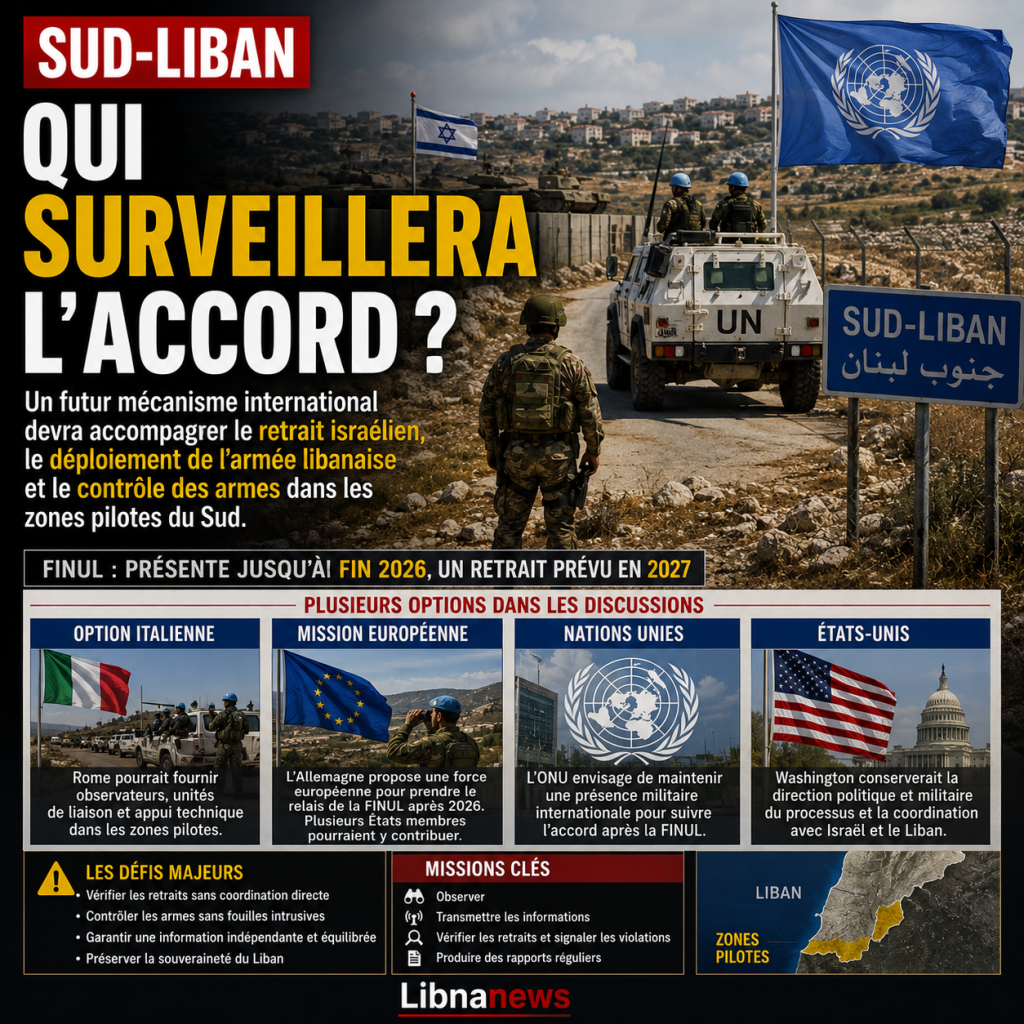
A future international mechanism must accompany Israeli withdrawal, the deployment of the Lebanese army and arms control in the pilot areas of the South. The need for an intermediary arises because Beirut refuses direct military coordination with Israel. Discussions conducted under American mediation opened several avenues. Italian participation was mentioned after the Rome meetings, while Germany is now defending a European mission to take over from the United Nations Interim Force in Lebanon. UNIFIL remains present until the end of 2026, before a drawdown phase planned for 2027. The United States, for its part, retains the political and military leadership of the process. No final choice has yet been announced. The credibility of the future mechanism will depend on its mandate, freedom of movement and ability to establish violations without automatically reproducing the information provided by one of the parties.
An intermediary that has become indispensable
Lebanon and Israel do not have diplomatic relations. They remain officially in a state of war and their armies do not directly coordinate their movements on the ground. The negotiations on the framework agreement are therefore conducted with American mediation. This approach allows delegations to discuss withdrawal, pilot zones and security assurances without establishing a permanent bilateral military relationship.
The need for an intermediary becomes even greater at the time of execution. An Israeli unit leaving a position must provide information on the timetable, access routes, possible dangers and boundaries of the evacuated area. The Lebanese army must then enter the area, secure the premises and verify that no non-State armed forces are established there. Without a channel recognized by both parties, any delay can be interpreted as a violation.
Beirut, however, refused to allow this mechanism to be transformed into direct coordination with Israel. The Lebanese authorities want to preserve the technical and indirect nature of the trade. They ask that a third party receive the information, verify it and transmit it to the army. This position responds to political, legal and security considerations. Formal cooperation with the Israeli army would lead to strong internal opposition and exceed the mandate given to the negotiators.
The future device must therefore fulfil a delicate function. It should facilitate movements without giving the impression of creating a common structure between the two armies. He will also have to distinguish between Washington-led political mediation and daily field observation. This separation explains the search for a European or international presence capable of carrying out technical tasks.
Italy referred to after the Rome talks
The possibility of Italian participation was reported after the sixth round of negotiations held in Rome. Italy has several strengths to play a role in the South. It knows the ground thanks to its long participation in UNIFIL. It maintains relations with Lebanon, Israel, the United States and other European countries. It also has units used to observation, liaison and support missions.
The Italian option does not necessarily mean the creation of a force exclusively under the command of Rome. It could take the form of a contingent in a European mission, a liaison team or a group to supervise the first pilot areas. The discussions have not yet produced a public mandate or final composition.
The tasks mentioned cover several levels. Observers could confirm the departure of Israeli units, record the arrival of the Lebanese army and control access to the areas concerned. They could also report violations, accompany certain inspections and verify that the military infrastructure attributed to Hezbollah has been removed or rendered unusable.
Italy could also provide technical support. Its personnel can contribute to mapping, demining, image analysis and axis security. These functions would be useful in areas affected by the fighting, where roads, homes and agricultural land may contain unexploded ordnance. However, they would not give observers the power to impose a decision on the parties.
A European mission takes shape in the debate
The European track gained more weight after the German proposal to replace UNIFIL with a European Union force. Berlin wants to avoid a vacuum after the end of the current mandate. The idea is to maintain an international presence capable of accompanying the Israeli withdrawal and preventing the return of Hezbollah units or infrastructure to areas transferred to the Lebanese army.
A European mission could bring together several States already present or experienced in Lebanon. Italy, France, Spain, Germany and other countries could provide observers, demining specialists, liaison officers and monitoring facilities. The composition would depend on the political decisions of the Union and the agreement of the Lebanese Government.
This would have an advantage for Beirut. It would provide a separate intermediary from the United States, which remains the main sponsor of the agreement and Israel’s strategic partner. A European presence could be seen as more balanced in daily operations. It would also maintain a link between South Lebanon and the partners that support the army, reconstruction and institutions.
The creation of a European mission would nevertheless raise several questions. The Union should establish a legal basis, command, rules of engagement and funding. Member States should agree to send personnel to an exposed area. Israel should recognize their role, while Lebanon should grant them the necessary authorization. None of these conditions is yet acquired.
Observe, transmit and verify
The future international mechanism would not only be responsible for seeing troop movements. Its first mission would be to produce common information. Today, each party has its own maps, its own reports and its own reading of incidents. This divergence feeds mutual accusations and slows down decisions.
Observers could prepare reports on Israeli withdrawals, remaining positions, Lebanese army movements and armed incidents. They could also confirm the presence of civilians, road conditions and access to villages. These data would be used for follow-up meetings and allow for a comparison of announced commitments with actual changes.
The transmission of information would be another central function. Israel could report a site it presents as a military infrastructure. The mechanism should receive contact information, review available information and communicate it to the Lebanese authorities. The army would then decide on measures in accordance with national law. This procedure would avoid direct contact while maintaining an operational channel.
The verification of withdrawals would finally require a physical presence or reliable technical means. Patrols, aerial images and geographical data could confirm that a position has been evacuated. The same principle would apply to Hezbollah facilities. The difficulty lies in access to private property and in the sometimes underground or mobile nature of the equipment sought.
UNIFIL retains a role until the end of 2026
UNIFIL remains the main international presence in the South. Its mandate includes monitoring the cessation of hostilities, supporting the Lebanese army and confirming the withdrawal of Israeli forces. It has an establishment, staff and liaison procedures built over several decades.
However, the Security Council last renewed its mandate until 31 December 2026. An orderly withdrawal phase must then begin and continue in 2027. This decision obliges actors to prepare a new architecture. The rapid disappearance of the mission would leave a vacuum at the time when the framework agreement requires more monitoring.
The UN Secretary-General has proposed to retain an international military presence after the end of the current format. This option would not necessarily extend UNIFIL in the same way. It could take the form of a smaller mission, focusing on resolution 1701, liaison, observation and support to the Lebanese army.
UNIFIL has an advantage that the new options do not yet have: it is already deployed. Its bases, patrols and local contacts allow for an immediate transition. However, it has ancient limitations. His movements have sometimes been hindered. Its reports have not always led to measures. It depends on the cooperation of the parties and does not have a general search power.
United States retains political leadership
The United States is leading the negotiations and coordinating the implementation of the pilot zones. The United States Central Command is participating in the technical discussions. Washington also has direct access to the Israeli authorities and maintains close cooperation with the Lebanese army. This position gives it a difficult role to replace.
American preference seems to be moving towards a mechanism capable of producing quick and verifiable results. American officials want to confirm the withdrawal of Israeli forces while preventing Hezbollah from restoring its positions. They also wish to have accurate information on weapons, tunnels and infrastructure in areas handed over to the Lebanese State.
Washington could retain the direction of a monitoring committee, even if the observation tasks are entrusted to Europeans or the United Nations. This would allow the United States to arbitrate political disagreements, while a field mission would provide technical findings. It would also avoid the deployment of a major American force to Lebanon.
However, the weight of the United States raised reservations in Beirut. Several officials fear that a mechanism under US command alone will adopt Israeli priorities. They therefore call for European or UN participation in order to diversify the sources of information and strengthen the legitimacy of decisions.
Lebanon wants to preserve its authority
The Lebanese position is based on the principle that the army remains the only authority responsible for acting on the territory. An international mission can observe, transmit information and provide support. It should not replace institutions or conduct searches freely in private houses and land.
This limit becomes essential in pilot areas. Israel may provide information on buildings that it suspects to house weapons. The Lebanese army does not want to intervene automatically on the basis of a foreign list. It must verify the elements, comply with legal procedures and assess the risk of incident with the inhabitants.
Beirut also seeks to prevent the future mechanism from creating an international zone beyond its control. The authorities want the deployment of the army to accompany every withdrawal. They call for additional means to hold positions, secure villages and prevent any resumption of fighting.
Lebanon therefore prefers a support mission rather than a force with autonomous power. It wishes to participate in the definition of the mandate, the handling of alerts and the publication of reports. This requirement may slow down operations, but it is consistent with the principle of sovereignty at the centre of the agreement.
Inspections at the heart of disagreement
The issue of inspections is one of the most difficult obstacles. Israel wants guarantees that the evacuated areas no longer contain Hezbollah weapons or infrastructure. The United States is also calling for measurable control. The Lebanese army accepts the principle of its authority, but refuses operations based on unverified accusations.
Private homes and properties enjoy legal protection. A search requires a legal basis and, as appropriate, judicial authorization. A foreign mission cannot enter a home freely. Even the army must act within a specific framework. These rules face requests for rapid verification.
The people of the South fear that Israeli intelligence may be used to justify repeated searches. They are also concerned that the coordinates transmitted are inaccurate or used for political purposes. The army wants to preserve the confidence of the population and avoid being perceived as executing external demands.
The future mechanism will therefore have to define a procedure. It could require specific elements prior to any inspection, organize a joint assessment with the army and provide for a post-intervention report. It will also have to determine the role of observers. Their presence may enhance transparency, but it does not replace the authorization of the Lebanese authorities.
A problematic dependence on intelligence
No mechanism can operate without information. Yet the information provided by Israel, Lebanon or other actors is not neutral. Each party can select the incidents that support its position. It can also transmit data difficult to verify or interpret a civilian movement as military activity.
A credible system must therefore cross several sources. Satellite images, field observations, army reports and local testimonies can complement reports. Observers must be able to visit the site when safety permits. Without independent access, the mechanism may become a simple registration chamber.
The same guarantees must apply to accusations against Israel. Lebanon must be able to report a new position, overflight, incursion or shooting. The mechanism must investigate and include the result in a report. A structure that controls only Lebanese obligations would quickly lose its legitimacy.
Regular disclosure of violations can reduce manipulation. Dated reports, together with maps and verifiable elements, would monitor commitments. Sensitive information may remain confidential, but the main conclusions should be accessible to the authorities and the public.
Lack of coercive power
Whatever its form, the future mission will probably have limited coercive means. Observers will not be able to force Israel to leave a position or force Hezbollah to hand over a facility. They will depend on the political decisions and action of the Lebanese army.
This limitation already characterizes UNIFIL. The mission can detect a violation, protest and inform the Security Council. It does not wage a war to impose resolution 1701. A European mission would probably operate according to a comparable logic, unless the participating States made an exceptional decision.
The mechanism should therefore be based on political consequences. A report confirming a violation could trigger an urgent meeting, diplomatic pressure or suspension of a step. The United States could use its influence on Israel. European partners could condition some aid. The Lebanese Government could prosecute or deploy additional units.
The effectiveness will depend less on the number of observers than on the response to the findings. A mission that publishes violations without any action will quickly lose its authority. Conversely, a limited but fast-tracked system can help prevent incidents.
Preferences not yet aligned
The United States wants to maintain political control and secure effective disarmament control. Europeans seek to avoid a security vacuum and preserve their role in Lebanon. Italy appears available for a field mission. Germany pushes the idea of a European Union force. The United Nations is proposing an international presence after UNIFIL.
Lebanon wishes to combine these options without losing its authority. He wants an intermediary accepted by Israel, but refuses a mission that would act directly on private property. It also calls for the same strict monitoring of Israeli violations as the obligations imposed on Hezbollah.
Israel favours a mechanism that provides it with security guarantees and checks the absence of weapons. It could accept European observers, provided they have sufficient access and transmit rapid results. It will continue to pay attention to the ability of the mechanism to act when information reports a military infrastructure.
These preferences can lead to a mixed architecture. The United States would provide mediation and political follow-up. A European or UN mission would observe the ground. The Lebanese Armed Forces would retain responsibility for inspections and territorial control. This formula remains most often mentioned, but it still requires detailed agreement.
Conditions for a credible mechanism
The first condition will be a clear mandate. The text should indicate who confirms the withdrawals, who receives the information, who authorizes the inspections and who publishes the violations. Areas of intervention and deadlines will have to be defined. The parties must not be able to change the current rules alone.
The second condition concerns freedom of movement. Observers must access roads, evacuated positions and reported points. This freedom shall be exercised with the consent of the Lebanese authorities and with respect for private property. Repeated restrictions would render verification unnecessary.
The third condition will be the independence of information. The mechanism will have to cross-reference reports and produce its own findings. It will have to consider the violations attributed to all parties. Unbalanced treatment would weaken the mission in its first weeks.
The fourth condition concerns publication. Regular reports will be required on withdrawals, incidents, completed inspections and blocked points. This transparency will enable governments, residents and international partners to measure implementation.
Technical negotiations must now determine whether Italy will intervene alone in a pilot phase, whether a broader European mission will be created or whether the United Nations will retain a presence after 2026. The first Israeli withdrawal and the corresponding deployment of the Lebanese army will be the immediate test of the chosen model.




