

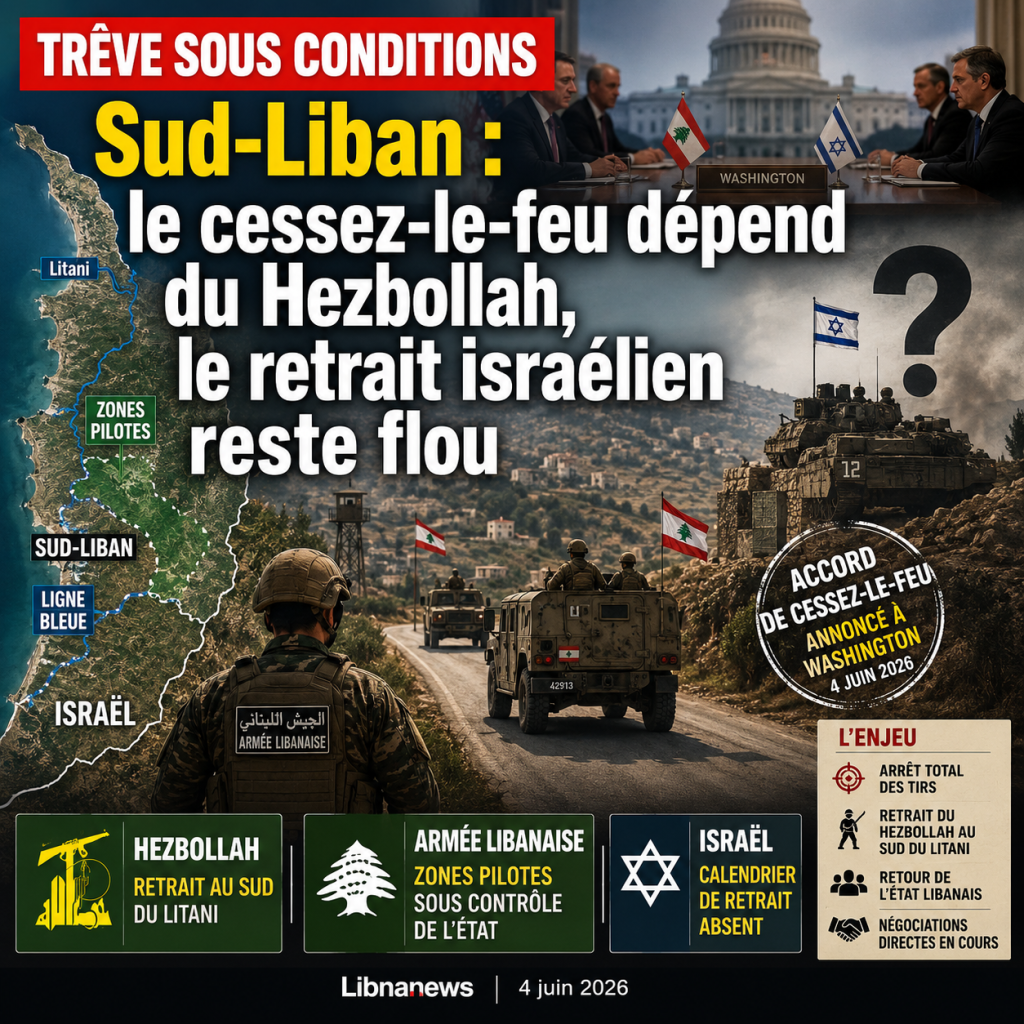
A ceasefire agreement between Lebanon and Israel was announced at the dawn of Thursday, 4 June, following negotiations in Washington. The text presented by the American mediators does not yet resolve the heart of the conflict, but it opens a new sequence. It makes the complete cessation of hostilities conditional upon the complete cessation of Hizbullah fire and the evacuation of its fighters from the area south of the Litani River. It also provides for the rapid establishment of pilot areas under the sole control of the Lebanese Armed Forces. The announcement marks a major inflection, as it now associates Lebanon Israel with a ceasefire, the return of the State to the South and the continuation of direct negotiations. However, it leaves a central question without an explicit answer: the Israeli withdrawal from Lebanese territory.
A ceasefire Lebanon Israel built on a major condition
The Washington communiqué presents the agreement as an implementation of a comprehensive ceasefire, but not as a peace already achieved. Its formulation is deliberately prudent. The mechanism only fully applies if Hezbollah stops firing and withdraws its operators from the southern Litani area. Since 2006, this region has been at the heart of the machinery provided for in Security Council resolution 1701. It should, in principle, be placed under the authority of the Lebanese State, with the support of UNIFIL. In fact, it has remained for years the most sensitive space of the military face-to-face between Israel and Hezbollah.
The novelty is the way negotiators have linked several files. The ceasefire is not only presented as a military break. It becomes the entry point of a wider political sequence. Lebanon and Israel claim, in the text, not to nurture hostile intent towards one another. They also commit themselves to continuing direct discussions to resolve outstanding issues. This sentence weighs heavily. It does not mean full political recognition. It does not yet mean a peace treaty. But it installs a de-escalation vocabulary that goes beyond the usual crisis management formulas.
However, the text avoids resolving the most anticipated issue in Beirut: Israeli withdrawal. There is no public clause specifying a schedule, withdrawal points, or a verification sequence. This omission already feeds questions. For Lebanon, territorial sovereignty is a red line. For Israel, the high priority remains the neutralization of the armed threat north of its border. The compromise announced this Thursday lies between these two requirements. It tries to create security spaces before resolving the territorial dispute.
The « pilot zones », laboratory of a return from the state
The most concrete passage concerns the pilot areas. Their principle is simple: identify areas where the Lebanese army alone exercises security control. No non-State armed actors should circulate, store weapons or conduct operations there. This step-by-step approach aims to avoid brutal application throughout the South. It would test the state’s ability to recover in exposed communities, while providing Israel with a visible indicator of change on the ground.
This choice also reflects a political limit. Negotiators do not appear to have achieved immediate general disarmament of Hezbollah. They therefore adopted a step-by-step approach. The model recalls the stabilization mechanisms already used in other crises: an area first, then an extension if the verification works. In the Lebanese case, the issue is more delicate. Hezbollah is not just a military force. It is also a party represented in political life and rooted in a part of Shiite society. Any change in its southern structure therefore affects Lebanon’s internal balance.
The Lebanese army is at the centre of the scheme. It should be the actor responsible for materializing state sovereignty. This mission gives it enhanced international legitimacy, but it also creates considerable pressure. The military institution must maintain a close line: to reassure foreign partners, to avoid internal confrontation and to maintain the confidence of civilian populations tested by the fighting. Its resources remain limited by the economic crisis, logistical needs, balance constraints and fragile infrastructure in the South.
The pilot areas finally raise a question of monitoring. Who will see the absence of weapons? Who will report a violation? Who will decide that a sector can move on to the next step? UNIFIL can play an observer role, but its mandate does not allow it to replace the Lebanese army. The United States can guarantee the process politically, but not occupy the ground. Israel may request evidence, but its direct involvement in verification in Lebanese territory would be rejected in Beirut. The success of the agreement therefore depends on a precise mechanism which has not yet been made public.
Israeli withdrawal, large absence from press release
The absence of an explicit reference to Israeli withdrawal is the main dead end of the announcement. Since the early stages of escalation, Lebanese officials claim that any lasting stabilization requires an end to Israeli positions on Lebanese territory. This request covers the recently occupied areas, as well as earlier disputes over disputed points of the Blue Line, Ghajar, Shabaa farms and Kfarchouba hills. For Beirut, there can be no restored sovereignty if part of the territory remains under foreign military presence.
Israel reason in reverse order. Its officials claim that withdrawal can only occur if Hezbollah ceases to pose a direct threat. Northern Israel has experienced evacuations, fire, repeated warnings and partial paralysis of civilian life. In this reading, a simple promise of calm is not enough. Israel calls for operational safeguards. He wants to ensure that Hezbollah units cannot return south of the Litani River, rebuild positions, install launchers or use border villages as cover.
This opposition explains the caution of the text. Washington is trying to turn an insoluble dilemma into a progressive calendar. Israeli withdrawal could be addressed later, once the pilot areas have produced tangible signs. But this logic involves a risk. If the withdrawal remains unclear, Hezbollah will be able to assert that the agreement imposes obligations on the Lebanese camp without any visible compensation. If Israeli forces maintain positions, the Lebanese army will find it difficult to convince the inhabitants that the State is actually regaining control. The silence of the communiqué is therefore not a detail. It will be one of the first political tests of the agreement.
Hezbollah, an actor absent but indispensable
Hezbollah did not participate directly in the discussions announced in Washington. However, the agreement largely depends on him. The central condition is its firing and the presence of its operators south of Litani. The paradox is obvious: the signatories treat an actor who is not around the table. This type of assembly is not new in Lebanon. State authorities, the President of the Republic, the Government, the President of Parliament and foreign mediators often serve as channels between international requirements and internal realities.
The reaction of the movement will be decisive. If he agrees to reduce his visible presence, he will probably seek to present this decision as a contribution to the protection of Lebanon, not as an imposed concession. If he rejects the formula, the ceasefire will remain theoretical. If he takes an ambiguous position, the situation will depend on local incidents, Iranian messages and the ability of the Lebanese authorities to avoid a public rupture. In any case, the movement retains a practical veto, even if the Lebanese State wants to display its primacy.
Hezbollah must also take into account its social environment. Villages in the South paid a high price. Displacement, destruction, civilian casualties and economic paralysis create a demand for respite. But part of his electorate refuses any formula perceived as capitulation while Israel remains present on portions of the territory. The movement will therefore have to arbitrate between the pressure of the base, reconstruction needs and regional instructions. It is this tension that makes implementation more complex than diplomatic announcement.
Washington imposes diplomatic rhythm
American mediation appears as the engine of the sequence. The negotiations were held in Washington, D.C., within a framework that allowed the Lebanese and Israeli delegations to converge on a common text. The United States seeks to prevent an extension of the conflict and to restore some form of predictability at the border. Their immediate objective is military: to silence the shots, reduce the strikes and prevent regional burning. Their broader objective is political: to turn the Lebanese-Israeli border into a negotiable file, not a permanent one.
This American role includes a part of authority and a part of bet. Washington can put pressure on Israel. It can also promise support to the Lebanese army and mobilize European or Arab partners. But it does not directly control Hezbollah. It must therefore build on Lebanese institutions, indirect channels and the internal balance of Beirut. This constraint explains the gradual formula. It offers each camp a way to save face. Israel has an explicit reference to the withdrawal of Hezbollah from southern Litani. Lebanon obtains recognition of the central role of its army and the opening of discussions on outstanding issues.
Mention of direct negotiations is also important. Lebanon and Israel have already negotiated in the past on limited issues, including under American mediation. But any broader political discussion remains sensitive in Beirut, where normalization with Israel remains an explosive subject. The press release bypasses that word. He talks about trust, security and global agreement. This vocabulary allows us to move forward without announcing immediate peace. It may, however, trigger internal criticism if the opinion considers that security concessions precede territorial guarantees.
Previous resolution 1701
The agreement announced this Thursday resumes a known architecture. Resolution 1701, adopted in August 2006, provided for the cessation of hostilities, Israeli withdrawal from the South, the deployment of the Lebanese army and the absence of non-State weapons between the Blue Line and the Litani. This framework remains the international reference. But it has never been fully implemented. Hezbollah maintained a military presence. Israel continued to report violations and conduct operations. Lebanon has also denounced overflights, strikes, occupations and violations of its sovereignty.
The difference in 2026 is due to the pressure level. Recent fighting has shown that the old status quo is no longer sufficient. The border can no longer function as a controlled conflict zone, with tacit rules and calibrated responses. Civilian populations on both sides require a sustainable return to security. The United States wants to avoid adding the Lebanese front to other regional crises. Europeans fear a new wave of destabilization. The Arab countries observe Lebanon’s ability to restore state authority without causing an internal crisis.
The implicit reference to 1701 can help Lebanon. It makes it possible to present pilot areas not as a bilateral concession to Israel, but as an application of an already accepted UN framework. It can also reassure internal actors hostile to standardization. But this reference can turn against the process if it remains symbolic. For nearly twenty years, resolution 1701 has served as a common language without preventing crises. The current agreement must therefore produce visible actions: deployments, withdrawals, controls, return of civilians and actual reduction of strikes.
Immediate risks in the field
The first risk is an incident in the early hours. A single shot, a drone strike, a poorly interpreted patrol or the discovery of a weapons depot can be enough to weaken the whole. Conditional ceasefires are the most vulnerable, as each camp may accuse the other of preventing full entry into force. In the South, the density of armed actors, topography, villages close to the border and recent traumas make verification difficult.
The second risk is political communication. If Israel presents the agreement as a military victory imposed on Hezbollah, the movement will have more difficulty accepting it. If Hezbollah claims a simple break without a real withdrawal from its men, Israel can say that the condition is not fulfilled. If the Lebanese government insists too much on direct negotiation, it exposes itself to accusations of normalization. If, on the contrary, it minimizes the content of the agreement, Washington may doubt its ability to implement it. Every word will count.
The third risk concerns civilians. The people of the South want to know when they will be able to return, under what authority and with what guarantees. The locations affected by the strikes must be cleared, secured and supplied. Schools, hospitals, roads and power grids will have to resume. A pilot area that would not allow the population to return would remain an incomplete military device. Conversely, a hasty return without security would expose civilians to further displacement.
What Beirut can get, what Israel wants to verify
For Lebanon, the deal can offer three wins. The first is the cessation of destruction. The second is the recognition of the army as the only legitimate force in the pilot zones. The third is the opening of a channel to deal with border disputes, prisoners, international guarantees and the conditions for an Israeli withdrawal. However, these gains remain conditional on the State’s ability to impose an effective presence. Without financial, logistical and political resources, the scheme will remain fragile.
For Israel, the interest is also clear. The government wants to prevent Hezbollah from returning to a band deemed strategic. He wants a mechanism that protects his northern communities and reduces the need for repeated military operations. It also wants to measure the reliability of the Lebanese army as a security interlocutor. If the pilot areas work, Israel will be able to accept a broader discussion. If they fail, he will probably claim freedom of military action.
The sequence of the next few weeks will therefore be decisive. Negotiators should specify the map of the pilot areas, the modalities for the deployment of the Lebanese army, the role of UNIFIL, United States safeguards, the treatment of violations and the possible Israeli withdrawal schedule. The discussions announced for the week of 22 June will have to turn a political communiqué into a practical mechanism. Until then, the ground will tell whether the ceasefire Lebanon Israel is a real de-escalation or a fragile break between two phases of confrontation.




