

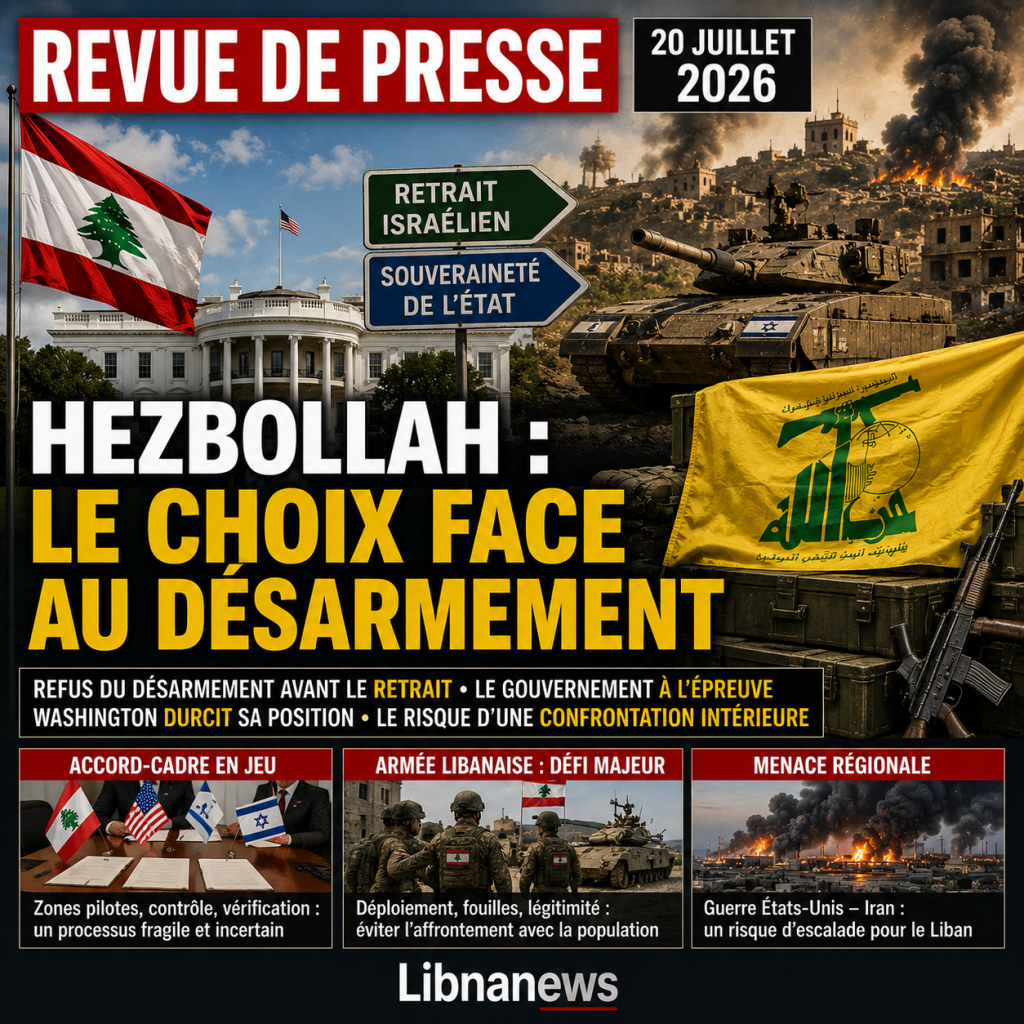
Hezbollah officials have reaffirmed their refusal to surrender arms as long as the Israeli army maintains positions in Lebanon and continues its operations. The statements reported by the Arab press on 20 July put the case back in a wider conflict. The movement claims that the crisis cannot be reduced to its arsenal. He cites the occupation, the strikes, the prisoners, the destruction and the return of the inhabitants of the South. In the face of this line, the United States is making arms exclusive in the hands of the State a central condition of its support for Lebanon. The government of Nawaf Salam must therefore move between two constraints. He is seeking a verifiable Israeli withdrawal, but he also wants to avoid confrontation with Hezbollah and its popular base. The party, supported by Nabih Berri, chose to remain in government despite its opposition to the framework agreement. This presence allows him to defend his positions within the institutions and to follow the next steps in the arrangements negotiated under American mediation.
Reaffirmed refusal after framework agreement
The positions published on 20 July extend the declarations made since the signing of the Framework Agreement of 26 June. Hezbollah officials present the conflict with Israel as a lasting threat against Lebanon. They therefore refuse to allow the discussion to begin with the question of the arms of the movement. According to them, such an approach reverses the order of responsibility and leaves aside the Israeli military presence, air attacks and destruction in the southern localities.
The movement insists on the political and territorial nature of the issue. He claims that weapons cannot be treated independently of Israeli withdrawal. It also called for an end to the strikes, the release of prisoners and the launching of reconstruction. They consider that these commitments must precede any action imposed on Hezbollah. This position does not constitute acceptance of further disarmament. The party does not set any timetable and does not describe the precise conditions for a surrender of its arsenal.
Hezbollah also challenges the method followed by the government. He rejected direct negotiations with Israel and criticized an agreement which he considered unbalanced. The movement considers that the text gives Israel a right of control over the measures taken in Lebanon, without guaranteeing a speedy withdrawal of its forces. He feared that pilot zones would become a model for the entire territory, while Israeli obligations would remain subject to conditions.
Hezbollah invokes an existential conflict
In the statements reported by the Arab press, Hizbullah officials portray confrontation with Israel as an existential conflict. They don’t describe it as just a border dispute. They see it as a threat to Lebanon’s territory, population and ability to defend itself. In their view, this reading justifies the maintenance of an armed force outside the regular army as long as Israel retains a military presence and a capacity for action in Lebanon.
The party claims that prior disarmament would eliminate its main deterrent. He believes that Israel could then maintain its positions or resume operations without having an equivalent response. Its officials recall the military campaigns against Lebanon and the destruction suffered by villages in the South. They argue that the population concerned cannot accept a mechanism that would begin with inspections and seizures of weapons without visible withdrawal.
This argument also concerns the social basis of the movement. Hezbollah seeks to show that it does not only defend an organization or military apparatus. It presents its weapons as an instrument for protecting exposed areas. This position remains echoed among residents who have lost their homes or cannot return to their villages. However, it met with opposition from many Lebanese who considered that decisions to war should be made exclusively by the State.
At this stage, the party avoids answering operational questions in detail. He does not publicly state how he would deal with his depots, tunnels or positions in an area evacuated by Israel. It does not specify whether it would accept verification conducted by the Lebanese army or by an international mechanism. These points will become unavoidable if the Israeli withdrawal actually begins in a first pilot zone.
Israeli withdrawal as a prerequisite
The order of the steps remains the main obstacle. Hezbollah demands that the Israeli withdrawal take place before any discussion on its disarmament. Israel takes the opposite position. He claims that his soldiers will remain in southern Lebanon as long as the movement retains its weapons and is considered a threat. The Framework Agreement attempts to bring these two requirements closer together through progressive application, but its timetable remains incomplete.
The text provides for pilot areas. In these areas, the Lebanese army must deploy, armed groups must be disarmed and residents must be able to return. Israel must gradually reduce its presence. A future security mechanism should specify the monitoring and verification mechanisms. A coordination structure with American participation must follow the application. However, several details remain under negotiation.
Hezbollah fears that the Israeli withdrawal will be delayed until the end of a national disarmament process. Such a reading would allow Israel to maintain a safe area for a long period of time. The party recalls that the handing over of its weapons could not be completed quickly, even in the event of political agreement. It therefore considers that the Israeli requirement can serve as a justification for prolonged occupation.
The Lebanese government is asking for another sequence. President Joseph Aoun wants a concrete first Israeli withdrawal. Beirut then wishes to deploy the army in the area concerned and demonstrate its ability to exercise its authority there. This step must provide a visible result for the inhabitants and reduce Hezbollah’s argument that Lebanon alone fulfils its obligations. The absence of withdrawal would instead reinforce the refusal of the movement.
Washington puts weapons at the centre of the file
American pressure was clarified during the exchanges between Joseph Aoun and Marco Rubio. The Secretary of State commended the Lebanese Government’s efforts to restore the country’s sovereignty. He cited the disarmament of Hezbollah and the dismantling of its military infrastructure as one of the objectives supported by Washington. The United States thus presents arms exclusivity as a central element of peace and economic recovery.
This position goes beyond security. Washington has a significant influence on aid to the Lebanese army, the mobilization of international partners and funding for reconstruction. Lebanon needs external resources to strengthen its regular forces, repair infrastructure and enable the return of internally displaced persons. The US authorities can therefore link some of their support to measurable progress on arms control.
The United States does not publicly request the Lebanese army to engage in a general confrontation with Hezbollah. They favour a gradual process, started in limited areas. However, they want concrete checks. Areas handed over to the army should be free of State-avoided combatants, depots and military installations. The future mechanism still needs to clarify how this absence will be established.
Hezbollah sees this pressure as an attempt to change the inner balance. It believes that international aid should not become a means of imposing decisions that concern national security. Its officials accuse Washington of resuming Israeli demands. They claim that support for Lebanon should begin with the guarantee of withdrawal and the cessation of Israeli military operations.
The Government Divided Between Two Requirements
The government of Nawaf Salam is at the centre of these opposing positions. He affirmed the principle of State monopoly on weapons. President Joseph Aoun also placed this commitment at the heart of his mandate. Yet the authorities do not want to turn this orientation into a military operation against Hezbollah. They know that an attempt at forced disarmament could cause clashes and divide the army.
The military institution must take control of the evacuated areas. It will also have to deal with weapons and infrastructure that might be found there. This mission seems simple in the texts, but it becomes more difficult in the inhabited villages. Requests for systematic inspections of private homes and properties are of concern. Military officials are concerned that large-scale searches may cause incidents with the inhabitants.
The army wants to avoid being perceived as executing information provided only by Israel. It requires verifiable information and a clear legal framework. A list of buildings or properties presented as military sites is not always sufficient to justify a search. Soldiers must respect Lebanese law, obtain the necessary authorizations and preserve their relationship with the population.
The government is therefore seeking a formula that combines state authority and internal stability. He wants to strengthen the army, get an Israeli withdrawal and limit the risk of confrontation. This method takes time. It is in tension with American and Israeli expectations, which demand rapid results. It also encounters the mistrust of Hezbollah, which suspects the mechanism to prepare its complete disarmament without equivalent guarantees.
The risk of an internal confrontation
The Lebanese authorities must also take into account precedents. Any decision directly affecting Hezbollah’s weapons can cause political and security tensions. The movement maintains an important popular base, a parliamentary group, ministers and an institutional network in several regions. A coercive operation would therefore not only involve isolated military depots. It could affect villages, neighbourhoods and families directly linked to the party.
The Lebanese army fears a situation in which its units should enter private property against the opposition of the inhabitants. A local incident could quickly take on a national dimension. Limited clashes could divide opinion and weaken the credibility of the military institution. They could also interrupt the Israeli withdrawal if Israel believed that the Lebanese commitments were no longer being implemented.
This fear explains Joseph Aoun’s caution. The former army commander knows the institution’s capabilities, but also its constraints. It seeks application based on coordination, local negotiation and international guarantees. The government wants to prevent the arms issue from being transformed into a confrontation between the state and the Shia community.
Foreign partners officially support a peaceful method. However, their demands for quick results can create pressure that is difficult to manage. The Lebanese State must prove that it is moving forward without triggering violence. He must also convince Israel that the army-controlled areas will no longer be used by Hezbollah. This dual requirement makes each step particularly sensitive.
Hezbollah and Berri remain in government
Despite their opposition, Hezbollah and the Amal movement did not leave the government. Ministers close to the Shiite tandem continue to participate in meetings and decisions. Nabih Berri did not call to overthrow the cabinet. It favours negotiation and seeks to change the application of the agreement rather than provoke an institutional crisis.
This decision responds first to a political calculation. By remaining in government, Hezbollah retains direct access to discussions. Its ministers may request information, challenge certain mechanisms and defend the principle of reciprocity. A resignation would reduce their ability to influence administrative, military and financial decisions related to the framework agreement.
Retention also avoids further state paralysis. Lebanon must manage the consequences of war, the displacement of a large part of the population, reconstruction and a continuing economic crisis. A fall in government would delay urgent decisions and complicate international negotiations. Hezbollah does not want to appear as the direct manager of a new institutional vacuum.
Nabih Berri plays a central role in this strategy. The President of Parliament shall maintain contacts with the Presidency, the Government and foreign mediators. It can convey the objections of the Shiite tandem and seek compromises on the timetable. Its retention in this intermediate position would be more difficult if the ministers of Amal and Hezbollah left the cabinet.
Negotiate from inside
The institutional presence allows the movement to defend the needs of its base. The affected regions are awaiting aid, compensation and reconstruction. Hezbollah ministers and deputies want to maintain an influence on resource allocation. They can also follow decisions on return, public services and local security.
This strategy does not mean that the party accepts the agreement. It allows him to negotiate from within while maintaining his public refusal. Hezbollah distinguishes its opposition from its institutional relationship. He claims that he wants to prevent a dangerous decision without bringing down the state. This line reduces the risk of an immediate break, but it does not resolve substantive disagreement.
The movement can also rely on Nabih Berri to slow down or redirect certain stages. The Speaker of Parliament may encourage consultations between blocks, seek guarantees or support a new formulation. Its role allows Hezbollah to maintain channels with officials who defend the agreement, without officially changing its position.
This method also protects the movement from political isolation. A government exit could bring its opponents together around a firm more directly supported by Washington. In remaining, Hezbollah prevents a major decision from being taken without internal debate. It retains a right of political scrutiny, even if the government has formal authority to implement its commitments.
Choices now open to movement
Hezbollah has several options. It may accept a limited application in a pilot area after an verified Israeli withdrawal. He could then present his cooperation as a response to a concrete measure and not as a surrender. However, this would leave the issue of its weapons open in the rest of the country.
The movement can also maintain a complete refusal. This choice would preserve its current position but increase international pressure. It could delay reconstruction, weaken support for the army and give Israel an argument to maintain its positions. A new military campaign would become more likely if the process remained blocked and incidents resumed at the border.
Another way would be through a national dialogue on the defence strategy. Lebanon has already organized such discussions without reaching a final agreement. Hezbollah could ask for guarantees on the role of the army, the protection of the territory and the timetable for withdrawal. The government could use this framework to avoid a decision imposed by external pressure alone.
The party could finally distinguish several categories of weapons. It could accept the withdrawal of certain equipment from pilot areas without recognizing general disarmament. Such a formula would create a limited space for compromise. It could also be rejected by Israel and the United States, which called for the complete dismantling of the movement’s military infrastructure.
Pilot zones as first test
The next steps will force the party to clarify its response. An Israeli withdrawal from a first zone would change the situation. The Lebanese army should enter the area, control the facilities and allow the return of the inhabitants. Hezbollah should then indicate whether it withdraws its fighters, surrenders its positions and accepts the planned verifications.
The question of private property will be decisive. Israel hopes that the sites designated on the basis of its information can be inspected. The Lebanese authorities refuse to allow this information to automatically lead to searches. They call for a procedure in accordance with the law and want to prevent soldiers from encountering hostile inhabitants.
Hezbollah could choose to cooperate quietly with the army. It could remove equipment prior to deployment and avoid public confrontation. This method had already enabled the military institution to recover some deposits without major confrontation. However, it would only be possible if the party obtained a visible counterpart on the Israeli withdrawal.
Conversely, denial of access would create an immediate crisis. The army should decide whether to impose its control or suspend the operation. The US mediators might consider that Lebanon does not implement the agreement. Israel could then maintain its positions, resume its strikes or expand its demands.
A response dependent on Israeli withdrawal
In the absence of withdrawal, the movement will retain its main argument. He may claim that the agreement imposes obligations on Lebanon without Israeli counterpart. Joseph Aoun’s visit to Washington is precisely to avoid this scenario. The President called on the United States to obtain a first visible movement and ensure that commitments were synchronised.
A limited withdrawal would provide the government with a political outcome. He would allow Joseph Aoun to show that negotiations produced effects. He would also place Hezbollah before a concrete decision. The transaction could no longer rely solely on the absence of a counterpart. He should specify what he accepts in the evacuated area.
The party can still rely on a slowdown in the process. Technical discussions, the future verification mechanism and disagreements over inspections may delay implementation. This period would allow him to negotiate additional guarantees and consult his allies. However, it would maintain uncertainty in the South and delay the return of the inhabitants.
The next test will therefore not only be political. It will be carried out on the ground, in the villages and areas chosen for the pilot phase. The response of Hezbollah, the conduct of the army, the behaviour of the inhabitants and the Israeli calendar will determine whether the party continues its institutional strategy or whether it hardens its refusal in the face of the first concrete measures.




