

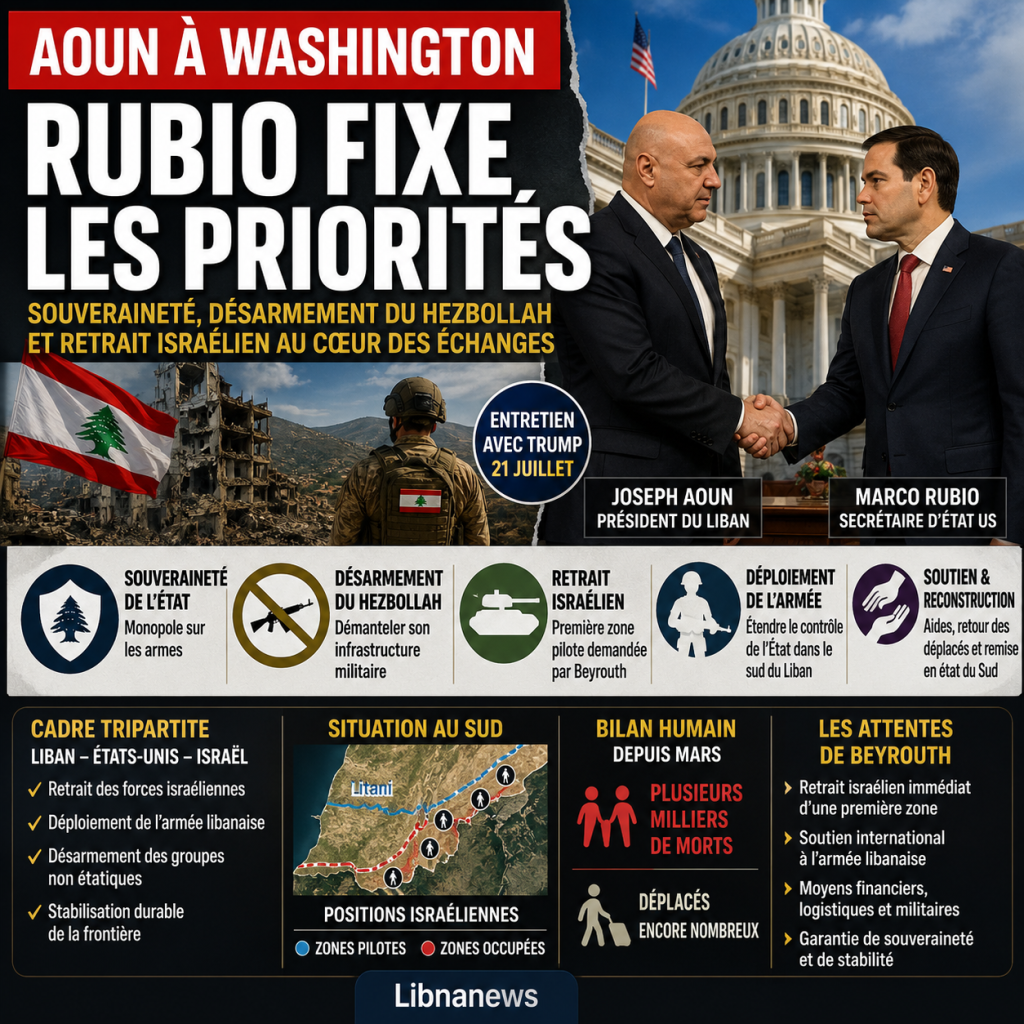
Lebanese President Joseph Aoun began an official visit in Washington, D.C., dominated by issues of sovereignty, security and implementation of the framework negotiated between Lebanon, the United States and Israel. Arriving in the US capital before his scheduled meeting with President Donald Trump on Tuesday 21 July, the Head of State met on Sunday with Secretary of State Marco Rubio. This first sequence set the tone for moving. The US official welcomed the Lebanese authorities’ action in favour of the state monopoly on arms and reaffirmed Washington’s commitment to Beirut. Joseph Aoun, for his part, requested concrete coordination in order to obtain an Israeli first withdrawal from the areas concerned by the negotiated arrangement. Aoun’s visit to Washington comes as the Israeli army maintains positions in southern Lebanon, many people remain displaced and Hezbollah rejects direct discussions with Israel and measures aimed at its disarmament.
A first meeting with Marco Rubio
The meeting between Joseph Aoun and Marco Rubio was held in the State Department. It focused on the implementation of the tripartite framework concluded under American mediation. According to the official U.S. record, both officials reviewed the steps needed to move this mechanism forward. The text provides for parallel progress on several files. It combines the withdrawal of Israeli forces, the deployment of the Lebanese army, the treatment of weapons held by non-State groups and the preparation of a lasting stabilization of the border. The meeting preceded by two days the meeting announced between Joseph Aoun and Donald Trump at the White House. It also enabled the US administration to clarify publicly its reading of Lebanon’s expected commitments.
Marco Rubio has made particular comments based on the actions of the Lebanese President and his Government. The Secretary of State praised the » courage » of the Lebanese authorities, which he presented as engaged in a determined effort to restore the country’s sovereignty. He cited three objectives: disarming Hezbollah, dismantling its military infrastructure and leading Lebanon towards peace. The US communiqué places the issue of Shiite weapons at the heart of the Washington-Beirut partnership. He does not present it as a separate file from the Israeli withdrawal. Both components are part of the same implementation framework, with the Lebanese Armed Forces expected to regain control of the sectors concerned.
Rubio salutes the » courage » of the Lebanese government
Marco Rubio’s choice of words marks the official American position at the beginning of this visit. Washington supports the authority of the Lebanese State and considers that it should be exercised throughout the country. The Secretary of State also reaffirmed United States support for the tripartite framework and Lebanese efforts to achieve peace. However, its communiqué does not provide a complete timetable or precise date for the Israeli withdrawal of the various positions. It also does not detail the technical mechanisms that would be used to verify the withdrawal of weapons and combatants from areas under Lebanese Army control. These points remain at the centre of the negotiations with the American mediation.
Joseph Aoun stressed to his interlocutor the need to align Lebanese and American positions. The President requested that the first stage of the scheme be translated into an Israeli withdrawal from the first pilot zone. Beirut wants the application of the framework to begin with a visible movement on the ground. The Lebanese authorities are thus seeking a measure to accompany the deployment of the army and to strengthen the credibility of the agreement. The request came after discussions in Rome between Lebanese and Israeli representatives under American sponsorship. Participants described these exchanges as positive, without announcing a final deadline for the start of the withdrawal.
Pilot zones at the centre of negotiations
The pilot areas are the first phase of the negotiated mechanism. They must allow the deployment of the Lebanese army to specific areas, in parallel with the verification of the absence of weapons and Hezbollah fighters. Several localities on both sides of the Litani River were mentioned in the information published on the scheme. Monitoring procedures remain under discussion. The possibility of assigning part of the verification to a third party was raised, without a final decision being announced. The United Nations Interim Force in Lebanon is among the actors mentioned in the exchanges, but no new mandate has been confirmed at this stage.
The framework signed in Washington on 26 June sets out a road map between the parties. It provides for the gradual withdrawal of the Israeli army from southern Lebanon and the deployment of Lebanese armed forces. It also deals with the disarmament of groups that escape State authority. Its implementation depends on coordinated and verifiable steps. Israel links its withdrawal to the neutralization of the threat to Hezbollah. Lebanon, for its part, calls for the Israeli withdrawal to begin in order to enable the army to effectively extend its control. The United States has a central position in this mechanism, as it has sponsored the agreement and continues its contacts with both delegations.
Aoun prepares his meeting with Donald Trump
Aoun’s visit to Washington should allow the Lebanese president to defend this sequence before Donald Trump. According to the information provided before his departure, Joseph Aoun intends to submit a written proposal to the US President. This document would cover the treatment of the Hezbollah arsenal and the conditions for the restoration of Lebanese sovereignty. The Head of State should also ask Washington to exert its influence on Israel in order to enforce the planned withdrawal. Tuesday’s meeting will be the first face-to-face meeting between the two presidents since Joseph Aoun arrived in Baabda.
The meeting at the White House is also of an institutional nature. No Lebanese president had been received in this framework for nearly 20 years. The previous visit to this level went back to the presidency of Michel Sleiman, received by Barack Obama in 2009. Joseph Aoun therefore went to Washington in an exceptional configuration, marked by direct American involvement in the negotiations between Lebanon and Israel. His trip also took place in the second year of his mandate, after a first phase focused on institution-building and support to the army.
The Presidency’s arms monopoly
Former commander-in-chief of the army, Joseph Aoun made the state’s arms monopoly one of the commitments of his mandate. At the time of his inauguration, he had affirmed the right of the State to exercise this monopoly alone. This position was then taken up by the government. The Lebanese army deployed units in the south and recovered weapons depots after the previous clashes. However, the new regional conflict has interrupted this dynamic and aggravated the security situation. Israeli strikes and ground operations have resulted in heavy casualties, extensive destruction and further displacement.
The Lebanese authorities present the deployment of the army as the basis for any stabilization. They require additional financial, logistical and military resources to carry out this mission. Washington remains one of the main supporters of the Lebanese Armed Forces. Joseph Aoun’s relationship with American officials was built during his years as head of the military institution. This cooperation is an important part of the visit, even though Sunday’s public statements focused on the tripartite framework, Israeli withdrawal and Hezbollah weapons.
Hezbollah rejects the process
Hezbollah rejects the process initiated by the government. The movement refused its disarmament and challenged direct discussions with Israel. It considers that negotiations cannot proceed as long as the Israeli army remains present on Lebanese territory. This opposition weighs on the application of the device. It puts the authorities in the face of a sensitive internal equation, while the government claims to want to avoid a new internal confrontation. Joseph Aoun maintained his line in favour of exclusive State control of arms, while stressing the need for Israeli withdrawal and respect for Lebanese sovereignty.
The war revived in the spring profoundly changed the political calendar. Hezbollah opened fire on Israel on 2 March in support of Iran, then targeted by American and Israeli operations. Israel responded with an air and land campaign in Lebanon. The Lebanese Ministry of Health has reported several thousand deaths since the beginning of this new phase, without systematically distinguishing between civilians and combatants. There have been extensive destruction of southern localities. Part of the population has not been able to return to their homes, while needs for rehousing and reconstruction continue to increase.
Direct negotiations under US mediation
In this context, Joseph Aoun called for direct discussions with Israel. This decision has opened the highest political contacts in decades between the two countries, which do not have diplomatic relations. Negotiations began with American mediation and then continued in Washington and Rome. They are not yet a peace agreement. These include the long-term cessation of hostilities, withdrawal of forces, the deployment of the Lebanese army and security assurances. The Lebanese President has not so far accepted the idea of a meeting with Israeli Prime Minister Benjamin Netanyahu.
Marco Rubio’s comments are therefore taking place at a time when Washington is seeking to transform the political framework into operational measures. The Secretary of State publicly associated Lebanese sovereignty with the disarmament of Hezbollah and the dismantling of its military capabilities. This formulation should be repeated in the Lebanese President’s discussions with the United States officials. It also sets out the position that the Trump administration will defend in the follow-up to the negotiations. The Lebanese authorities, however, insist on the reciprocity of commitments and the need for an effective Israeli withdrawal.
A first field test
The first pilot zone should be used as a test. Discussions focused on how to confirm that the sectors concerned no longer contain Hezbollah weapons, positions or fighters. They also concern the moment when the Israeli army will leave the points it occupies. Lebanese units have already been redeployed to certain locations mentioned in the scheme. However, several of these areas are outside the area where Israeli forces are currently present. The next step should therefore concern a point where an actual withdrawal can be observed and verified.
Joseph Aoun should use his interview with Donald Trump to ask for an American decision on this sequence. The Lebanese President believes that Washington’s influence on Israel can unlock the first phase. It also intends to present the commitments of the Lebanese State on the control of the territory and the treatment of weapons. The full content of the written proposal was not made public. No official timetable was announced for its implementation. Tuesday’s meeting should indicate whether the United States supports an immediate withdrawal of a first zone and what guarantees will be required in return.
Reconstruction and support to the army
The economic issue will accompany the security discussions. The reconstruction of the south, the return of internally displaced persons and the rehabilitation of infrastructure require funding that Lebanon cannot mobilize alone. The US administration links the return of stability to the application of the political and security framework. Marco Rubio presented the march towards peace as a condition for recovery. The Lebanese authorities seek international support without waiting for the full resolution of all disputes. They want to consolidate the army, restore public services in the affected areas and prepare for the return of the inhabitants.
The visit takes place as Lebanon continues to face the consequences of the financial collapse that began in 2019. The State has reduced budgetary margins. The military itself suffered the effects of the depreciation of the currency and the decline in the purchasing power of its members. Joseph Aoun had warned, when he was running the institution, about the risk of a weakening of his operational capacity. Foreign aid has maintained certain essential functions. Expanded deployment in the south will, however, require additional long-term staff, equipment and resources.
The trip to Washington also includes contacts with US political and security officials. Their detailed content has not yet been published. The Lebanese Presidency focuses its communication on the meeting with Donald Trump and on seeking support for the country’s sovereignty. The report of the State Department shows that the Hezbollah file will remain indisputable. It also confirms that the United States expects concrete measures from the Lebanese Government. At the same time, Beirut awaits US action with Israel.
A calendar still missing
The positions expressed on Sunday do not remove the obstacles present on the ground. Israel did not announce a date for its withdrawal from the first pilot zone. The verification mechanism remains to be established. Hezbollah maintains its rejection of disarmament. The Lebanese army must still be provided with the necessary means to occupy the sectors concerned in a sustainable manner. The United States expressed support, but the transition from statements to operational measures would depend on the decisions taken after the White House meeting.
The diplomatic sequence will continue on Tuesday 21 July with the interview between Joseph Aoun and Donald Trump. The Lebanese President must present his requests for Israeli withdrawal, support for the army, reconstruction and implementation of the tripartite framework. Marco Rubio’s remarks have already defined American priorities: state sovereignty, the disarmament of Hezbollah, the dismantling of its military infrastructure and progress towards peace. The next concrete indication will be the announcement, or not, of a timetable for the Israeli withdrawal from the first pilot zone and the verified deployment of the Lebanese army.




