

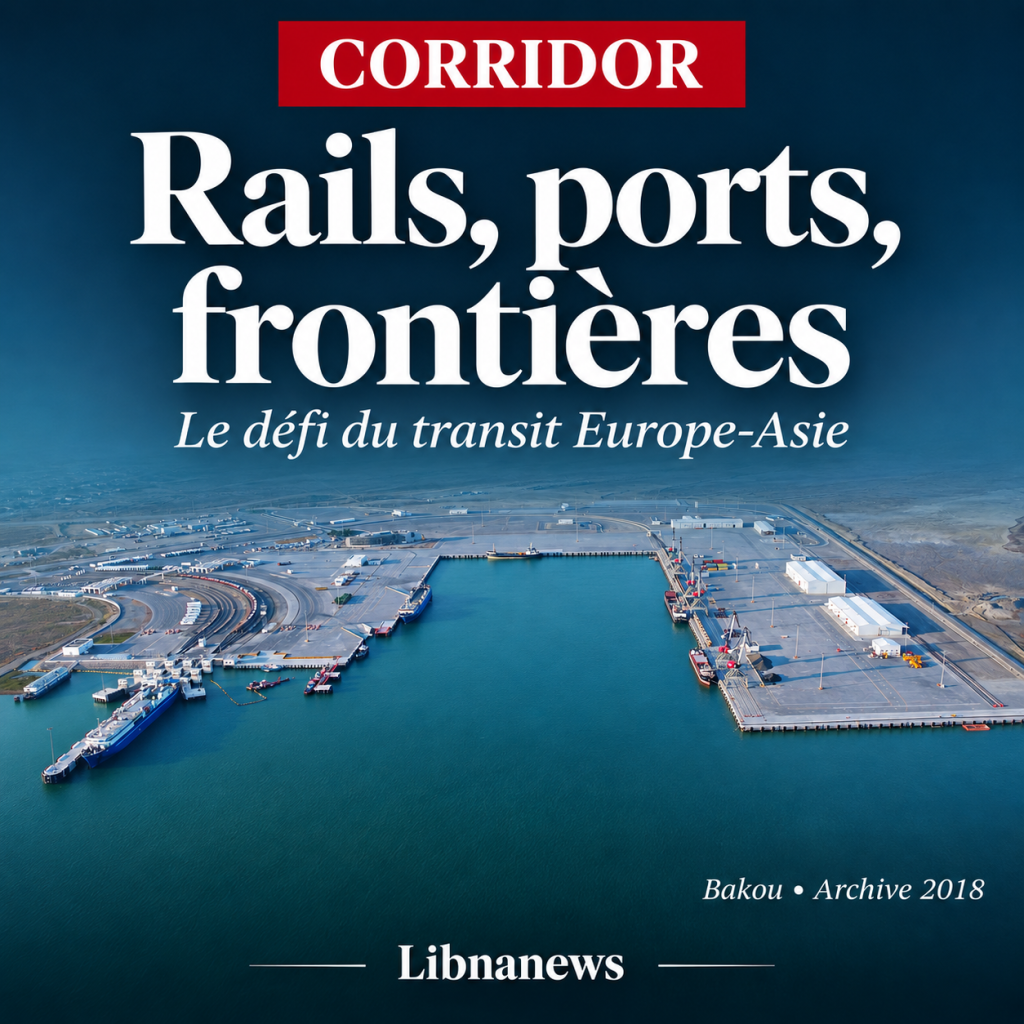
The Trans-Caspian corridor will not gain its place in Europe-Asia trade with rails alone. Meeting in Brussels on 16 November 2026, European officials and their regional partners placed borders, customs and the reliability of services at the centre of their roadmap. The railway and port projects in Kazakhstan measure this scale change. They also show why a bank guarantee, a funded yard and an effectively available capacity remain three different realities.
Trans-Caspian corridor in front of the border test
The ministerial meeting was co-chaired by Kaja Kallas, Marta Kos and Jozef Síkela. Its conclusions call for enhanced customs cooperation and better coordination of operators. The objective goes beyond infrastructure construction: to reduce delays and make deliveries predictable for businesses.
This priority corresponds to the very nature of the route. The corridor combines rail sections, sea crossings and road links between Asia and Europe. A commodity must therefore move from one network to another. Accelerating a section is not enough if the next transfer remains uncertain.
In Kazakhstan, a guarantee to finance rail
A project approved on 25 March 2026 illustrates the resources mobilized. The Asian Infrastructure Investment Bank provides a partial debt guarantee of $564 million. It is to accompany the construction of 322.3 kilometres of track between Mointy and Kyzylzhar, Kazakhstan.
At the same time, the International Bank for Reconstruction and Development provides partial credit guarantees of up to $846 million. Both institutions must cover part of KTZ’s repayment obligations to commercial banks. The Kazakh State is making the sovereign commitments provided for in this assembly.
Therefore, these are not two grants paid out of lost funds. These instruments should facilitate the mobilization of long-term private capital. The new line aims to shorten the route and bypass congested sections. However, the financial approval does not prove its completion or opening to traffic. The project sheet presents an investment to increase capacity, not a gain already seen on deliveries.
Aktau: two docks at the heart of the sea passage
The Kazakh port of Aktau is another decisive crossing point. The European Bank for Reconstruction and Development ranks its modernisation operation at the « signed » stage. Approved in July 2025, the financing includes a loan of up to €35 million over 10 years. The total cost of the project included in its sheet is EUR 55 million.
The work concerns docks Nos. 3 and 12. The acquisition of two transfer cranes between ship and dock must improve container handling. These equipment respond to a specific problem: to track the increase in land arrivals with an adapted maritime capacity.
The project also includes environmental and safety obligations. In particular, the assessment identifies the necessary improvements in electrical safety, fire prevention and control of on-site companies. It calls for better monitoring of water and spill risks. Increasing traffic is therefore not simply adding lifting gear: the port operation must absorb this activity under controlled conditions.
Handling objectives, not a completed balance sheet
In its presentation of the operation, the bank referred to a possible European grant of EUR 10 million. This supplement was presented as potential. Do not automatically assimilate a payment made.
The equipment must double the capacity of the containers. The average handling time would increase from four minutes to two and a half minutes per container. These are project objectives, not certified results for November 2026.
The distinction also applies to volumes. The 121% increase mentioned in this announcement concerned container traffic observed during 2025. It is not a growth rate for 2026. Mixing these periods would give a misleading picture of the rise of the corridor.
Regional needs exceed projects undertaken
A World Bank study, published on 28 September 2026, sets needs on another scale. It estimates that more than $25 billion in physical infrastructure is needed by 2040. It adds about 30 billion for equipment and connections that make the whole system usable: internal terminals, railway equipment, local connections and digital systems.
These amounts represent an estimate of requirements. They do not form an envelope already assembled. The study also modeled a possible tripling of exchanges and a split of journey times by two. With complementary reforms, gains could be greater. They remain conditional.
In particular, the bank advocates a common digital system for transport and transit data. It also recommends better integration of rail and maritime services. The monitoring of the corridor will therefore have to cover several distinct indicators: progress of work, the funding actually mobilized, the passage times and the regularity of services offered to shippers.





Comments