

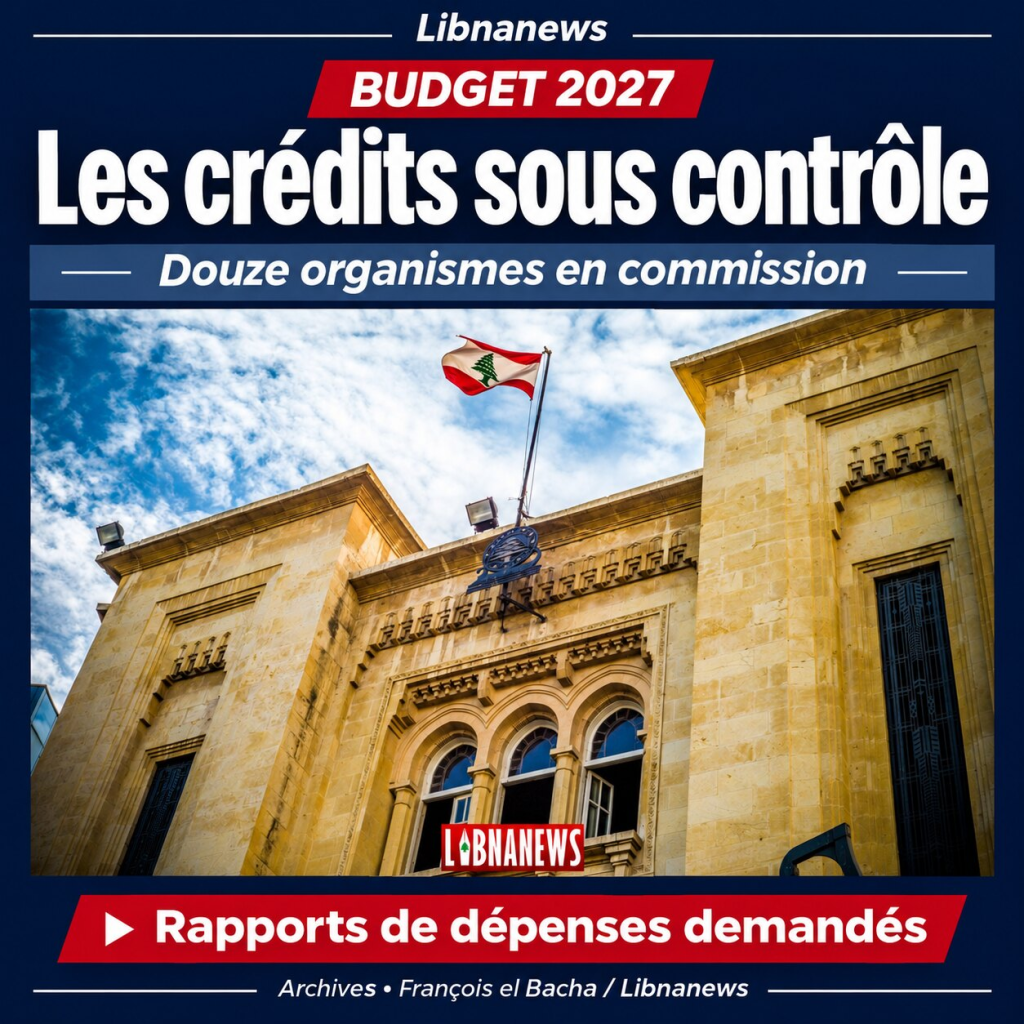
The Finance Committee examined the appropriations of twelve bodies and demanded detailed accounts, with certain reservations. The case of the National Human Rights Commission illustrates the issue: justifying the expenditure, but also distinguishing an announced envelope from the means actually available to carry out a mandate.
Approval in committee did not conclude the examination of the accounts. On 18 November, the Parliamentary Finance and Budget Committee, chaired by Ibrahim Kanaan, approved the budgets of twelve agencies under the 2027 Finance Bill. It simultaneously requested detailed statements of expenditure and activity, suspending certain appropriations pending clarification.
This combination is important. It does not mean that the twelve institutions are deprived of funding or that all the amounts requested are definitively acquired. It describes an ongoing parliamentary work, which is not worth adopting the finance law by the House.
Very different missions, same request for justification
The bodies examined range from the National Human Rights Commission to the missing, including the civil servants’ cooperative, the National Archives, IDAL or the Tripoli Special Economic Zone. Food safety and cannabis regulation authorities are also among the budgets approved in committee.
In its report, Parliament reported on a joint request: linking appropriations to the use of funds and the activities carried out. With regard to human rights, Ibrahim Kanaan stated that he had requested a review of the previous year and the reasons for the additional sums requested. It presents the approach as an account review, without announcing the initiation of an investigation.
However, the diversity of mandates prohibits measuring these institutions with a single indicator. A supervisory authority, an investment body and a service establishment shall have neither the same expenditure nor the same expected results. A statement of the amounts consumed answers the question of their use; An activity report has yet to show which missions they have served.
Human rights quantify their demand
The National Human Rights Commission issued its own presentation of the meeting. She said she had requested £99.488 billion for 2027, while the project maintained its allocation at £50.990 billion, as in 2026. It links the additional request to its capacity to recruit, handle complaints and conduct preventive visits to places of detention.
According to his report, MEPs promised an additional 30 billion on the budget reserve, subject to the written justification requested. This supplement would raise the envelope to £80.990 billion, even lower than demand by £18.498 billion. This is an undertaking reported by the institution, not a payment made.
The Committee on Human Rights also recalls that an additional 30 billion was not approved when the 2026 budget was examined. This time she asks for an explicit guarantee on the amount and its availability. This precedent is presented by the institution itself; It explains why it distinguishes the political promise of effective access to credits.
List, authorize, make available
The file thus highlights three successive questions. How much is required to fulfill the mandate? What amount will eventually be included in the adopted budget? And under what conditions can the organization actually use these means? One response to the first does not automatically resolve the other two.
For parliamentary scrutiny, the interest of the documents claimed is to make arbitrations readable. A request for an increase must specify the new expenditure it would finance. On the other hand, the maintenance of an amount must be reconciled with the missions to be carried out: extending a line does not demonstrate that the means are sufficient.
Monitoring cannot therefore be limited to the heading announcing approved budgets. The next useful documents will be the justifications given, the appropriations finally retained and, for the supplements announced on the reserve, the decisions enabling them to be mobilised. It is their concordance that will make it possible to distinguish an assured funding from an intention still to translate into acts.
Photograph of Parliament archives: © François el Bacha / Libnanews. Date of shooting unknown; This image does not represent the November 18 session. Editorial dress.





Comments