





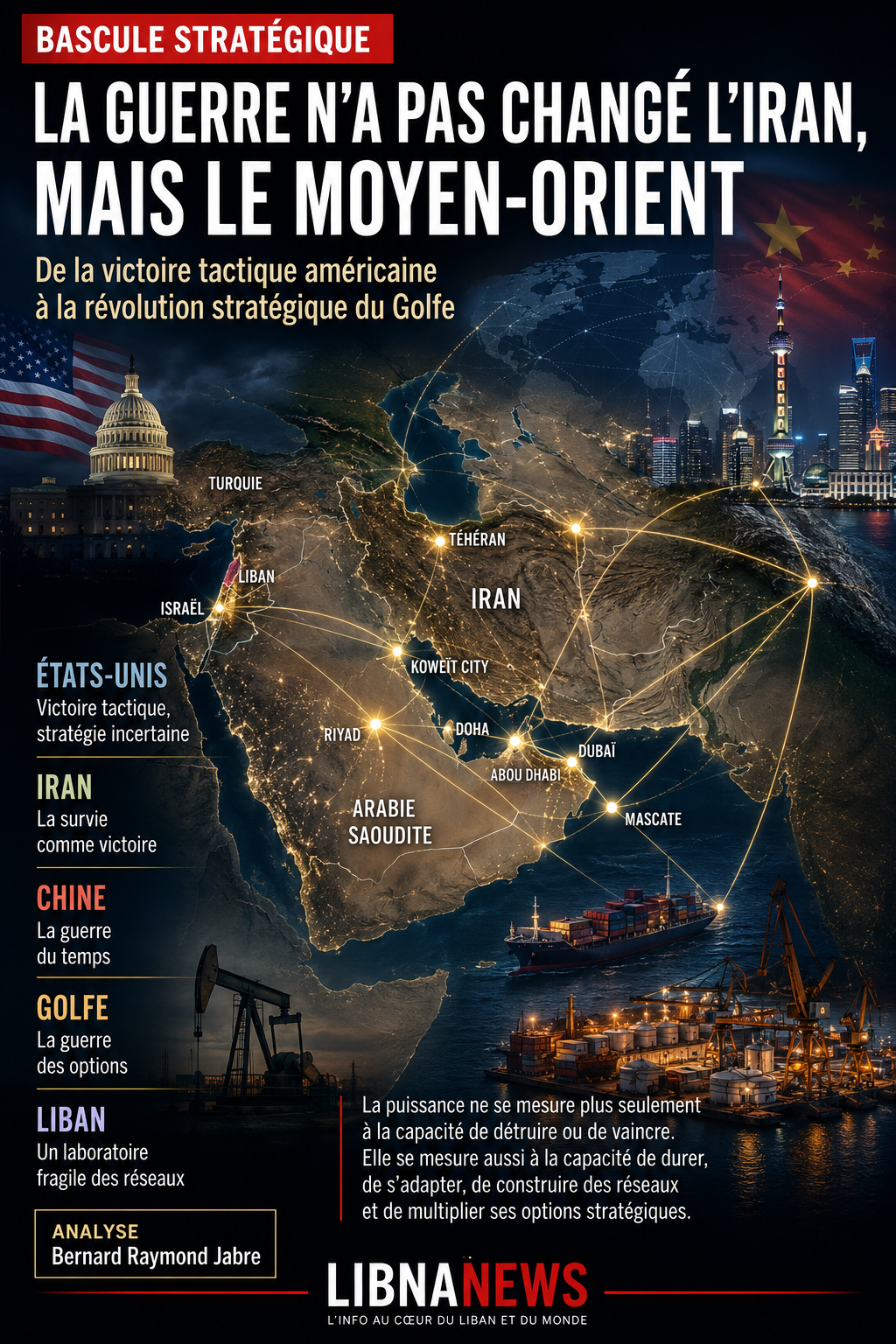
From American tactical victory to the Gulf Strategic Revolution
This war between the United States, Israel and Iran revealed something deeper than a simple military confrontation. It revealed a transformation of the international system: the gradual transition from a world of empires to a world of networks.
Behind missiles, air strikes, secret negotiations and official statements, a more discreet reality has emerged. Power is no longer limited to the ability to destroy or defeat. It also measures the ability to last, adapt, build networks and multiply its strategic options.
As often in history, contemporaries looked at events while profound transformations took place in the background.
The first lesson of this war concerns the fundamental difference between tactics and strategy.
The tactic answers a simple question: how to win a battle?
The strategy answers a much more difficult question: what can we do with this victory?
At the tactical level, the United States has demonstrated undeniable superiority. Their military projection capability, intelligence control, technology and operational coordination remain unique. Israel has also demonstrated remarkable effectiveness in identifying, striking and neutralizing certain threats.
But when weapons are silent, the strategic issue remains.
Iran is still here.
His institutions are still there.
His Pasdarans are still here.
Its regional influence, although weakened, remains present.
In other words, the battle was won, but the desired transformation did not occur.
This phenomenon is not new in history.
Napoleon entered Moscow but lost Russia.
The United States won most of the battles in Vietnam but did not transform the political outcome of the conflict.
Afghanistan experienced 20 years of western military domination before returning to its starting point.
The tactical victories are visible immediately.
Strategic outcomes are only revealed years later.
One reason for this resilience is the very nature of Iran.
Much of Western analysis continues to observe Iran as a mere authoritarian regime. Iran is more than a regime. It’s a civilization.
Historical continuity of more than two thousand years.
Empires followed each other.
Dynasties appeared and then disappeared.
Ideologies have changed.
But Persian identity survived.
This historical depth produces exceptional resilience.
The Iranian system is based on several levels of power: the Supreme Leader, the Pasdarans, the Bassidjis, the regular army and the state administrative apparatus. This architecture creates a form of institutional redundancy. When one component is weakened, the others take over.
The Iranian objective was not necessarily to win the war.
The goal was to survive.
And in long conflicts, survival is often a form of victory.
Yet the real surprise of this war may not be in Washington, Tehran or Jerusalem.
It is located in the capitals of the Gulf.
To Riyadh.
In Abu Dhabi.
In Doha.
To Muscat.
Kuwait City.
For several decades, the Gulf monarchies had lived in a relatively simple equation: American security against regional stability and energy cooperation.
This equation seemed almost natural.
Then several events gradually changed this perception.
Abqaiq’s attack.
The American withdrawal from Afghanistan.
Then this war.
The problem is not American power. No one in the region seriously doubts this power.
The problem has become predictability.
More precisely: permanence.
Gulf leaders have understood that an ally can be extremely powerful without being automatically available in all circumstances.
This awareness triggered a silent intellectual revolution.
The Gulf began to reason as an asset manager.
Any experienced investor knows that a concentrated portfolio is vulnerable, even when it is based on an excellent asset.
Diversification reduces risk.
The Gulf States now apply this logic to geopolitics.
The United States remains an essential partner.
But they are no longer the only option.
China is becoming a partner.
India becomes a partner.
Europe remains present.
Regional relations are developing.
Turkey is taken into account.
Even Iran sometimes becomes another interlocutor.
This strategy is not based on ideology or emotion.
It is based on risk management.
The sovereignty of the twenty-first century increasingly resembles a well-built portfolio.
China has fully understood this development.
While others managed the crisis, Beijing continued its course.
China’s strength lies less in its military power than in its ability to think over decades.
Where democracies often reason on an electoral scale, Beijing is reasoning on a historical scale.
The Silk Roads perfectly illustrate this logic.
China is not just trying to control it.
She’s trying to connect.
Ports.
Infrastructure.
Logistics corridors.
Energy networks.
Trade flows.
Data.
Power now comes from centrality as well as domination.
China does not necessarily seek to win wars.
She’s trying to save time.
Faced with it, Europe appears to be a paradox.
Never before did a region have such advantages.
A huge economy.
An international currency.
Prestigious universities.
A remarkable institutional quality.
Yet, when a geopolitical crisis breaks out, Europe often struggles to speak with one voice.
His problem is not economic.
He’s strategic.
How can we turn a market into power?
How can we transform a union into a political will?
The answer remains incomplete.
Then the case of Lebanon appears.
At first glance, Lebanon seems to be one of the great losers of modern history.
Yet it is also a fascinating laboratory.
The emerging world is becoming increasingly complex.
Identities overlap.
The influences cross.
Membership is growing.
From this perspective, the 21st century is gradually more like Lebanon than the old homogeneous nation states.
But this wealth carries a risk.
That of constantly looking outside what should be built inside.
This is where the comparison with Singapore becomes enlightening.
In the 1950s and 1960s Singapore had several contradictory influences.
Chinese.
Indian.
Malaysian.
British.
On the day when Singapore’s leaders decided that Singapore’s interest should take precedence over all other affiliations, the state could truly emerge.
Lebanon continues to face the same issue today.
Who will protect us?
But: what do we want to build together?
For no external alliance replaces a national project.
Behind all these developments is an even deeper transformation.
The world gradually ceases to be organized as an empire.
It becomes a network.
For centuries the power was vertical.
Today, it becomes horizontal.
The most successful actors do not necessarily seek to dominate.
They seek to become indispensable.
Singapore.
Dubai.
Qatar.
The big financial hubs.
The big logistics hubs.
All work according to this logic.
Centrality gradually replaces domination.
This transformation also changes the very definition of sovereignty.
For a long time, being a sovereign meant not dependent on anyone.
This definition is no longer appropriate.
Nobody is completely independent.
True sovereignty now consists in relying on sufficient actors to avoid being a prisoner of any.
This is precisely what the Gulf is building today.
And this may be the main strategic consequence of this war.
Geopolitical picture of war
Actor Tactical Victory Strategic Victory Note /100
China Low Very strong 95
Iran Average Strong 88
Oman Low Very strong 85
Qatar Low Strong 82
United Arab Emirates Low Strong 80
Saudi Arabia Low Strong 78
United States Very strong Average 62
Kuwait Low Average 60
Lebanon Low Limited 55
Russia Low Limited 52
Bahrain Low Limited 50
Hezbollah Very Low Low 40
Europe Very low Low 35
Israel Strong Very low 30
This classification does not measure gross power.
It measures the strategic repositioning produced by war.
And that’s exactly what makes him interesting.
At the end of this analysis, four conclusions are required.
The United States won the tactical war.
Iran won the war of survival.
China has won the war of time.
The Gulf won the options war.
But perhaps the deepest lesson is elsewhere.
The empires built the modern world.
The networks will probably build the coming world.
The empires sought domination.
Networks are looking for centrality.
The empires demanded alignment.
Networks reward diversification.
The empires promised protection.
Networks offer options.
This war may not have changed Iran.
It may have changed the way the Middle East views its security, sovereignty and future.
The missiles stopped flying.
Ideas only begin their journey.
Bernard Raymond Jabre