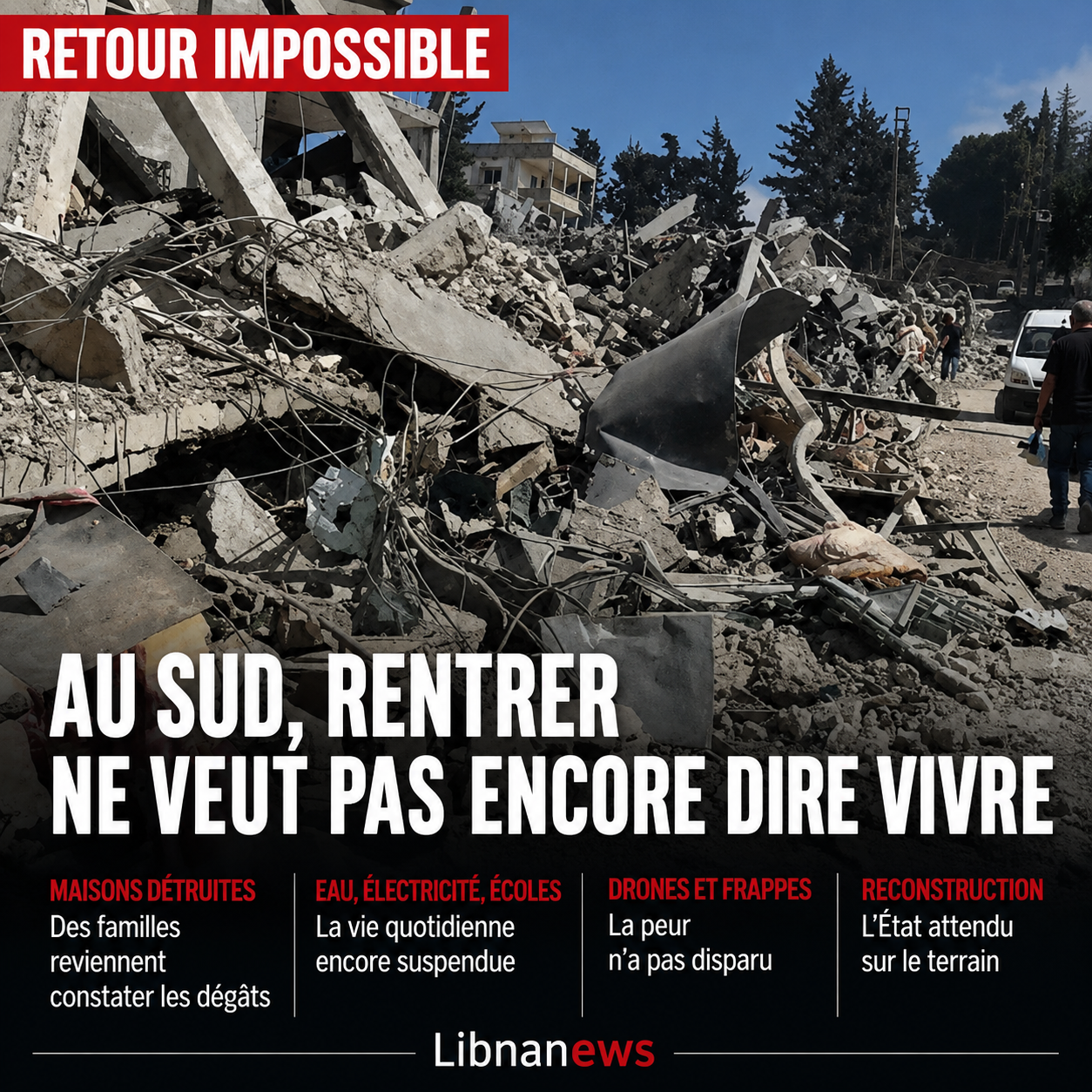
The families of South Lebanon come back in waves, often without certainty, sometimes only for a few hours. The roads reopened after the announcement of the de-escalation saw cars passing loaded with mattresses, bags, cans, blankets and souvenirs recovered in the emergency. But returning to the South does not yet mean returning to normal life. In a number of localities, the inhabitants discover empty houses, neighbourhoods without water or electricity, unusable schools, destroyed shops and still dangerous streets. Israeli drones remain present. Point strikes continue to be reported. The ceasefire has lifted some of the immediate fear, but it has not yet made the villages habitable.
From car lines to uncertainty
The first sign of the new phase appeared on the roads. Displaced families have left shelters, schools, rented apartments or family homes to return to southern Lebanon. Some wanted to check their housing condition. Others were looking for papers, jewellery, photos, tools or merchandise that were still intact. Many had no intention of staying at night. Return often starts with an inspection, not with an installation.
According to Reuters, the Lebanese authorities warned the displaced against a return too soon after the announcement of the agreement between the United States and Iran. The danger is not limited to visible destruction. Areas remain unstable, roads can be damaged and localized strikes or shots continue to be reported. This formal prudence reflects the gap between the diplomatic announcement and the field.
In villages, the shock is read in gestures. The inhabitants walk in the rubble, look for a door, recognize a wall, raise a sheet metal, look at a staircase that leads to nothing. Houses are not just buildings. They contain the traces of a family life, the savings invested for years, the children’s rooms, the lounges, the agricultural reserves, the working tools. To return is to measure in a few minutes what the war has taken away.
This movement is also social. Those who still have a repairable home can consider a gradual return. Those whose homes are destroyed must return. Those with relatives, diasporas or political resources can look forward to faster assistance. Others await the state, municipalities, associations or an international promise. The return thus already reveals inequalities in reconstruction.
Houses destroyed, neighborhoods erased
Destruction is not limited to border villages. Deeper cities and towns in the South have been hit, evacuated, destroyed infrastructure and damaged shops. The Associated Press described the limited return of families to Nabatiyah, where residents came to see the damage in ravaged houses and markets, despite the continuation of localized fighting in the surrounding area. Several residents found uninhabitable housing, without essential services and with fear of a resumption of bombing.
The material balance gives the measurement of the shock. Reuters reported that the conflict had damaged or destroyed about 68,000 housing units, with more than 1.2 million displaced at the height of the war. The agency also refers to thousands of deaths, affected hospitals and weakened civilian infrastructure. These figures are not just a military crisis. They describe a crisis in housing, public health, education and municipalities.
Destruction also has a local economic dimension. In many municipalities, a house houses a shop, a workshop, a depot, a cold room, a store of tobacco, olives, mechanical parts or goods. When the building falls, the income falls with him. Physical return becomes insufficient. A family can return to their village and lose their jobs. A merchant can open his grill and discover that he has nothing left to sell. A farmer may return to land inaccessible or damaged.
Reconstruction will therefore not only be a matter of concrete. It will have to re-start a local economy. Roads, water, electricity, telephone networks, schools, clinics, gas stations and markets form the backbone of village life. Without these services, residents can return by day, but cannot resume a stable existence.
Return does not mean the end of war
The ceasefire changed the atmosphere, but not the perception of security. In the South, many people have already experienced fragile truces, hasty returns and new evacuations. Recent memory feeds prudence. The noise of a drone may be sufficient to interrupt house cleaning. A strike in a nearby village can push dozens of families to Saida, Beirut or Bekaa.
The Guardian has received this caution among Lebanese tired of the war, some claiming to want to be 100 per cent sure before returning permanently. The newspaper reports that the Lebanese Army has warned against premature returns, particularly due to the presence of still dangerous areas, explosives and persistent military activities.
The events of the last few days confirm this concern. Reuters reported that Israeli drone strikes killed at least four people in southern Lebanon on 16 June, following the announcement of the de-escalation. Another strike had already killed a motorist in the South, the first fatal incident reported after the announcement of the American-Iranian agreement.
This persistence of strikes blurs the message sent to the inhabitants. Diplomats talk about a ceasefire. Families still see drones. The authorities are calling for patience. The displaced want to go home. Municipalities are asking for resources. Hezbollah presents the return as proof of resistance. Israel claims to want to maintain its freedom of action against threats. Between these stories, the Southern civilian must decide whether he sleeps at home or leaves before the night.
Return therefore becomes an act of courage, but also of calculation. Each family evaluates the distance to the border, the state of the road, local rumours, the presence of the army, the possibility of reaching a relative, the level of destruction and the needs of children. Peace is measured here in simple gestures: let the children sleep, open a tap, turn on a refrigerator, send a student to school, reopen a pharmacy.
Housing emergency
The first need is housing. A partially damaged house can be secured, stashed, cleaned and repaired. A destroyed house imposes an alternative shelter. Families who have lost their homes must choose between staying displaced, occupying a collective building, settling with relatives or returning in precarious conditions. This situation can last a long time if no national plan is implemented quickly.
The authorities will need to identify the damage with methodology. Without a reliable inventory, the aid will be challenged. A distinction should be made between destroyed houses, heavily damaged housing, repairable buildings and affected economic property. Municipalities are often aware of families, neighbourhoods and priorities. But they lack resources. The state must therefore involve town halls, the army, ministries, engineers, NGOs and international donors.
The emergency also requires temporary shelters. Many internally displaced persons do not want to stay in schools or public premises, especially if the school year is to resume. Improvised shelters can quickly become unhealthy. They create fatigue, family tensions and prolonged dependence on food aid. A roofless return is not a return. It is a new form of displacement, this time in the midst of the ruins.
Housing finally raises a question of trust. Residents will return if they believe that the state, municipalities and foreign partners will not abandon them. They will stay if the first works start soon. They will leave if promises are lost in administrative lines, political rivalries or delays in funding.
Water, electricity, care: services before slogans
The second need is for services. In a destroyed village, drinking water becomes an emergency. Networks can be cut, wells contaminated, tanks damaged. Without water, families cannot clean, cook or resume a minimum life. Municipalities need fuel, parts, technicians and teams capable of quickly repairing pipelines.
Electricity is just as central. Lebanon was already suffering from a deep electrical crisis before this war. In the South, destruction worsens an old situation. Private generators can compensate for a time, but they require fuel. Families returning may have to choose between lighting, refrigeration, water pumping and telephone charging. This survival economy cannot sustain a massive return.
Care is a third front. The World described Tebnine Hospital as one of the last operational establishments near the border, receiving wounded after strikes and serving as a lifeline for dozens of villages. The settlement has treated a large number of wounded since the intensification of the conflict, while suffering damage and shortages itself.
Health is not limited to emergencies. Families returning need chronic drugs, follow-up care for the elderly, child care, psychological support and care for untreated injuries. Local clinics will need to be reopened quickly. Pharmacies must be supplied. Ambulances must be able to travel on safe roads. Health reconstruction will be one of the invisible conditions of return.
Schools as another measure of normality
A village returns to life when its schools reopen. For families in the South, the school question is often decisive. A parent may agree to return to a damaged house if he or she knows that his or her children will have a clear class, transportation, manuals and calendar. Conversely, the absence of school prolongs the displacement. It encourages families to stay in cities where children have been temporarily enrolled.
Schools in the South have suffered several forms of damage. Some were affected. Others welcomed internally displaced persons. Still others lost teachers, left with their families or prevented them from returning. Even when a building is still standing, the pedagogical rhythm is broken. Students experienced fear, departure, waiting, promiscuity and sometimes mourning.
Educational reconstruction must therefore begin early. It cannot wait for the complete end of military debates. Temporary classes, catch-up, safe school transportation and psychological support will be required. School can become an area of social stabilization. It can also reveal the failure of the state if it remains closed while families return.
This school dimension links return to long time. The houses can be repaired in a few months. Educational consequences are measured over years. A generation of students in the South may cumulate the effects of economic crisis, war, displacement and uncertainty. Physical return is not enough to repair this rupture.
Drones, roads and daily safety
Daily safety remains the condition that controls all others. People are asking not only for the absence of total war. They call for the absence of a permanent threat. A drone over a village, a cut-off road, a prohibited field, a targeted vehicle or a nearby strike prevent normality. Civil life cannot resume in an area where every displacement seems exposed.
Roads must be inspected. Buildings threatening to collapse must be reported. Unexploded ordnance must be identified and neutralized. Bridges, support walls, power lines and water systems must be secured. This task is the responsibility of the State, the army, the Civil Defence, municipalities and specialized organisations. It must precede any massive return to the most affected sectors.
Israeli overflights pose a political and practical problem. They remind the inhabitants that the decision to strike does not depend on their state. They feed Hezbollah’s discourse on the need to maintain military capacity. They weaken Lebanese officials who want to resettle the army as their main interlocutor. Each drone becomes a message: war can resume.
Road safety is also economical. Traders do not reopen if suppliers cannot pass. Farmers don’t come back if the workers fear the roads. Families do not return if ambulances cannot reach a village. Reconstruction therefore begins with safe routes.
State facing the return test
The return of the families of the South places the Lebanese state in front of a simple ordeal to formulate and difficult to succeed: to be present. Present in the damage census. Present in help. Present in security. Present in schools. Present in hospitals. Present in municipalities. Also present in the political discourse, to prevent reconstruction from being captured by partisan forces alone.
This presence is essential for national cohesion. If people in the South feel that the state abandons them, they will turn to community networks, parties, diaspora or foreign donors. These supports can be useful. But without public coordination, they will produce uneven reconstruction. Some villages will move quickly. Others will be waiting. Some families will receive several helpers. Other none.
Political risk is known. Fragmented reconstruction strengthens dependencies. She turns aid into loyalty. She feeds the accusations of favouritism. It prevents the birth of a national narrative around the South. But the return could be a moment of reaffirmation of the State, if it succeeds in organizing aid with transparency and efficiency.
This requires a civilian emergency plan. It should include a damage cadastre, a quick repair fund, a public list of priorities, local technical teams, coordination with expatriates, simplified procedures for families and independent monitoring. The goal is not only to rebuild walls. It is to restore confidence.
Between relief and anger
The return to the South produces contradictory emotions. The relief first: to see his village again, to touch his door, to find a neighbour, to pray in a familiar place, to walk in a known street. Then the shock: finding that the neighborhood has disappeared, that the house is no longer habitable, that the business no longer has a roof, that the children’s room is open to heaven. Then anger: against Israel, against the impotence of the state, against foreign powers, against slowness, against the promises of war and peace that are decided away from the ruins.
This anger can be transformed into solidarity. Families clean up together. Neighbors share the water. Young people clear the rubble. Municipalities are improvising. Diaspora sends money. Associations distribute food. But it can also become a fracture if aid is slow, inequality worsens or political debate resumes before people have a roof.
Physical return should therefore not be confused with victory. It’s a first step. It shows family attachment to their villages. It also shows the depth of the damage. The South does not only call for speeches of resistance, sovereignty or solidarity. It requires pumps, cables, ambulances, engineers, schools, housing and security guarantees.
The difference between returning to normal life and returning to normal life will be played in the next few days. Cars can come back soon. Families will only remain if the ceasefire holds, if the strikes cease, if the services resume and if the state turns compassion into an organization. In the destroyed villages, many have already taken the first step. They are now waiting for the return road not to bring them back to interior exile again.