

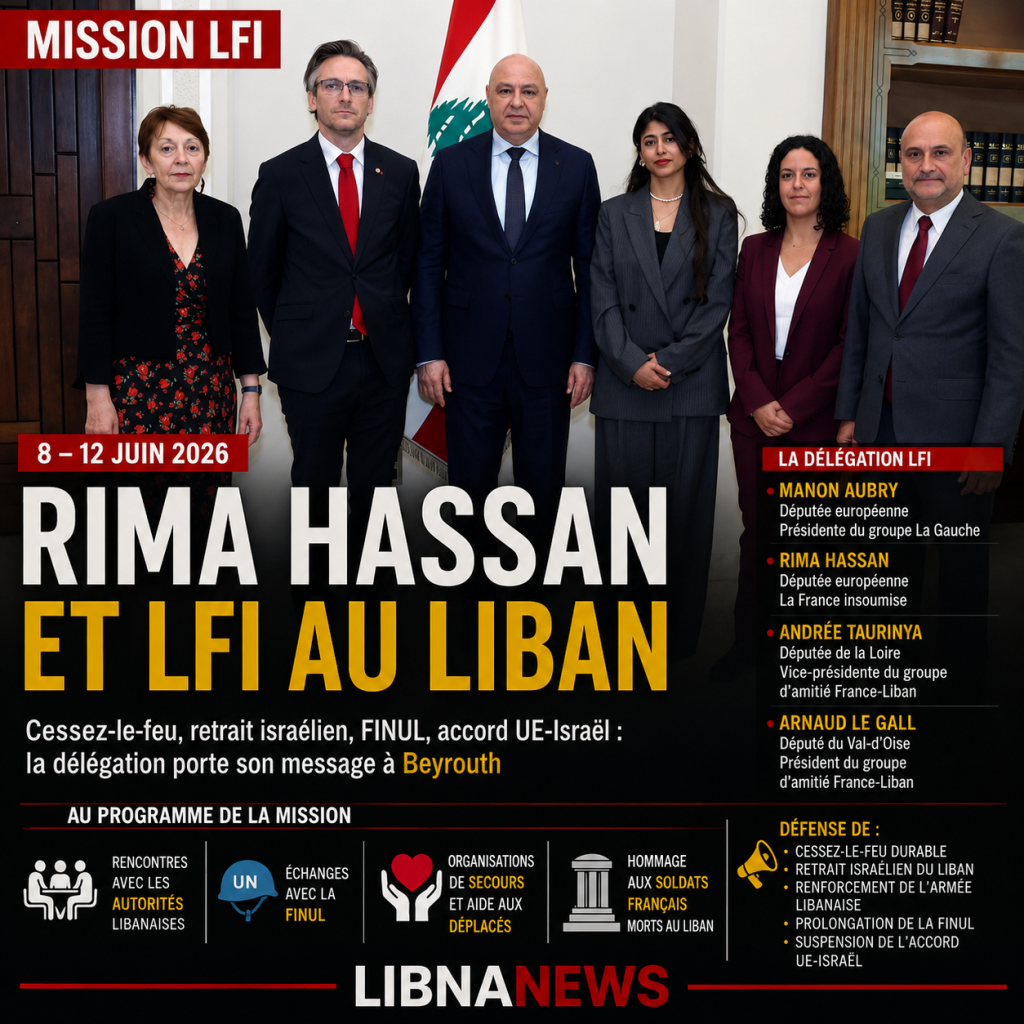
A delegation of four parliamentarians from La France insoumée is in Lebanon from 8 to 12 June 2026, according to a press release distributed in Beirut. The mission is presented by the movement as a displacement of solidarity with Lebanon, in a context of war, bombing, displacement and diplomatic discussions on a ceasefire. It brings together two MEPs, Manon Aubry and Rima Hassan, as well as two French MPs, Andrée Taurinya and Arnaud Le Gall.
The presence of Rima Hassan gives this visit a special resonance. The MEP LFI is known for his commitment to Palestinian and Middle Eastern issues. She accompanied Manon Aubry, President of the La Gauche Group in the European Parliament, as well as Andrée Taurinya, Member of Parliament for the Loire and Vice-President of the France-Lebanon Friendship Group in the National Assembly, and Arnaud Le Gall, Member of Parliament for Val-d’Oise and President of the same friendship group. The delegation intends to meet with Lebanese political leaders, national authorities, representatives of UNIFIL and relief organizations.
La France’s press release describes the visit as an official and political step. He claims that Lebanon is the victim of a war waged by Israel and mentions thousands of civilian casualties, including journalists, serving relief workers and children. The delegation wishes to recall several requests: an effective and lasting ceasefire, the withdrawal of the Israeli army from Lebanon, the strengthening of the Lebanese army, the extension of the UNIFIL mandate beyond 2026, the suspension of the European Union-Israel Association Agreement, and the friendly ties between the Lebanese and French peoples.
Meeting with Joseph Aoun
The meeting with the President of the Republic, Joseph Aoun, gave an institutional dimension to this visit. In a publication accompanied by a photo of the interview, Manon Aubry indicated that the delegation had been received in Beirut by the Lebanese Head of State. She reported that the President had insisted that diplomatic initiatives were cheaper than war. She also reported that Joseph Aoun had called for Lebanon not to be abandoned, while the country was facing heavy destruction, significant loss of life and massive displacement of civilians.
According to figures reported by Manon Aubry in this publication, more than 57 towns and villages have already been completely razed, more than 3,500 people have been killed since early March and 1.2 million people have been displaced. These elements were presented in the context of the exchange with the Lebanese President and the delegation’s call to step up diplomatic pressure for a lasting cessation of hostilities. They add to the data provided by several Lebanese officials and institutions on the destruction in the South, the humanitarian crisis and the need for an effective ceasefire.
Manon Aubry also reported a position of President Aoun on the Hezbollah issue. According to her, the Head of State considered that those who believe that they can disarm Hezbollah by military means are mistaken and that this method contributes to feeding it. This formulation places the political and diplomatic solution at the centre of the message conveyed by the delegation. It is part of a line that the Lebanese Presidency regularly puts forward: to avoid the extension of the war, to get a halt to the strikes and to put the southern issue in an institutional framework.
The same publication indicates that Joseph Aoun presented the diplomatic path as the only lasting outcome to the conflict with Israel. According to the reports, this outcome requires a lasting ceasefire, the withdrawal of the Israeli army from southern Lebanon and the return of the displaced. These three points agree with the claims mentioned in the press release of La France insoumée. They form the core of the public message conveyed by the four parliamentarians: the settlement cannot be limited to a military break, but must allow for a real stabilisation of Lebanese territory and the return of civilian populations.
A five-day political mission
The trip takes place over five days, from Monday 8 to Friday 12 June. The delegation initially planned meetings with the Lebanese political groups represented in Parliament and with the main authorities of the country. The communiqué does not yet detail the entire timetable, but it states that several Lebanese officials must receive French and European parliamentarians. This institutional sequence should allow LFI elected officials to bring their positions to the attention of Lebanese decision-makers and collect their readings of the situation.
The visit also includes an international component. Parliamentarians must meet with the representative of the United Nations Interim Force in Lebanon. UNIFIL remains one of the most sensitive points of the security crisis in southern Lebanon. His mandate was extended until the end of 2026, before a withdrawal process planned by the United Nations. His delegation intended to defend its extension beyond that deadline, while discussions on post-FINUL had intensified in chanceries and at the United Nations.
Another aspect of the mission concerns humanitarian actors. The elected representatives must meet with several relief organizations to assist Lebanese displaced by the bombings and Israeli offensive, according to the terms of the communiqué. Lebanon faces massive displacements from the southern regions and increased pressure on host families, municipalities, hospitals and associations. His delegation wished to place its visit in that humanitarian reality, not in the diplomatic context alone.
A tribute to the French soldiers who died on mission in Lebanon was also announced. This gesture must recall France’s place in international operations in Lebanon and in the history of UNIFIL. It is also part of a Franco-Lebanese relationship marked by an ancient diplomatic, military, cultural and humanitarian presence. His delegation associated a political denunciation of the current war with a reference to French commitments on Lebanese territory.
Rima Hassan, Manon Aubry and Lebanon’s Choice
The press release highlights four political profiles. Manon Aubry represents the Left Group in the European Parliament and holds a Presidency position in this formation. Rima Hassan also sits in the European Parliament, in the same European political group and under the label of La France insoumée. Their presence enables LFI to bring the Lebanese case to the European level, in particular on the question of the Association Agreement between the European Union and Israel.
Andrée Taurinya and Arnaud Le Gall represent the French parliamentary level. Their role in the France-Lebanon friendship group gives their presence a specific institutional dimension. Arnaud Le Gall is its president. Andrée Taurinya is vice-president. Their participation allows the delegation to include the mission in the framework of parliamentary relations between Paris and Beirut, beyond the only partisan line of La France insoumée.
Rima Hassan’s choice is also political. The MEP has established himself as one of the most identified figures of the movement on Palestinian, Israeli and humanitarian issues. His presence in Lebanon comes in a sequence in which the Lebanese issue is increasingly linked to the debates on Gaza, the West Bank, European sanctions against Israel and the place of international law in the ongoing conflicts. This visit will be an extension of France’s positions in the European Parliament and in the French debate.
This mission also comes after several episodes that placed Rima Hassan at the centre of media attention. His name remains associated, in French opinion, with mobilizations linked to Gaza and Palestinian rights. In Lebanon, its presence is likely to generate different reactions depending on the political forces encountered. However, the LFI communiqué stressed the delegation’s collective framework and the stated objective of expressing solidarity with the Lebanese people.
The ceasefire at the heart of the message
The first request made by the delegation concerned the urgency of an effective and lasting ceasefire. The choice of terms is important. LFI is not just talking about a break or temporary de-escalation. The movement calls for an effective halt to the fighting and the withdrawal of the Israeli army from Lebanon. This position is in line with the criticisms made by several Lebanese officials against the partial or conditional agreements which, in their view, allow Israeli strikes to continue on Lebanese territory.
His delegation linked the ceasefire to the issue of withdrawal. In its reading, the end of the bombing is not enough if an Israeli military presence is maintained on Lebanese soil or if repeated strikes continue to target the South, the suburbs of Beirut or other localities. The communiqué therefore presents the ceasefire as a measure to be accompanied by respect for the territorial integrity of Lebanon. This formulation places Lebanese sovereignty at the centre of the mission.
The text also stresses the need to empower the Lebanese army to defend the integrity of its territory and borders. This request is aimed at strengthening the institutions of the Lebanese state. It takes up a theme in the international discussions on South Lebanon, where Western and Arab partners regularly refer to the role of the army as an instrument of stabilization. The LFI delegation made this one of the points to be recalled at its meetings.
The communiqué also refers to the extension of the mandate of UNIFIL beyond 2026. The issue is sensitive, as the Security Council decided to extend until the end of 2026 before a withdrawal phase. France takes a clear position here: it wishes to maintain the UN mission beyond this deadline. This request is to be discussed with representatives of the international force and Lebanese officials who met during the visit.
The EU-Israel agreement in the sights
The Delegation also wished to recall the urgency of suspending the Association Agreement between the European Union and Israel. This claim is part of a long-standing line defended by France, which has been instigated by the European Parliament. The Association Agreement organises an important part of the political, economic and commercial relations between Brussels and Tel Aviv. Its suspension would be a strong political signal, but it would imply a European decision that was difficult to obtain, given the divisions between Member States.
LFI wants to make Lebanon part of the European debate on Israel. The communiqué does not limit its requests to Gaza or the West Bank. It places Lebanese territory at the heart of criticism of Israeli policy. By going to Beirut, the unsubstantiated elected officials want to link the bombings in Lebanon to broader discussions on sanctions, trade agreements, European responsibility and the protection of civilians. This approach aims to further internationalize the Lebanese issue in the European institutions.
The request for the suspension of the agreement is in addition to the European appeals already made against certain Israeli settlers, politicians or entities related to violence in the West Bank. Several European countries want to strengthen their position vis-à-vis the Israeli government. France goes further in demanding a structural measure on the association agreement. This claim should be one of the political messages of the delegation during its stay in Lebanon.
This European dimension also explains the presence of two women MEPs in the European Parliament. Manon Aubry and Rima Hassan can take this matter directly to Brussels and Strasbourg. Their movement brings together elements from Lebanese actors, humanitarian organizations and international representatives. These elements can then feed into the interventions of the Left Group in the European debates on Israel, Lebanon and UNIFIL.
A visit in a tense Lebanese context
The LFI mission comes as Lebanon passes through a particularly heavy sequence. Israeli strikes, evacuation orders, displacements and reported damage to heritage sites have heightened concern. In parallel, the Lebanese authorities sought to maintain a diplomatic channel with Washington, to preserve the role of the Lebanese army and to obtain international guarantees. In this context, any foreign parliamentary visit may be broader than its official programme.
The communiqué emphasizes relief organizations and internally displaced persons. This humanitarian axis corresponds to one of the most visible realities of the crisis. Families have left the border villages, entire neighbourhoods have been evacuated, and host municipalities must manage housing, food, care and schooling needs. The French and European elected representatives want to meet the actors working on these emergencies, in order to highlight the need for protection and assistance.
The delegation also plans to meet with the political groups represented in Parliament. This decision involves exchanges with Lebanese actors with divergent positions on war, Hezbollah, the army, the state, American diplomacy and ongoing negotiations. The communiqué does not specify the parties concerned. It only indicates that parliamentary formations are covered by the programme. These meetings could give the delegation an overview of the Lebanese internal divisions around the response to the war.
LFI arrives in Lebanon with a political line already affirmed. The movement denounces Israeli action, calls for a ceasefire, defends the strengthening of the Lebanese army, supports the extension of UNIFIL and calls for increased European pressure on Israel. This clarity can facilitate the public message. It could also expose the delegation to the criticisms of its political opponents in France, where France’s stance on Israel and Palestine was regularly highly controversial.
Between solidarity and parliamentary diplomacy
Displacement is an act of solidarity, but it is also a matter of parliamentary diplomacy. The elected representatives do not represent the French government. They carry the position of their respective movements and mandates. Their visit can nevertheless contribute to the public debate between Paris and Beirut, including on aid to Lebanon, UNIFIL, the Lebanese army and relations between the European Union and Israel. It can also strengthen contacts between French parliamentarians and Lebanese officials.
The France-Lebanon Friendship Group of the National Assembly occupies a notable place here. Its president, Arnaud Le Gall, and vice-president, Andrée Taurinya, participated in the mission. These friendship groups do not lead France’s foreign policy, but they serve as institutional relays between parliamentarians, embassies, civil societies and foreign officials. In the Lebanese context, their work can focus on reconstruction, sovereignty, francophonie, humanitarian aid and cooperation.
The presence of UNIFIL in the programme also recalls the importance of France in the international arrangements in South Lebanon. French soldiers served in the UN force and some died on mission. The tribute announced by the delegation is part of this story. It also allows elected officials to link the memory of French commitments to their current request to extend the mandate of the mission.
Finally, the communiqué stresses the friendship between the Lebanese and French peoples. This form belongs to the traditional register of bilateral relations. It is, however, of particular value at a time when Lebanon is demanding more political and humanitarian support. France insoubted intends to present its visit as a gesture of proximity to the Lebanese, but also as an inquiry by the European and French institutions on their policy towards Israel.
The delegation will continue its meetings until 12 June. In the coming days, the Lebanese officials received, the relief organizations met, the discussions with UNIFIL and the messages that Manon Aubry, Rima Hassan, Andrée Taurinya and Arnaud Le Gall will choose to carry on their return to France and the European Parliament.




