

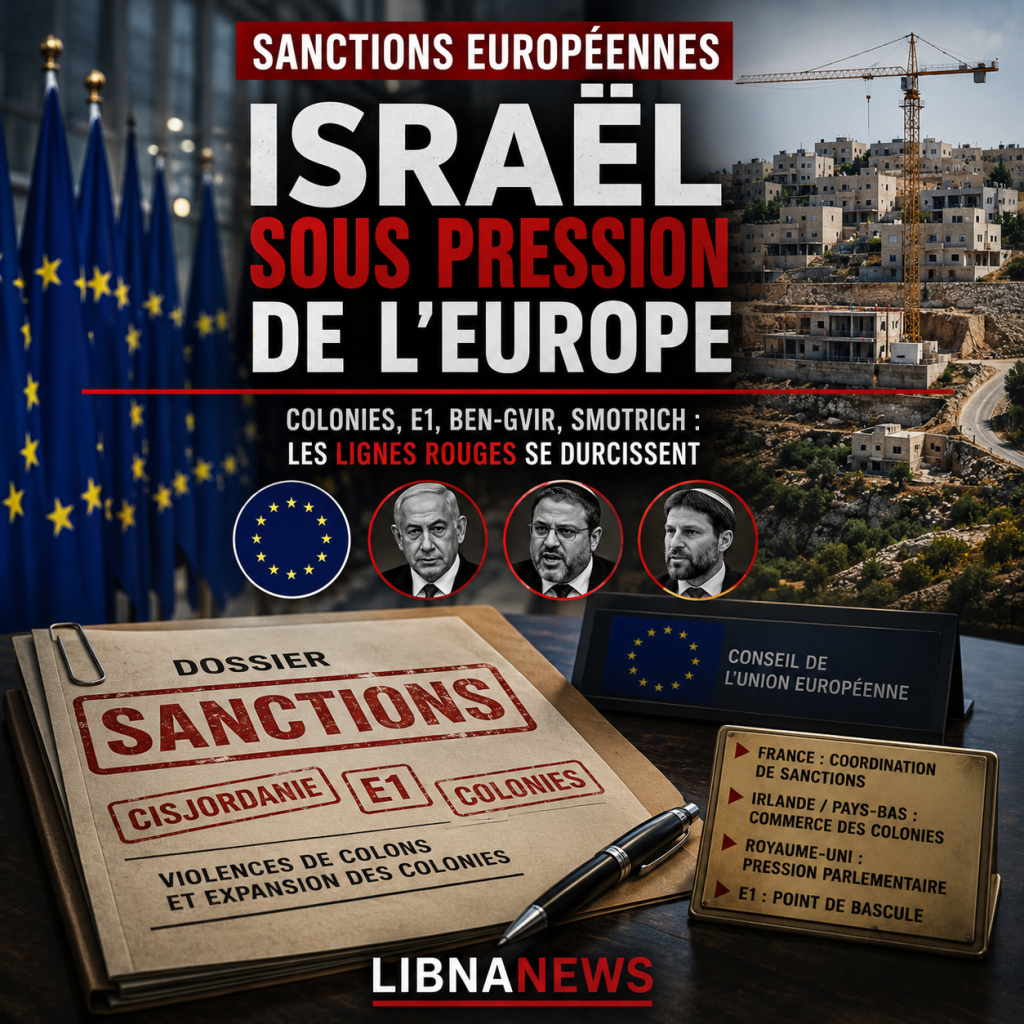
Sanctions against Israel are at the forefront of European diplomacy. After months of condemnation, several capitals are preparing or stepping up measures against settler violence in the West Bank, the expansion of settlements and the politicians who encourage them. France is pushing a new sequence of coordinated sanctions. Ireland and the Netherlands are moving towards trade restrictions on colonies. Spain, Belgium and Slovenia defend a firmer line. The United Kingdom, often summarized in the public debate by « England », now seems close to joining this movement, at least through targeted measures.
Change is both political and legal. For a long time, European governments condemned colonization without turning this condemnation into a strong economic constraint. They distinguished Israel as a strategic, commercial and diplomatic partner from colonization, which was considered illegal by the majority of the international community. This distinction remains. But it becomes more difficult to hold when Israeli ministers openly claim de facto annexation, expansion in the West Bank or even more aggressive positions towards Lebanon. Sanctions against Israel then become, for several European countries, a means of defending their own red lines.
The most explosive case remains in the West Bank. Project E1, located between East Jerusalem and Maalé Adumim, crystallizes concerns. It provides several thousand homes and could cut off the territorial continuity of a future Palestinian state. For European diplomacy, E1 is not an ordinary building site. It represents a geographical lock, capable of making the two-state solution even more theoretical. That is why the new sanctions under discussion do not only target violent individuals. They also seek to discourage companies and economic networks that would make this colonization irreversible.
Sanctions against Israel: a European threshold crossed
The European Union has already crossed a threshold by punishing violent Israeli settlers and related organizations. The device remains targeted. It generally includes asset freezes and travel bans. It does not cover the entire Israeli state. But he put an end to a long period of European hesitation, during which the convictions followed without a regular coercive mechanism. The most critical capitals now want to broaden this framework.
France plays a leading role in this sequence. Paris seeks to coordinate national measures with other partners, as the Union remains divided. The French Minister for Foreign Affairs referred to possible new sanctions in the coming days against settlers or entities linked to violence in the West Bank. This approach makes it possible to act without waiting for a full European consensus. It also puts the cautious countries before a simple question: how to condemn colonization as illegal, while refusing to punish those who accelerate?
Ireland has taken one of the most advanced positions. His Government wished to prohibit the import of goods produced in Israeli settlements in the Occupied Palestinian Territory. Dublin presents this measure as a response to its international obligations and as a practical application of the distinction between Israel and the occupied territories. The text does not constitute a break with Israel. It aims at a specific trade, linked to the colonies. But it has a strong symbolic significance, as it moves from labelling or denunciation to prohibition.
The Netherlands follows a close logic. The Hague is examining a ban on trade in colonial goods and the possibility of extending the scheme to services and investment. This last point is essential. Colonies not only work with agricultural or manufactured products. They also depend on construction, logistics, insurance, banking, technology, tourism and infrastructure. Sanctioning property sends a signal. Touching services and investments would further alter the economic cost of colonization.
The United Kingdom approaches the movement
The United Kingdom occupies a special place. It no longer belongs to the European Union, but retains a major diplomatic weight. London remains historically close to Israel, while being subjected to increasing internal pressure. More than one third of Labour MEPs have asked the British government to stop trade with Israeli settlements in the West Bank. This mobilisation puts Prime Minister Keir Starmer under pressure because it must reconcile the alliance with Israel, the ties with Washington and the evolution of a more critical British opinion.
The British Government did not remain inactive. In 2025 he sanctioned Itamar Ben-Gvir and Bezalel Smotrich with several partners, including Canada, Australia, New Zealand and Norway. These personal sanctions targeted two Israeli government ministers accused of inciting violence in the West Bank. They marked a major breakup. Western countries were no longer limited to punishing groups of settlers or extremist activists. They were targeting members of Benjamin Netanyahu’s cabinet.
The new stage could go further. According to the British press, London is preparing with several Western partners a package of sanctions linked to the E1 project. The aim would be to deter companies from participating in the development of this area and to penalize entities supporting settler violence. If the United Kingdom joins this device, the signal will be strong. He will indicate that some of Israel’s historical allies are ready to make a stronger distinction between Israeli security, which they continue to defend, and settlement, which they consider incompatible with their official position.
However, the terms must be used precisely. It is not England alone that decides, but the United Kingdom. Confusion is common in common language. It does not change the political background: London is approaching the group of countries that want to use targeted sanctions to curb colonization. The British choice will weigh all the more as it can lead to other prudent states, especially in the Anglo-Saxon world.
Historical allies now embarrassed
Hardening no longer comes only from Israel’s traditionally most critical countries. It also affects States that have long favoured a cautious approach. The United Kingdom, Germany, Italy, Canada, Australia and New Zealand participated in statements calling on Israel to halt settlement expansion and contain settler violence. Some of these countries remain opposed to a global breakdown. But they can support targeted sanctions if the Israeli government continues to assume a line of annexation or colonization.
Recent comments by Itamar Ben-Gvir and Bezalel Smotrich aggravate this embarrassment. According to a Turkish agency citing an Israeli media, Ben-Gvir mentioned settlement projects in Lebanon, as well as incentives for Palestinians to leave Gaza and the West Bank. These statements, if confirmed in their exact wording, move the debate. They are no longer limited to the West Bank. They extend the discourse of the Israeli radical right in Lebanon, at a time when Europeans are trying to prevent a deeper regionalisation of the war.
Smotrich, for his part, defended an expansion of settlements in the West Bank and presented these constructions as a means of anchoring Israeli control and blocking the creation of a Palestinian state. Other reports from regional media also give him a vision of security expansion into Gaza, Lebanon or Syria. Even when these statements have to be verified in their exact context, they weigh on Western perception. They give the proponents of sanctions a new argument: it would no longer be merely a matter of responding to violence on the ground, but of sanctioning a political orientation claimed at the top of the Israeli government.
This is a contradiction between Israel’s allies. They continue to support Israel’s right to security. But they also defend the two-state solution, the refusal of annexation, the protection of civilians and the territorial integrity of neighbouring states. When Israeli ministers speak of colonization, displacement or broader territorial control, they weaken Western governments seeking to maintain unconditional support. Sanctions then become a means of preserving a distinction: supporting Israel’s security does not mean supporting annexation or the extension of the conflict in Lebanon.
Brussels divided, capitals on the move
The European Union remains divided. Spain, Ireland, Slovenia and Belgium defend a harder line. France wants to coordinate national measures with allies. Germany and Italy remain more cautious because of their history, their economic ties and their strategic reading of Israeli security. This division makes it difficult to suspend the Association Agreement between the European Union and Israel widely. It explains why national measures are becoming more important.
National sanctions have an advantage. They can be adopted faster. They allow a group of countries to move forward without waiting for European unanimity. They also set a precedent. When one country prohibits settlement property, another examines services and a third punishes E1-related entities, a common architecture can be formed by accumulation. The Union is then faced with the political fact of its own members.
But this method also has limitations. Dispersed sanctions can create uneven effects. Companies can bypass certain markets. Customs controls may vary. Lists of individuals and entities may not coincide. To achieve a real impact, European countries will need to harmonise their criteria, exchange information, monitor supply chains and clarify the obligations of companies. Without coordination, sanctions may remain more symbolic than economic.
The debate therefore concerns the transformation of political indignation into an operational mechanism. Sanctioning a minister is visible. Prohibiting a product requires a customs capacity. Preventing a company from participating in E1 requires mapping of contracts, subsidiaries and beneficiaries. Controlling investments requires financial rules. Europe can harden its line. It will also have to prove that it knows how to implement its own decisions.
E1, the tipping point
E1 has become the symbol of this new phase. The project has been challenged for years because it threatens to further fragment the West Bank. Its advancement would be seen as a political declaration: Israel no longer seeks only to expand certain settlements, but to establish a geography that prevents the continuity of a future Palestinian state. For the European capitals which still defend the two-state solution, the stake is existential.
Smotrich’s statements reinforce this reading. The Minister of Finance, also responsible for broad prerogatives on civil affairs in the West Bank, presented colonial expansion as a means of preventing the creation of a Palestinian state. This political openness makes diplomatic prudence more difficult. Western governments can no longer speak only of misunderstanding, local construction or internal electoral pressure. They are facing an assumed strategy.
This is why the sanctions under preparation also target economic actors. It is not enough to condemn a ministerial decision. It must be prevented or made more expensive. Companies that build, finance, provide, equip or facilitate settlement projects may become compliance targets. Even without a general prohibition, the threat of an asset freeze, market exclusion or reputation risk may change some calculations.
The private sector is sensitive to this type of signal. A company can support a disputed activity as long as the legal risk remains low. It hesitates when several Western governments announce sanctions, when banks ask for checks, when insurers review their hedges and when investors fear being associated with illegal occupation. Targeted sanctions often operate less by their immediate amount than by the area of uncertainty they create.
Targeted sanctions, not a general break
At this stage, the measures under discussion do not constitute a general embargo against Israel. They cover three categories. The first concerns violent settlers and the organizations that support them. The second concerns some politicians accused of inciting violence, annexation or colonization. The third relates to colonial goods, services, investments or businesses. This architecture seeks to maintain a distinction between Israel as a State and the occupied territories.
This distinction is central to Europeans. It makes it possible to sanction colonization without breaking any cooperation with Israel. It is also based on a legal basis. European states claim that they must distinguish between the recognized Israeli territory and the territories occupied since 1967 in their economic relations. For years this requirement has been translated into product labelling. Current measures seek to go beyond labelling by banning certain imports or limiting economic relations with colonies.
Israel denounces this logic as a hostile and selective measure. The right-wing leaders see this as an infringement of Israeli sovereignty. The government insists on security imperatives and on the history of the Jewish bond with the West Bank, which it calls Judea and Samaria. But Europeans respond by international law and their official political position. They considered that colonization made a negotiated settlement more unlikely and fueled violence on the ground.
The debate is no longer limited to chanceries. It affects parliaments, businesses, trade unions, human rights associations, universities and public opinion. In the United Kingdom, the mobilization of Labour Members illustrates this shift. In Ireland, the colonial import law responds to old political pressure. In France, the government must also take into account an increasingly critical public opinion of Israeli conduct in the West Bank, Gaza and Lebanon.
Lebanon in the European calculation
Ben-Gvir’s comments on Lebanon add a regional dimension to the file. European sanctions against Israel have long been linked to the West Bank and Gaza. The Lebanese front now faces the same reasoning. If Israeli officials refer to the idea of colonization or expansion in Lebanon, even in the form of radical discourse or political provocation, they give Europeans a further reason for hardening. Lebanon is not an occupied territory as well as the West Bank, but it is a sovereign State whose territorial integrity is recognized.
This dimension can broaden the circle of countries concerned. European states that were reluctant to sanction Israel on the Palestinian question alone can be more attentive if rhetoric affects Lebanon, Syria or regional stability. The risk is no longer just that of a blocked Palestinian peace process. It becomes that of an enlarged war, a challenge to borders and instability affecting the eastern Mediterranean. For Europe, Lebanon is also a subject of security, migration, humanitarian aid and diplomatic presence.
The statements of Israeli ministers on Lebanon therefore weigh beyond their domestic audience. They complicate Israel’s defence by its allies. They feed the arguments of countries that want to sanction. They also reinforce the line of those who claim that the Netanyahu government can no longer be treated as an ordinary partner as long as its cabinet members have objectives incompatible with international law and regional stability.
This situation does not mean that all Israel’s historical allies will shift to heavy sanctions. Germany, Italy or some Central European countries remain cautious. But it makes support for targeted, limited and legally justified measures more likely. It is often through these types of measures that difficult consensus is formed: travel bans, assets freezes, restrictions on settlement property, warnings to businesses, and possibly broader trade measures.
The political cost to Netanyahu
For Benjamin Netanyahu, the sequence opens a new diplomatic front. His Government was already under pressure because of the war, tensions with Washington, the humanitarian crisis in Gaza, violence in the West Bank and the Lebanese front. European sanctions add an external cost to a coalition that depends on ultra-nationalist ministers. The more Ben-Gvir and Smotrich radicalize their discourse, the more they give Western chanceries arguments to harden their line.
The immediate economic impact of targeted sanctions may remain limited. Settlement trade represents only a fraction of the overall trade between Israel and Europe. But the political cost is greater. A Western sanction says that certain Israeli government practices are no longer only disapproved. They become punishable. It also weakens Israeli diplomacy, which seeks to portray critics as marginal or hostile. When the United Kingdom, Canada, Australia or Germany are involved in the pressure, this reading becomes less convincing.
Netanyahu can use these sanctions to mobilize its base. It can denounce a hypocritical, hostile or detached Europe from Israeli security realities. This line can work with some Israeli opinion. But it does not solve the strategic problem. Israel depends on its relations with Europe for trade, research, technology, transport, diplomacy and international legitimacy. Accumulation of targeted sanctions can create progressive wear and tear, even without sudden breakage.
The Israeli government must also manage the relationship with businesses. If settlement-related projects become more risky, some companies may withdraw or seek guarantees. Banks can strengthen their controls. International investors can avoid certain sectors. Exporters may have to prove the precise origin of their products. This compliance work can affect Israeli businesses, including those that do not have a direct political role.
A less passive Europe
The current dynamic shows a Europe that is less passive but still divided. Sanctions against Israel are progressing in circles. The first circle targets violent settlers. The second reaches ministers accused of incitement. The third relates to colonial property. The fourth could concern services, investments and businesses associated with E1. The transition from one circle to another will depend on Israeli actions, the evolution of war and the ability of European governments to bear the diplomatic cost.
The United Kingdom will be one of the countries to be observed. If it fully joins the coordinated measurements, it will give the movement a wider scope. He will show that hardening is not limited to Israel’s most critical countries. It could also lead other Western allies into a targeted approach, presented not as a break with Israel, but as a response to colonies, violence and radical ministerial statements.
Future decisions will indicate whether this sequence remains limited or opens a new chapter. If Israel advances over E1, if settler violence continues and Ben-Gvir or Smotrich continues to defend annexation, colonization or aggressive positions towards Lebanon, sanctions will become more difficult to avoid for prudent Western countries. The challenge is no longer just to condemn. It is important to know whether Europe is willing to use its economic weight to defend the principles it has affirmed for years.
European chancelleries are therefore moving towards a moment of clarification. They can maintain no effect statements, at the risk of E1 and annexation of progress. They can also move to targeted, coordinated and applicable sanctions, assuming tension with the Israeli Government. The United Kingdom seems close to this second path. Other Israeli historical allies could follow if Israeli ministerial rhetoric continues to cross the red lines on the West Bank and Lebanon.




