

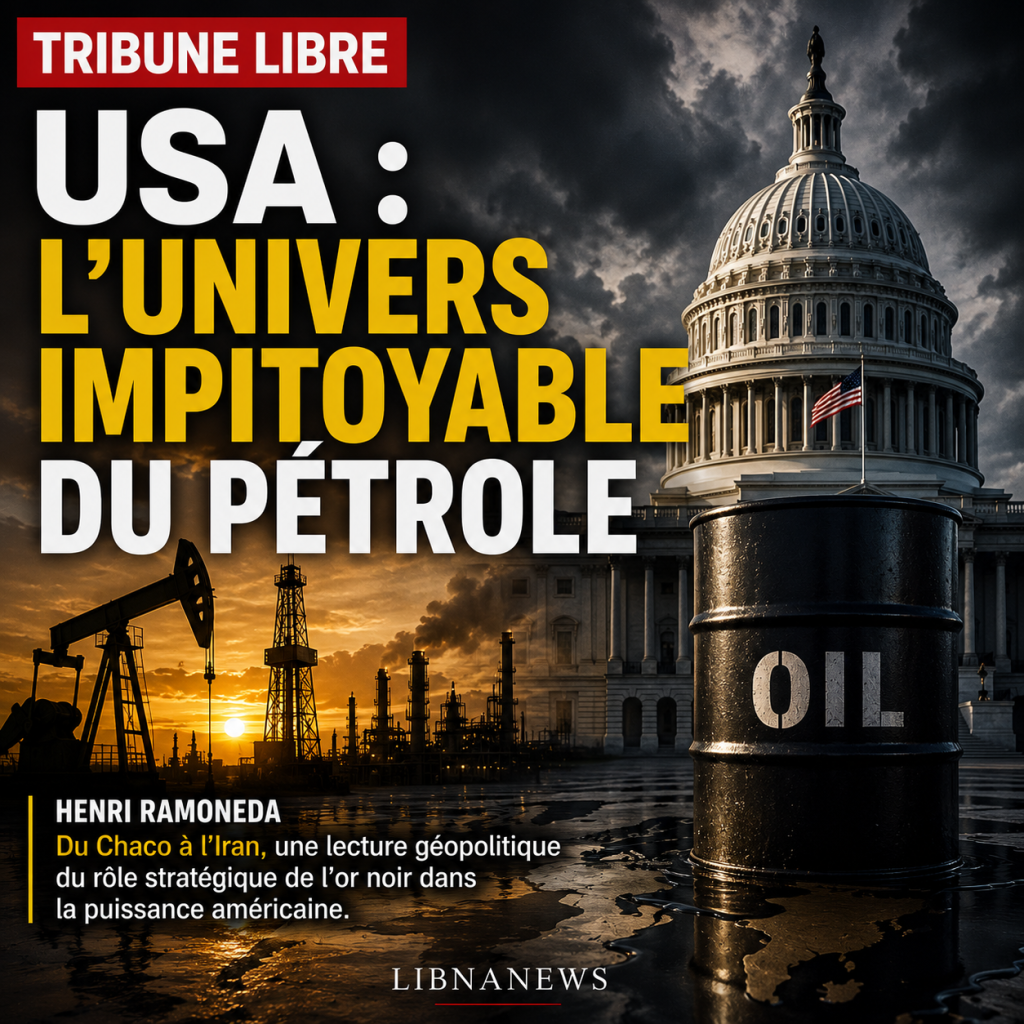
From 1932 to 1935, the vast Chaco plain, supposedly rich in oil, was at stake in a deadly war between Bolivia and Paraguay. Bolivia was supported in its war effort by the US oil companies, known as the seven-sister cartel, while Paraguay was armed by the British oil companies.
After a ceasefire agreement on 12 June 1935, a peace treaty was signed by both nations in 1938. However, it was found that the oil deposit was insufficient for overvalued production.
In the end, this conflict proved to be an excellent business for the arms trade. Apart from the fact that the people of Bolivia and Paraguay suffered the loss of many lives, these two nations plunged into extreme poverty.
While Britain dominated the economic and financial world throughout the period of XIXesince the discovery of Edwin Drake in 1859, nicknamed Colonel Drake, oil has become the cornerstone of US leadership.
After World War II, the black gold rush allowed the United States to become the first industrial, commercial and financial power.
Over time, the United States has been very active in many coups d’état, including Cuba in 1952, Iran in 1953, Guatemala in 1954, Congo in 1965, Chile in 1973, Grenada in 1983, Panama in 1989, Ukraine in 2014 and Venezuela in 2026.
However, the United States operates between 750 and 800 military installations in about 80 countries: an unprecedented presence in contemporary history. Wasn’t it Wesley Clark, former NATO Supreme Commander, who had declared in 2007 that wars in Iraq, Libya, and others were long planned by US military and political strategists?
Undoubtedly, the United States has partly strengthened itself on oil exploitation and has become a central pillar of its foreign policy. In 1974 Henry Kissinger had entered into an agreement with Saudi Arabia: all oil sold worldwide was to be priced in US dollars.
Since 1974, this financial exclusivity has increased the size of the dollar in international trade. To this is added the extraterritoriality of American law. Since 2018, European companies have suffered direct losses estimated at over EUR 19 billion for non-compliance with US laws.
With a virtual monopoly on world oil production, the United States uses oil as a diplomatic and military weapon. And they don’t take it away.
Ironically, Australia suddenly cancelled a contract of 56 billion euros with France for submarines belonging to the French Naval Group, and its main managers had favoured the United States for the supply of nuclear submarines.
Deployed and discontented, Australians will receive used American submersibles… This shows that many political leaders have short memories. Henry Kissinger, then Secretary of State, is quoted as saying: « Êamerica may be a dangerous enemy.Êbeing his friend is mortal. ».
However, the current war in Iran was launched on 28 February 2026 by the United States in violation of international law. President Donald Trump is constantly changing his motivations and threats.
In an interview with the show « 20/20 » in 1987, presented by Barbara Walters on ABC News, Donald Trump insisted on how Washington should deal with Tehran and its oil. He told Barbara Walters:« Why don’t we go over there and take some of their oil along their coasts? »
These words today have a special resonance.
Certainly, the main objective of the United States remains the takeover of Iranian oil facilities. This war proves to be very dangerous and deadly, as it perpetuates the diplomacy of the gunboat.
Finally, this conflict of illegitimate violence constitutes an unprecedented increase in the price of the barrel, certain inflation, a probable recession, a decline in world GDP, and ultimately a considerable decrease in strategic reserves.
Henri Ramoneda




