

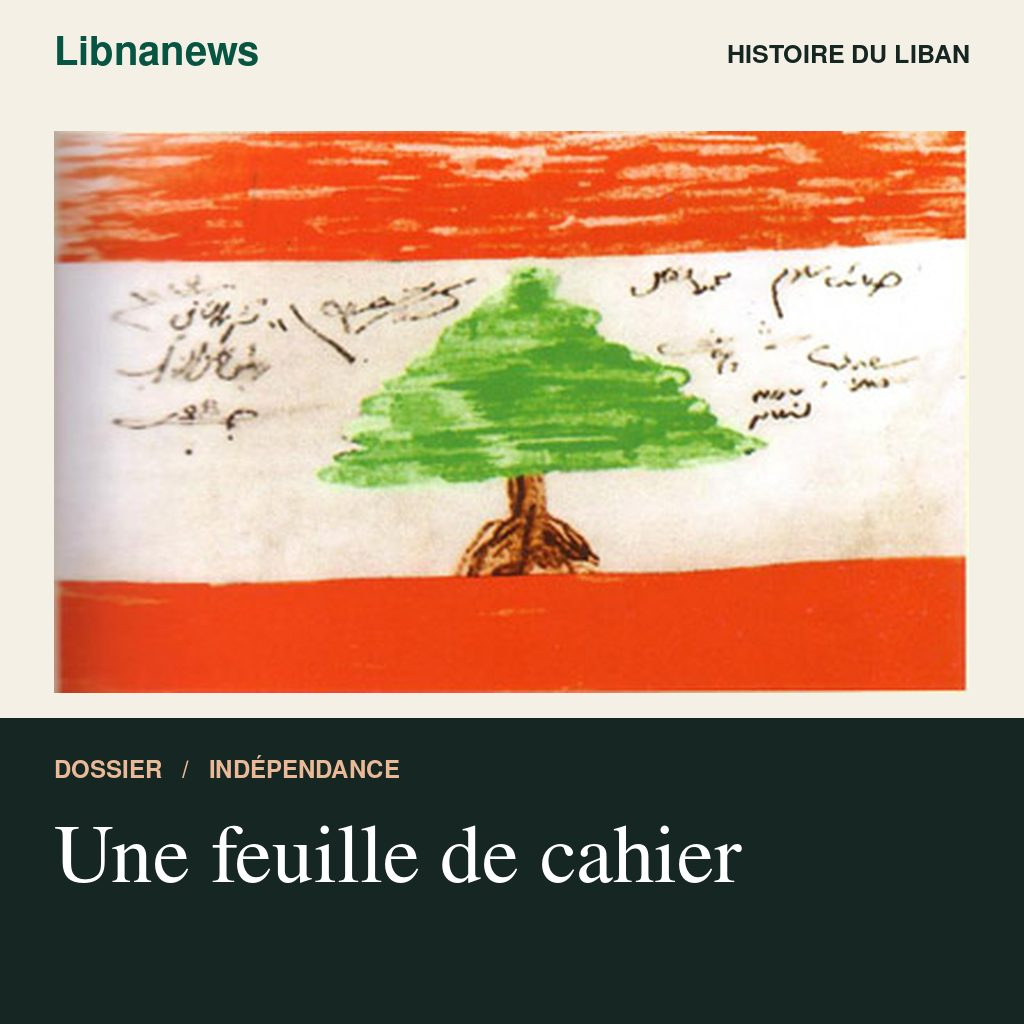
On the drawing of the flag signed in November 1943, the two red bands and the cedar left room for the names of the deputies. The Lebanese army reports that seven parliamentarians approved this model on 11 November, while French troops surrounded the House. It will be necessary to wait until 7 December for the Constitution to determine the proportion of such measures.
The cedar was already there. A Lebanese who had known the official flag before independence recognized the tree in the centre of the emblem. What he saw change in November 1943 was first at the disposal of the colors. Under the mandate, three vertical stripes, blue, white, and red, took over the French tricolor. On the white was the cedar. The former Article 5 of the Constitution explicitly described this drawing.
Seven deputies reach the Chamber
On 11 November, when the French authorities arrested President Béchara el-Khoury and the head of government Riad el-Solh, the President of the Chamber, Sabri Hamadé, summoned the deputies. The historical booklet published by the Lebanese Armed Forces states that some of them must pass through windows to enter the closed building. Seven parliamentarians managed to meet. They maintain their position on the end of the term and agree on a new emblem.
The same account describes a sheet from a school notebook. At the bottom and around the drawing are the signatures of Sabri Hamadé, Said al-Mounla, Henri Pharaoh, Saeb Salam, Rachid Beydoun, Mohammad al-Fadel and Maroun Kanaan. The reproduction of this sheet makes it possible to see both the decision and the ones who do not. Attributing the flag to the sole hand of a cartoonist would make disappear what the document establishes best: the agreement of seven elected representatives in the midst of a political crisis.
White occupies half the flag
The drawing circulates before its proportions are included in the law. When the leaders imprisoned in Rachaya regain freedom, on 22 November, the new flag already exists. The constitutional text which describes it bears another date, that of December 7, 1943. This succession explains why there are two dates about the same emblem, sometimes even in national holiday stories.
Article 5 gives instructions that are precise enough to allow a seamstress to trace the strips. For a flag one meter high, it reserves 25 centimetres in red from the top, 50 centimetres in white and 25 centimetres in red from the bottom. The cedar is green. It occupies a third of the width of the white stripe and touches it from side to side in the direction of the height: its top reaches the upper red stripe, its base the lower stripe.
Between the signed sheet and the December text, the function of the document changed. The first still identifies the men who took the risk of approving the drawing that day. The second allows a school, municipality or family to make the same flag without ever seeing the 1943 sheet.
File of 22 November 2026.Follow the direct from the Independence Day.





Comments