

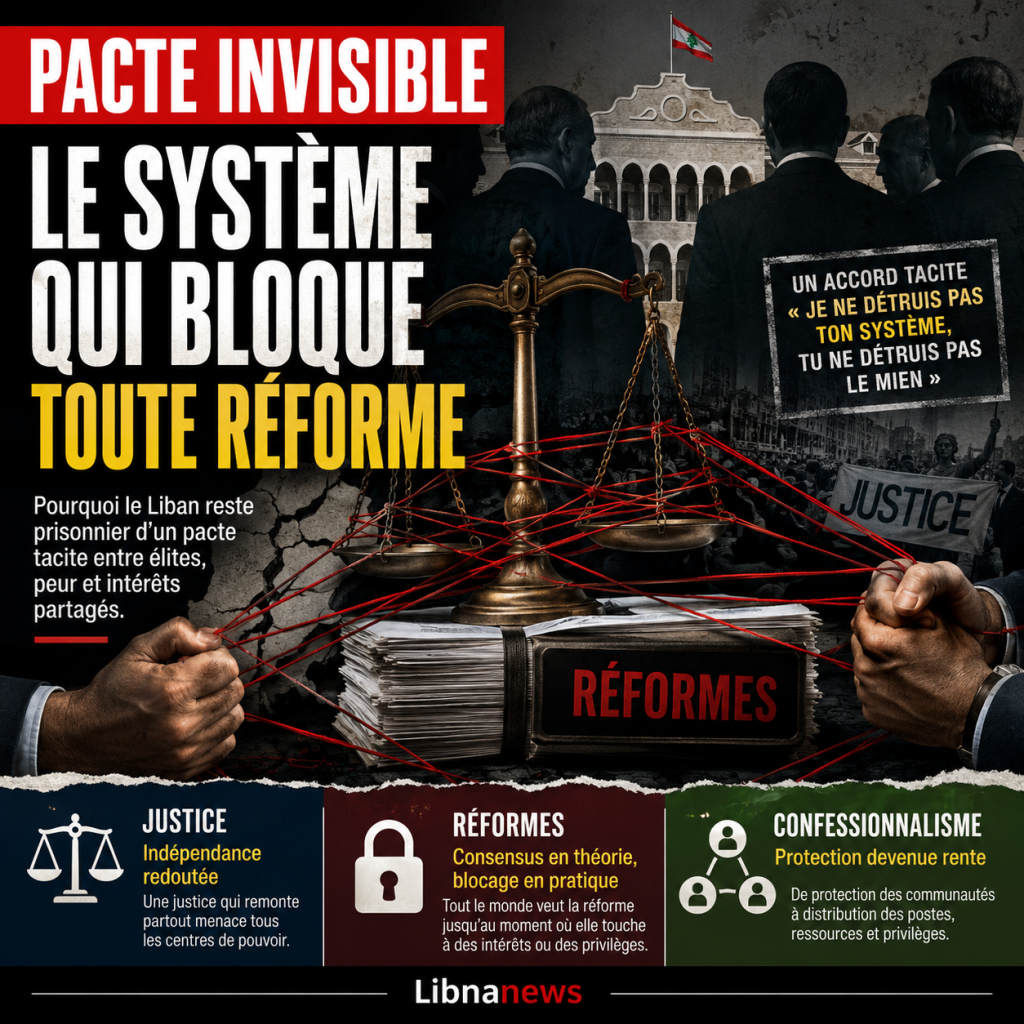
The invisible pact
Many Lebanese think that the problem comes from a man, party or government. Yet decades pass, faces change and crises follow, but the result often remains the same. As if real power was not held by those occupying institutions but by an invisible mechanism that traverses generations. This mechanism can be summed up by a simple formula: « I do not destroy your system, you do not destroy mine. »
The country where everyone wants reform
The Lebanese paradox is fascinating. Everyone wants reform. However, when reform becomes concrete and threatens interests, privileges or networks of influence, consensus disappears. Reform is widely supported in theory but feared in practice.
The great fear of elites
Lebanese elites often compete. They fight in elections and publicly criticize each other. But they share a common fear of full transparency that could reach all power centres. True independent justice could go back to all camps without distinction.
The fundamental confusion
The system has gradually confused the protection of communities with the protection of the elites who represent them. This confusion has made any questioning of leaders akin to an attack on the community itself, making it more difficult to exercise individual responsibility.
True Power: Preventing
In many democracies, the power is to decide. In Lebanon, it often involves preventing. Preventing an appointment, law, inquiry or reform has become a form of political power. This blocking capacity is one of the central features of the system.
Why Justice Scares
A truly independent justice system is capable of crossing all Community, political and financial borders. She is not interested in belongings but in responsibilities. It is precisely this capacity that worries a system based on permanent balances and compromises.
Ghada Aoun Syndrome
The Ghada Aoun case revealed the tensions that arise when a magistrate seems to want to go back to several power centres at once. Beyond the debates about his person, this case highlights the institutional resistance that emerges when justice touches established balances.
When fear becomes a system of government
One of the characteristics of modern Lebanon is that many decisions are influenced by fear: fear of returning to civil war, fear of the domination of a community, fear of losing gains or fear of certain truths emerging. When fear becomes the organizing principle of the system, caution becomes paralysis.
Confessionalism: from protection to rent
The original objective of confessionalism was to protect communities. Over time, it has gradually become a mechanism for the distribution of posts, resources and privileges. This shift from protection to rent explains part of the resistance to reforms.
Why the Truth Scares
A true investigation does not select its conclusions in advance. She’s following the facts. But the facts can go very far and concern multiple actors. In a system where responsibilities are often intertwined, truth can appear to be more destabilizing than silence.
The Lebanese tragedy
Lebanese want justice but sometimes fear its consequences. They want reform but fear what it might reveal. Thus, each individual sometimes contributes to strengthening the system that he/she criticizes. This is one of the most tragic dimensions of the Lebanese crisis.
How to break the invisible pact
Change will probably not come from a providential man but from cultural and institutional development. Justice must be accepted for all, including those who are considered to be part of their own camp. It is on this condition that the invisible pact will begin to crack.




