

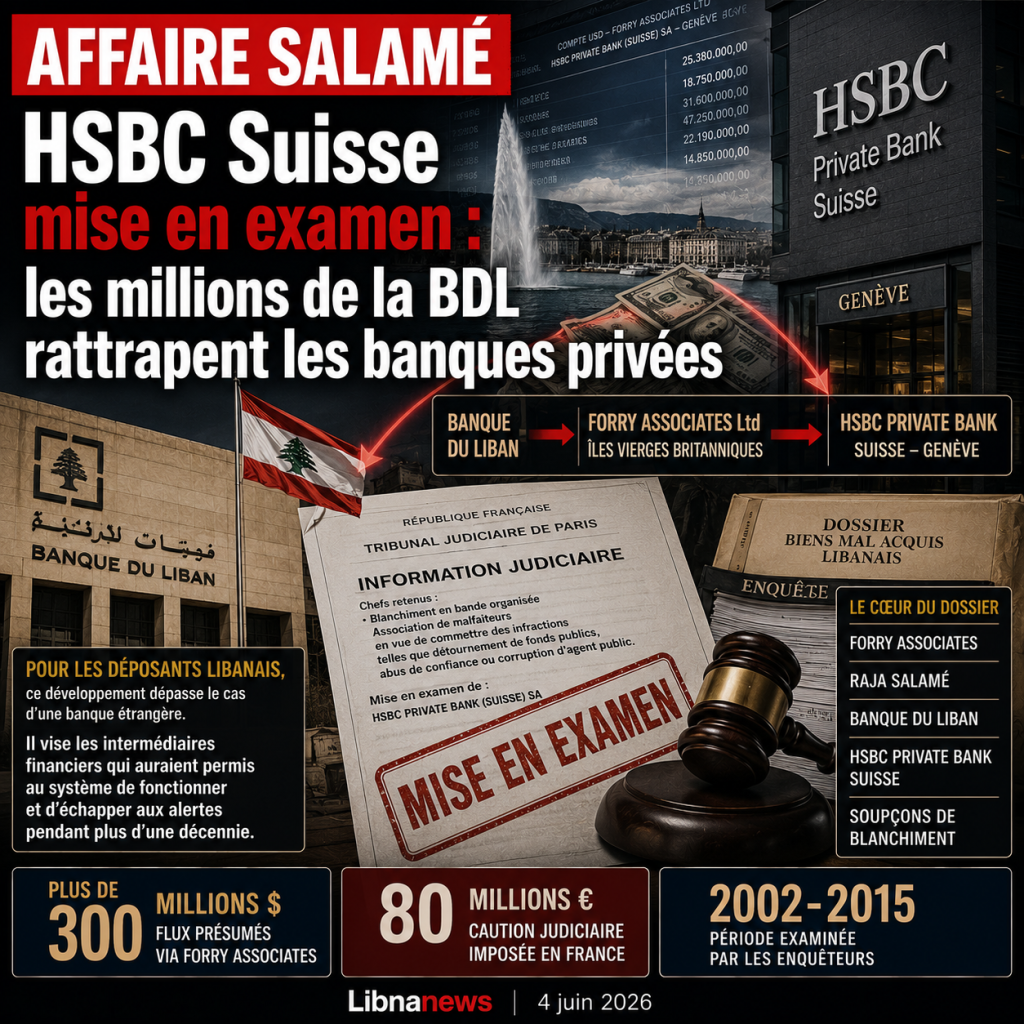
The indictment of HSBC Private Bank Switzerland in the Riad Salamé case marks a judicial turning point for Lebanon. The Swiss subsidiary of the British banking giant is suspected by the French justice system of having facilitated the laundering of suspected funds diverted from the Bank of Lebanon by the former governor and his entourage. The case concerns more than $300 million spent by Forry Associates, an offshore structure linked to Raja Salamé, brother of the former head of the central bank. For Lebanese depositors, ruined by the financial collapse since 2019, this development exceeds the case of a foreign bank. It places at the heart of the investigation financial intermediaries who would have enabled the system to function, last and escape alerts for more than a decade.
HSBC Riad Salamé: a judicial turning point
The French decision is aimed at HSBC Private Bank Switzerland for suspicions of money laundering in organized gangs and association of criminals with a view to committing offences such as embezzlement of public funds, abuse of trust or corruption of public officials. The bank was required to pay a guarantee of EUR 80 million, in particular to cover any damages. At this point, this is not a conviction. The bank contests any final presentation of its responsibility and indicates cooperation with the authorities. Riad Salamé, for his part, denied the charges against him from the beginning and claimed that his wealth came from income accumulated prior to his arrival at the Bank of Lebanon, particularly when he worked in international finance. But HSBC’s entry into the circle of charged changes the scale of the file.
The case no longer concerns only the former governor, his brother, some relatives or European real estate companies. It is now questioning the role of an international banking institution in the circulation of suspected hijacked Lebanese public funds. This is a major point for Beirut. For years, the Lebanese crisis has been described as the product of a local system dominated by an opaque central bank, commercial banks exposed to public debt and a political class unable to reform. The respondent for the HSSBC recalls that this system did not operate in a vacuum. It used financial centres, private banks, offshore companies, cross-border circuits and real estate acquisitions in Europe.
Infographic — The facts alleged against HSBC Switzerland
| Folder Element | Data and facts |
|---|---|
| Targeted bank | HSBC Private Bank Switzerland, Swiss subsidiary of HSBC Group |
| Judicial decision | France’s investigation into Lebanese ill-acquired property |
| Counts selected | Organized band laundering and criminal association |
| Amount at the heart of the file | Approximately $330 million, or more than $300 million |
| Period under review | 2002-2015 |
| Central Society | Forry Associates Ltd, registered in the British Virgin Islands |
| Suspected economic beneficiary | Raja Salamé, brother of Riad Salamé |
| Origin of funds | Bank of Lebanon, via commissions linked to financial operations |
| Account used | Forry Associates dollar account at HSBC Private Bank Switzerland in Geneva |
| Number of operations reported | Over 300 operations over the period |
| Suspect transfers cited | 192 transfers to accounts in Lebanon reviewed by investigators |
| Charged against the bank | Allowing a pass account to operate without sufficiently clarifying the origin, purpose and background of the funds |
| Internal alerts | Compliance signals would have been ignored or insufficiently addressed |
| Reporting to the Swiss authorities | The relationship would have been closed in 2016, but the report would only have been made in 2020 |
| Previous Swiss sanction | FINMA found in 2024 serious breaches of anti-money laundering rules |
| French measure | Judicial bond of €80 million |
| Lebanese Issue | Possible restitution or compensation to the Bank of Lebanon and Lebanese victims |
Forry Associates, the core of the alleged mechanism
The alleged mechanism begins in the early 2000s. In 2002, the Bank of Lebanon signed a contract with Forry Associates Ltd, a company registered in the British Virgin Islands. This company is presented as an intermediary or broker responsible for collecting commissions on transactions related to financial products of the central bank. However, investigators suspect that its real economic beneficiary was Raja Salamé. The point is central. If Forry was controlled by the governor’s brother, the commissions paid by the central bank were no longer simple brokerage fees. They became a potential channel for transferring public funds to a family circle.
Between 2002 and 2015, nearly $330 million is reported to have passed through a dollar account of Forry Associates at HSBC Private Bank Switzerland in Geneva. The funds came from the Bank of Lebanon. A party was then reportedly returned to accounts in Lebanon. Another would have been circulating in more complex installations, involving offshore companies and real estate acquisitions in France, Switzerland, Luxembourg, the United Kingdom and other European countries. The French justice system seeks to establish whether these flows have been used to convert commissions unduly collected into private assets, under the guise of banking and investment.
The warnings the bank should have seen
HSBC’s role is based on the quality of its controls. Investigators believe that the bank has the necessary legal, regulatory and operational tools to detect anomalies. The client profile, the amounts, the public source of the funds, the use of a transit account, rapid returns to Lebanon and family ties should have triggered in-depth checks. The Swiss supervisory authority had already accused HSBC Private Bank Switzerland of serious breaches in the prevention of money laundering involving two politically exposed persons, without publicly naming them. The transactions reviewed covered over $300 million between 2002 and 2015.
The French elements add a heavier criminal dimension. An investigation report submitted to the file in spring 2026 would involve several levels of the bank. He referred in particular to insufficiently monitored internal alerts, poorly documented high-risk operations and validated suspicious transfers without adequate clarification. Among the items discussed were 192 suspicious transfers to accounts in Lebanon. For French judges, the question is not just whether HSBC has failed to be vigilant. It is to determine whether the bank has agreed, through its practices and omissions, to allow a mechanism of concealment to operate.
Swiss sanction before the French stage
The case had already been an important step in Switzerland. In 2024, FINMA sanctioned HSBC Private Bank Switzerland for serious violations of its due diligence obligations. The regulator noted that funds from a Lebanese State institution had been transferred from Lebanon to Switzerland before, generally shortly thereafter, leaving to other accounts, mainly in Lebanon. The bank would never have clarified why an account at home had been used as a transitional account. Nor did it report suspicions to the Swiss anti-money laundering authorities for a long period of time. The relationship was reportedly closed in 2016, but the report was reported only in 2020.
This chronology feeds the central question of the file: why were not alerts dealt with earlier? The Swiss private bank managed high-risk clients, linked to a foreign public institution and a country where the risks of corruption were known. However, anti-money laundering rules require greater vigilance for politically exposed people and their environment. The situation of the Governor of the Bank of Lebanon, his power over public financial operations and family ties around Forry should have placed the case among the most sensitive. Investigators are now looking at whether deficiencies are due to negligence, complacency or conscious participation in the system.
Bankers and managers in the sight
The human dimension of the investigation reinforces these suspicions. Forry or Riad Salamé account relationship managers are examined in Switzerland and Luxembourg. A former employee of HSBC Luxembourg was allegedly questioned after receiving several hundred thousand dollars from Riad Salamé between 2013 and 2019. In Switzerland, investigations are also aimed at the internal organisation of the bank and the role of some bankers. These elements are not worthy of condemnation. However, they show that the case is not limited to an abstract failure of conformity. It concerns people, decisions, remuneration, supposed gifts and a culture of wealth management where the powerful customer could take precedence over regulatory prudence.
For Lebanon, the stake is considerable. The Bank of Lebanon is now a civil party in the French proceedings. This decision reflects inflection. For a long time, the institution was associated with the defence of its former governor or with a form of prudent silence. The new management seeks to present itself as a victim of a fund-raising system. This also corresponds to a social demand. Lebanese depositors, who have been deprived of free access to their savings since the bank collapse, demand that political, banking and financial leaders be held accountable. The question is no longer just where the money went. She knows who helped her to get out, move around and turn into goods.
Lebanese applicants in the centre of the case
The review of HSSBC therefore opens up a prospect of recovery. If the court establishes the bank’s liability, the proceedings could result in compensation or restitution for Lebanese victims. This perspective remains long and uncertain. International financial trials last years. Appeals, jurisdictional debates, evidence of the origin of the funds and parties’ rights can slow down decisions. But the presence of a large bank in the file changes the balance of power. Unlike Riad Salamé, who was the target of a French arrest warrant but was present in Lebanon, HSBC could hardly ignore proceedings before European courts.
The file also has a symbolic scope. HSBC is not a small offshore structure. He is a global banking player, subject to compliance obligations, powerful regulators and an international reputation. Its review recalls that the laundering of public funds is not only dependent on corrupt leaders. It also depends on the institutions that accept funds, keep accounts, execute transfers, document transactions poorly and delay reporting suspicions. For a country like Lebanon, where local officials often invoke international complexity to dilute responsibilities, this judicial development is important.
A Lebanese and international channel
It also asks the Lebanese banks a question. Forry-related commissions were allegedly associated with operations on financial products of the Bank of Lebanon involving commercial banks. The Lebanese financial system has long benefited from the high yields offered by the central bank. It also benefited from the opacity that surrounded certain financial engineering. The proceedings against HSBC should therefore not be used to move all liability abroad. On the contrary, it must inform the entire chain: decision at the central bank, role of Forry, participation of local institutions, accounts in Switzerland, returns to Lebanon, offshore companies and acquisition of property.
The Lebanese crisis gives the case particular gravity. Since 2019, the book has collapsed, banks have imposed informal restrictions, deposits have been blocked or severely decoded, and hundreds of thousands of families have seen the fruit of their work disappear. In this context, the $330 million mentioned in the case is not an abstract figure. They represent hospitals, wages, pensions, deposits, imports, schools and a destroyed share of public confidence. Money that would have left the Bank of Lebanon through opaque channels is being examined at a time when the country is still trying to distribute the losses of its financial collapse.
A defense that challenges the accusations
The defense of Riad Salamé remains constant. The former governor contests the accusations and claims that his assets are derived from his personal wealth formed before his mandate to the central bank. His lawyers claim to have provided evidence of his previous income. This line of defence will be at the heart of any possible trial. It will have to face bank flows, contracts, beneficial owners, real estate companies and acquisition dates. HHSBC’s defence should cover its level of knowledge, the checks carried out at the time, the rules applicable between 2002 and 2015 and the criminalization of its breaches.
The presumption of innocence therefore remains necessary. But it does not reduce the scope of French development. The indictment of a bank of this size means that judges consider that there are serious or concordant indices justifying its formal entry into the proceedings. It also means that the file of ill-acquired Lebanese property does not stop at natural persons. It goes back to the financial infrastructure of the alleged laundering. For Lebanese victims, this extension is essential. Suspicious fortunes do not only form in the offices of power. They are consolidated in the bank accounts that host them and in the real estate markets that absorb them.
The sequel between Paris, Geneva and Beirut
The continuation will depend on several steps. The French judges will have to continue to examine the flows, hear the bank officials, confront the versions and determine whether the breaches alleged by HSBC are criminally responsible. The Swiss and Luxembourg authorities will continue their own procedures. The Bank of Lebanon will have to continue its cooperation and document the losses it considers to have incurred. Anti-corruption associations will seek to preserve the objective of restitution to Lebanese. The case thus enters a heavier phase, where the international financial system ceases to be a mere setting and becomes a central judicial actor.
In Lebanon, this development comes at a time when the population still doubts the ability of local justice to judge the powerful. European procedures often appear to be the only ones able to circumvent political and banking blockages. This finding is severe for the Lebanese State. It underlines the inability of its institutions to impose transparency alone in one of the biggest financial collapses in the world today. But it also offers a possibility: if European files move forward, they can provide evidence, decisions, seizures and pressure that Beirut can no longer ignore. The indictment of HSBC Switzerland now places part of the truth in the hands of French judges.




