

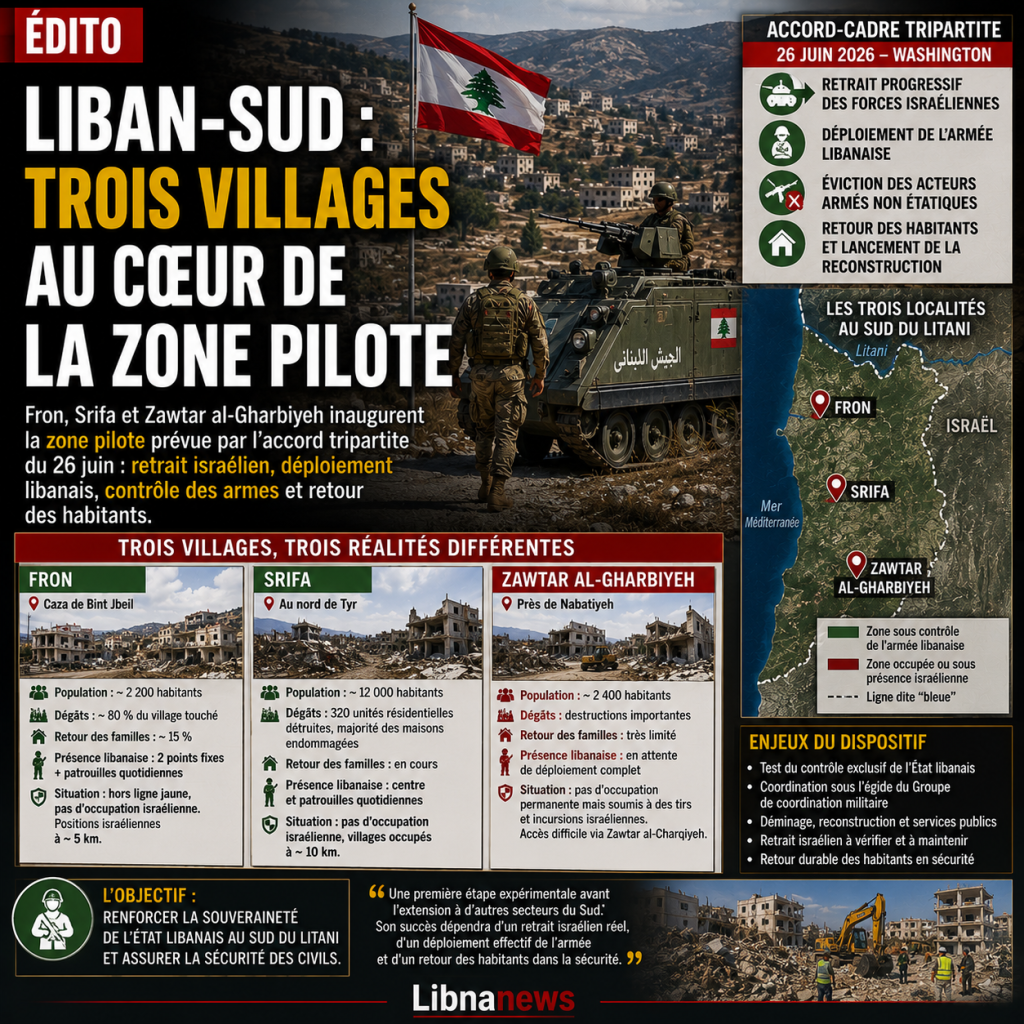
The American announcement of the launch of a « pilot zone » in southern Lebanon places three localities in the centre of a security mechanism still largely to be built. Fron, Srifa and Zawtar al-Gharbiyeh are to serve as the first areas of application for the tripartite framework agreement concluded in Washington on 26 June between Lebanon, Israel and the United States. The principle is based on a precise sequence: Israeli withdrawal, the deployment of the Lebanese army, the eviction of non-State armed actors, the return of the inhabitants and the launching of reconstruction. On the ground, however, situations differ widely from one village to another. Two localities already host Lebanese units, while the third remains difficult to reach due to the Israeli military presence in its immediate environment.
Pilot zone in southern Lebanon tested in three villages
The choice of Fron, Srifa and Zawtar al-Gharbiyeh does not form a perfectly homogeneous geographical whole. The three localities are located south of the Litani River or directly near the river, in an area marked by fighting, displacement and destruction of infrastructure. However, they are distinguished by their size, position, level of damage and current exposure to Israeli forces.
The objective of the scheme goes beyond the security of a few villages. The US authorities present it as a first step towards the restoration of exclusive control of the Lebanese State in the territory. The text of the Framework Agreement provides for the gradual, complete and effective management of security by the Lebanese armed forces. This rise in power must accompany a phased Israeli redeployment, subject to verification.
The « pilot zone » formula therefore reflects an experimental method. The parties want to test, on a limited perimeter, the ability of the mechanism to operate before extending. The arrangements involve military coordination, inspections, road security, a sustainable military presence and guarantees for civilians. It also calls for the disarmament of non-State groups and the dismantling of their military infrastructure.
The launch announced on Monday took place during the visit of Lebanese President Joseph Aoun to Washington. His planned interview with US President Donald Trump gives additional political significance to this first phase. Beirut seeks a tangible Israeli withdrawal, while Washington wants to demonstrate that the agreement signed in June produces concrete results. The reality on the ground, however, remains more complex than the diplomatic presentation.
Fron, agricultural village near Litani
Fron, sometimes transcribed Frun, belongs to Bint Jbeil’s caza. The town has about 2,200 inhabitants, according to the communal data reported by the press. Agriculture, beekeeping and livestock are an important part of its activity. The village is located on a height overlooking the Litani basin and offers views over several sectors of the South Lebanon.
Its position gives it particular strategic value. To the east lies Marjayoun District, to the west is Tyre District and to the north is Nabatiyah District. This situation links Fron to several roads, but the war has made certain routes dangerous or impassable. The safest access passes through the Qasmiyeh Bridge, Deir Qanoun al-Nahr, Maaroub, Derdghaya, Srifa, Bourj Qalaway and Ghandourieh.
The locality has suffered massive destruction. The municipality estimates that the damage affects about 80% of the village. This figure includes buildings, roads, networks and several essential equipment. Part of the houses were completely destroyed. Others remain standing, but they require heavy repairs before any lasting return.
Since the ceasefire came into force, almost 15 per cent of families have reportedly returned. This movement remains limited by insecurity, housing conditions and weak services. Residents who return often have to deal with rubble, power cuts, damaged water systems and the absence of several economic activities.
The Lebanese Army has two fixed points in the area, plus daily patrols. The United Nations Interim Force in Lebanon also maintains an operational presence. This configuration explains why Fron appears to be one of the most rapidly integrated localities in a pilot area under Lebanese control.
According to the president of the municipality, Hassan Bazzi, the village is outside the so-called yellow line and is not occupied by the Israeli army. The nearest Israeli positions are said to be about five kilometres away. This distance remains small in a space where artillery fire, drones and point incursions can affect daily life without permanent occupation.
An ancient memory of the front line
Fron also has a special story. The village has experienced the consequences of Israeli operations since 1978. During the 1982 invasion, Israeli forces reached the Litani River. After the partial withdrawal in 1985, the locality was found near a confrontation line. It then suffered several waves of bombardment during successive conflicts.
This memory weighs on the current perception of the device. The inhabitants know that the proximity of the Litani gives their village greater military importance than its size. In the Israeli debate, the river has often served as a geographical benchmark for defining security objectives. Fron lies precisely in this territorial depth.
During the last war, however, Israeli forces did not enter the village permanently, according to local officials. The destruction is mainly related to the bombing. This difference with direct terrestrial occupation in theory facilitates Lebanese deployment. It does not address the issues of mine clearance, aerial surveillance and reconstruction.
For Fron, the pilot zone therefore begins with a relative advantage: the Lebanese army is already present and access remains possible. Its success will depend, however, on the ability to transform the presence into effective control. Most of the residents are awaiting the reopening of roads, the restoration of networks and guarantees against further strikes.
Srifa, a more populated and heavily affected community
Srifa is located north of Tyre, at the administrative boundary between the governorates of South Lebanon and Nabatiyah. It is surrounded by Bourj Qalaway, Ghandourieh and Fron in the east. The Litani separates her from Kfar Sir in the north. To the west are Shhour and Arnoun, while its land boundaries reach the Naffakhiyeh farm in the south.
The town has approximately 12,000 inhabitants, including nearly 4,000 voters. This larger population makes it a different test than that of Fron. Securing is not just about a few rural axes. It must cover dense neighbourhoods, extensive service networks and a high number of damaged housing.
The destruction is considerable. Mukhtar Khodr Najdi evokes 320 residential units completely destroyed. The majority of the other houses were said to have suffered partial damage. Damage also affects roads, water lines, the electricity grid and telecommunications.
From the first days of the ceasefire, the inhabitants began to return gradually. The municipality has undertaken emergency clearing and repair work. The immediate objective is to make roads workable, evacuate rubble and restore a minimum of public services.
The pace of return depends not only on security but also on the material capacity of families to repair their homes. Many lost part of their income during the war. Agricultural, commercial and craft activities have been discontinued. Reconstruction costs often exceed household resources.
The Israeli army is not present inside Srifa, according to local officials. The Lebanese Army has a centre there and conducts patrols every day. The villages still occupied further south are about ten kilometres away. This situation places Srifa in an intermediate area: it is not occupied, but it remains close to an active front.
An experiment contested by the inhabitants
The term pilot zone gives rise to strong local distrust. Some officials consider it artificial, because the Lebanese army is already in the village. For them, the American announcement gives a new name to a partially existing reality, without responding immediately to the central problems: Israeli withdrawal, cessation of strikes, compensation and reconstruction.
This criticism does not mean that the device is ineffective. International coordination can provide additional guarantees, strengthen Lebanese staff and speed up aid. It may also establish a withdrawal schedule and a verification system. But these benefits remain hypothetical until the modalities are made public.
In Srifa, the main challenge will be to prove that the pilot area is actually improving civilian life. An increased military presence will not suffice. The mechanism should enable the rehabilitation of schools, clinics, networks and housing. It should also protect farmers who wish to resume their activities.
The size of the village makes needs more important than in Fron. It also creates a governance issue. Local authorities should coordinate their work with the army, ministries, international agencies and donors. Without rapid funding, the return of families may remain partial and fragile.
Zawtar al-Gharbiyeh, the most difficult test
Zawtar al-Gharbiyeh is about 82 kilometres from Beirut and nine kilometres from Nabatiyeh. The village rises to nearly 450 metres above sea level and covers about nine square kilometres. It has some 2,400 inhabitants, including about 1,300 voters.
Its boundaries affect Zawtar al-Sharqiyah, Qaaqaiyat al-Jisr, Mayfadoun and Choukin. The Litani separates her from Deir Siryan. This geography places the village in a road network closely dependent on Zawtar al-Sharqiyah, where the Israeli presence complicates displacement.
Unlike Fron and Srifa, Zawtar al-Gharbiyeh remains difficult to reach. The press reports that no Israeli force maintains a permanent occupation there, but that the village remains under direct threat of fire and incursions. Israeli soldiers would advance to its neighbourhoods on an ad hoc basis to conduct raking, destruction and fire operations.
The president of the municipality, Abdel Ezzeddine, describes a town « occupied by fire ». This term summarizes a situation where the absence of a fixed military post does not mean freedom of movement. The inhabitants cannot return safely. Municipal teams and journalists also face difficulties in reaching the area.
The main access passes through Nabatiyah al-Fawqa and Zawtar al-Sharqiyah. However, the Israeli presence in the latter town makes the journey uncertain. The deployment of the Lebanese army to Zawtar al-Gharbiyeh therefore depends on a prior Israeli withdrawal or repositioning.
The Lebanese Armed Forces reported that they continued to coordinate with the Lebanese Military Coordination Group in preparation for its entry. This formulation shows that the third component of the pilot zone is not yet at the same stage as the other two. The political launch of the scheme precedes its full implementation.
The order of the stages at the heart of the dispute
The case of Zawtar al-Gharbiyah reveals the main weakness of the mechanism: the concrete order of operations. The agreement provides for an Israeli redeployment parallel to the Lebanese deployment. On the ground, the Lebanese army cannot enter freely as long as the roads remain exposed to Israeli forces.
This difficulty feeds critics. Local officials asked how civilians could return if their road crossed an occupied area. They also question how the Lebanese army could assume full security responsibility without access control.
The success of the device will therefore depend on a clear sequence. Israel must withdraw or guarantee a safe corridor. The Lebanese army must then take a position, inspect the area and secure the roads. Technical teams must assess mines, unexploded ordnance and the condition of buildings. Residents can only return after these checks.
A diplomatic announcement is not enough to resolve these constraints. The situation requires accurate maps, movement schedules, communication channels and response mechanisms. Ambiguities can cause blockage or confrontation.
What the Framework Agreement of 26 June provides for
The framework agreement announced in Washington sets a central objective: to strengthen the Lebanese state’s arms monopoly and extend its sovereignty to the entire territory. Article 3 provides that the Lebanese Armed Forces shall progressively assume full and effective security responsibility in pilot areas.
These areas should serve as a mechanism for organizing a gradual and verified Israeli redeployment. The withdrawal of Israeli forces must move forward in parallel with the Lebanese deployment. The parties agreed on two pilot areas, with the possibility of adding additional areas by mutual agreement.
The text also links the security transition to the disarmament of non-State armed groups and the dismantling of their infrastructure. Once this stage has been verified, the Lebanese army must exercise effective control alone. Reconstruction projects can then start with international support.
The return of civilians is one of the expected results. It must be under the exclusive authority of the Lebanese legal institutions. This point directly links security with sovereignty and reconstruction. It is not just a matter of changing a military line, but of restoring a complete administration.
However, several questions remain open. The public text does not always detail the criteria for success, the duration of each phase or the procedures in case of disagreement. Nor does it specify the extent of the financial resources already committed for reconstruction.
The role of the Military Coordination Unit
Operations are conducted under the auspices of the Military Coordination Group for Lebanon. This structure brings together Lebanese, American and Israeli representatives. It should facilitate planning, information sharing and verification of movements.
Its effectiveness will depend on its ability to prevent incidents. Lebanese and Israeli forces remain separated by a history of conflict, a lack of diplomatic relations and deep mistrust. Coordination therefore requires US mediators and strict technical procedures.
Finul retains an important role in southern Lebanon. It patrolled, observed violations and supported the Lebanese army in its area of operations. The new mechanism does not remove this presence. However, it adds a separate structure, directly linked to the framework agreement.
The coexistence of several frameworks can create overlaps. The responsibilities of the Lebanese army, the military group and the Finul will need to be clarified. Residents need to know which authority to report an incident, unexploded ordnance or obstruction of return.
Reconstruction, security and return of inhabitants
The pilot area will be judged on its visible results. The first indicator will be the effective withdrawal of Israeli forces from the sectors concerned. The second will be the ability of the Lebanese army to control roads, entrances and neighbourhoods without a competing presence.
The third indicator will be for civilians. In Fron, the return remains limited. In Srifa, it progressed despite the destruction. In Zawtar al-Gharbiyeh, it remains largely blocked. These differences allow the measurement of obstacles at each stage.
Reconstruction is a huge challenge. Local figures show hundreds of homes destroyed and extensive damage to infrastructure. Municipalities do not have the resources to finance the work alone. They expect assistance from the State, international donors and specialized agencies.
Clearing is the first emergency, but it cannot precede all security checks. Gravats may contain ammunition, hazardous materials or unstable elements. The teams must also restore water, electricity and telecommunications before a massive return.
Schools and health centres must reopen. Farmers need access to their land. Merchants must be able to receive goods. Without economic recovery, residents may remain dependent on aid or prolong their displacement.
A political test for Beirut and Washington
For the Lebanese State, the three villages are a test of credibility. The government must show that it can protect the inhabitants, deploy the army and impose a single authority. It must also prevent the pilot zone from being perceived as an externally imposed administration.
Washington is also seeking to demonstrate the effectiveness of its mediation. The launch of the device during Joseph Aoun’s visit to the United States responds to this logic. Progress on the ground would strengthen the framework agreement. A quick block would weaken.
Israel links its withdrawal to guarantees on the disarmament of Hezbollah and the absence of military infrastructure. On the contrary, Lebanon demands that the withdrawal allow its army to deploy. This difference in priority can slow down each step.
The three villages already show that the mechanism cannot be uniform. Fron has a Lebanese presence and relative access. Srifa must manage a larger population and massive destruction. Zawtar al-Gharbiyeh remains dependent on an Israeli withdrawal to the neighbouring area.
The next concrete development will be observed in Zawtar al-Gharbiyeh. The effective entry of the Lebanese army, the securing of the road from Nabatiyah and the return of the first families will determine whether the pilot zone constitutes a real transfer of control or, at this stage, remains a political announcement.




