

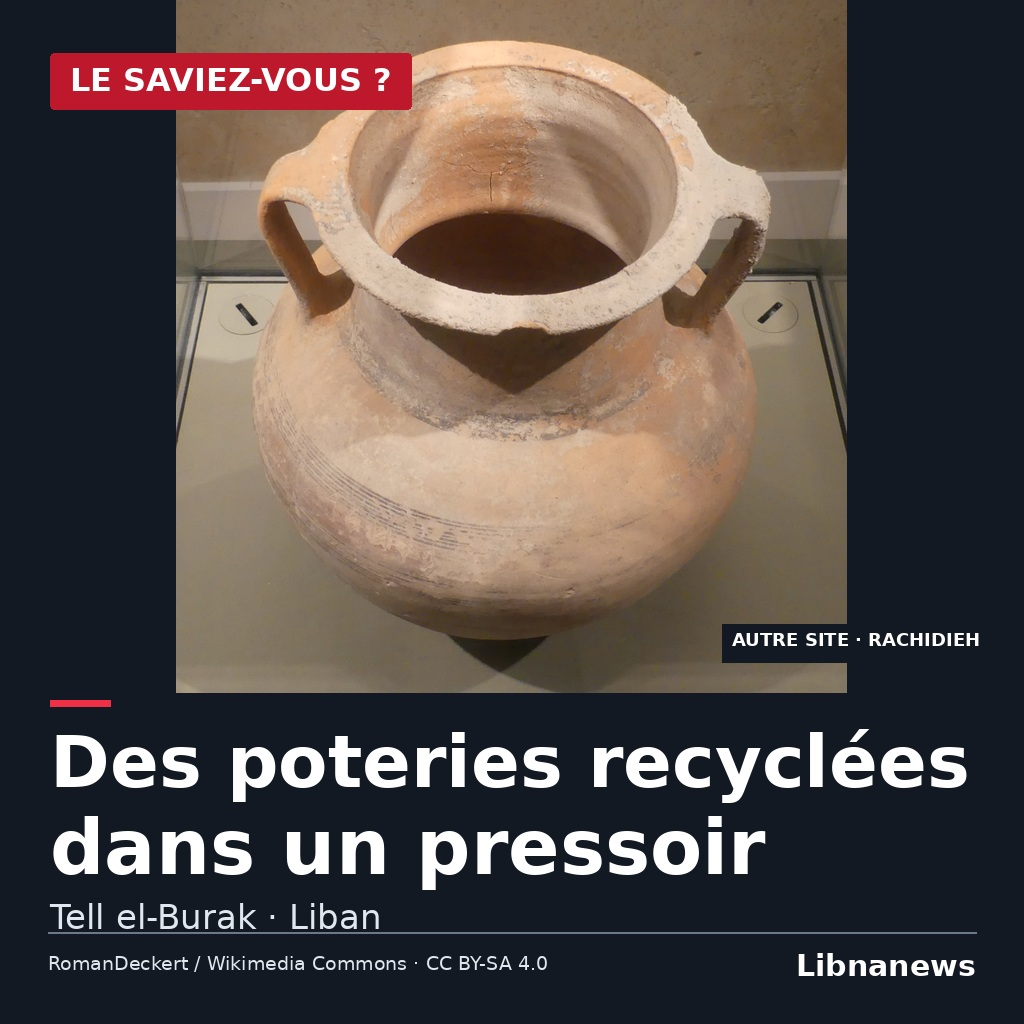
In Tell al-Burak, south of Saida, the coating of a Phoenician press contains fragments of crushed ceramic. The debris was not found in bulk next to the facility: it was part of the lime mortar that covered the basins. Analyses published in 2025 show that this mortar could harden in the presence of water.
Tessing into the press tank
The press was cleared about nine kilometres from Saida, on the slope of a former Lebanese coastal settlement. The excavation team places its construction probably at VIIecentury B.C.E., without excluding the end of the VIIIe. The researchers studied the surface of the basin where the grapes were trolled and the surface of the juice-gathering tank. The form of the installation, the grape seeds found on the site and the presence of many amphorae support its identification as a wine press.
By observing fine sections of the coating under microscope, the researchers recognized clay grains mixed with lime. These grains are the main material added to the binder in the samples analysed. Tessons were also identified in the coatings of two other site developments, the precise function of which is not established. The method was therefore not reserved for a single tank.
Why the crushed pottery changed the mortar
The first analyses published in 2020 had established the presence of ceramics in the mortar and suggested that this addition made the coating more rigid and less prone to cracks. The 2025 study combined several methods of microscopy and mineral analysis. The team concluded that it was a hydraulic mortar: unlike an ordinary lime coating that hardens in contact with the air, it could also be taken in a wet environment.
The exact origin of the teeth remains less certain than their presence. Their composition is reminiscent of that found in Tell al-Burak, some of which were probably made in Sareptah, the present Sarafand. It is not established that all fragments came from these containers, nor that the technique was invented on the spot. What the samples show is that, south of Saida, crushed pottery had found a new use in the construction of a press.





Comments