

From radio to record, from Baalbek to cinema, Fairouz’s songs have changed audience and sometimes function. Three works follow this movement: a piece of his radio debut, a song recorded at the Baalbek festival and an ode in Jerusalem that became the soundtrack of a Palestinian documentary.
In October 2018, at the French Chateaubriand Institute in Jerusalem, a session devoted to the representation of the city in Palestinian cinema presented a seven-minute short film dating back to 1969. Fairuz wasn’t on the poster as a stage performer. We heard it in the movie. The documentary by Ali Siam, whose images are signed Hani Jawharieh, had given toZahrat al-Madāina second life: that of a song listened to while watching the city to which she addresses.
This screening, almost half a century after the film was made, allows us to understand what separates a famous song from a cultural landmark. The first is identifiable to his voice or melody. The second is also transmitted by the uses attached to it: to listen to the radio at home, to find on record a performance of Baalbek, to hear the same song in a room where one discusses the history of Jerusalem.
« Etab »: a repertoire formed on radio
The name Fairouz appeared in the programmes of the Lebanese national radio station as early as summer 1950, according to Dar El-Nimer, who devoted several listening sessions to these early years. The cultural centre, together with the association IRAB, established the beginning of collaboration with the Rahbani brothers in autumn 1950 and its installation in early 1952. Radio is not only the way to pass a record to the antenna: it provides the studios and the programs in which their repertoire is built.
Researcher and collector Rami Soudah placesEtab(« Reproche ») among the first three Rahbani songs that Fairouz performed. The sources do not allow to give a specific day for its first broadcast. However, they describe a working environment that linked Lebanese radio, Syrian radio and Near East Broadcasting Station. Dar El-Nimer also noted in the 1952 press that listeners were asking to rehearse Fairouz songs. This provides information on the place of the interpreter on the air, not on the number of broadcasts specific to theEtab.
« Khedni Taht el aricheh »: from Baalbek to 45-rounds
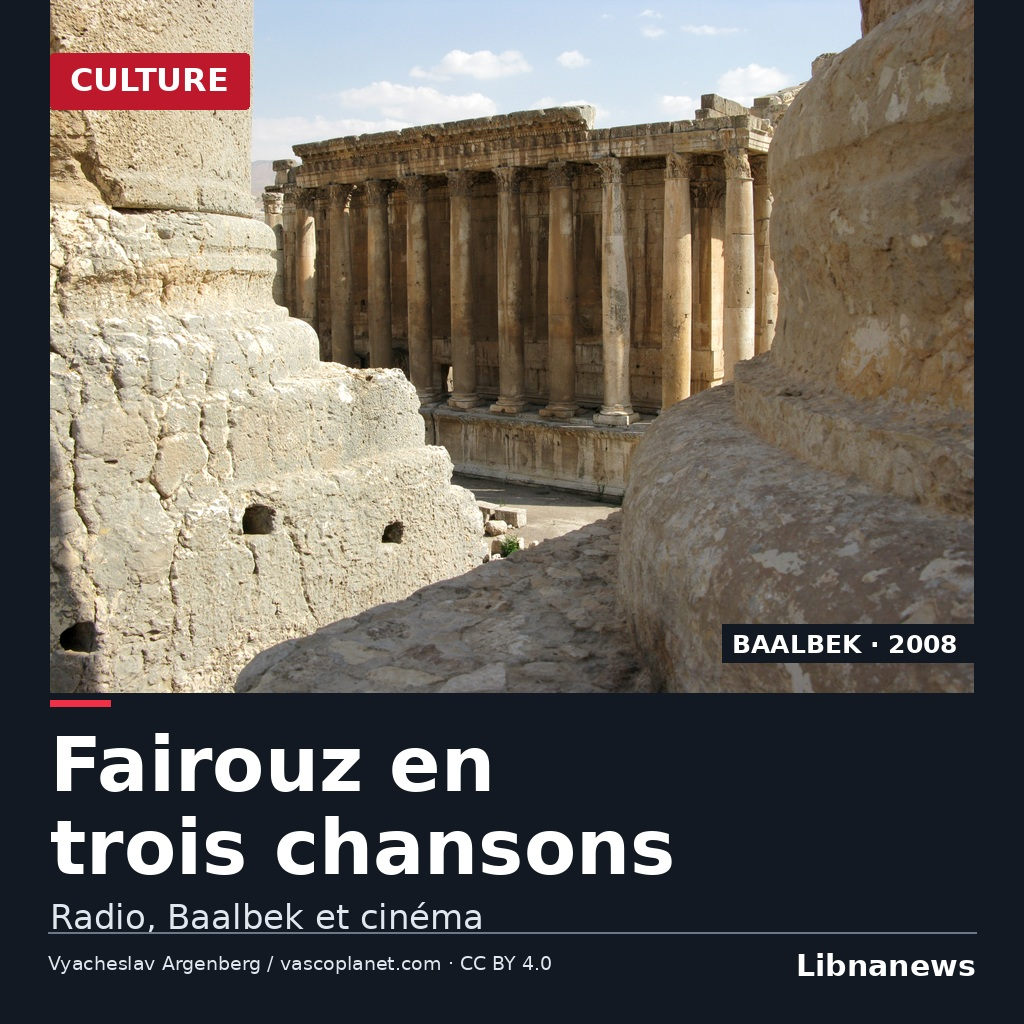
In Baalbek, the scale change is documented up to the record collections. The Bibliothèque nationale de France preserves a 45-tours entitledBaalbek Festival 1961, sung by Fairouz and edited in France by Pathé Marconi in the Voix de l’Orient collection. Its notice identifies in particularKhedni Taht el arichehand distinguishes the place and year of registration, Baalbek in 1961, from the French legal deposit in 1962.
The archives of the Baalbeck International Festival held at the American University of Beirut shed light on this recording. In 1957, the Lebanese Nights brought together the singer, the Rahbani brothers and other composers, including Toufic El Bacha, Zaki Nassif and Philemon Wehbe. The 45-tours do not return the entire show or its decor. It shows, however, how a song recorded at the festival was published elsewhere, on a medium that a listener could find without having attended the performance.
« Zahrat al-Mada
InZahrat al-Madāin(« The Flower of Cities »), the 1969 film takes up Fairouz’s homonymous song to accompany his images of Jerusalem and Palestinian life upset by the Israeli occupation after the 1967 war. The song no longer serves only to evoke an absent city: it accompanies the views of this city and gives the montage its soundtrack. The project of conservation The Void Project documents the restoration of the film by Azza El-Hassan in 2017. The following year, the screening in Jerusalem was accompanied by a discussion on the city’s place in Palestinian cinema.
In these three cases, the song does not reach the audience alone. Radios put it in circulation, a publisher fixed a version of a festival on record, filmmakers recapture it and restaurateurs put the film in projection. These traces don’t prove that everyone associates the same memories with Fairouz. They show how several generations were able to regain his voice in very different contexts, without the works being reduced to the memory of their first interpretation.





Comments