

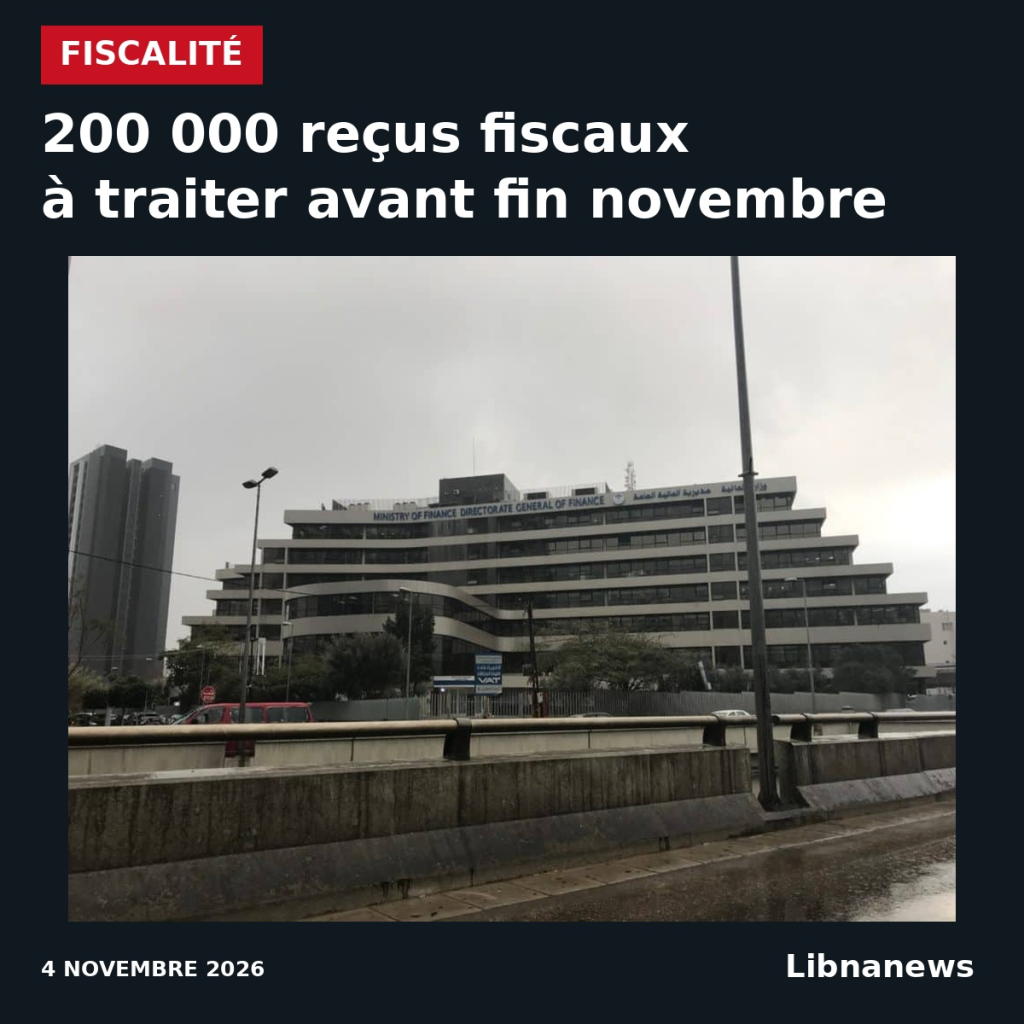
The Lebanese Ministry of Finance has initiated the processing of a stock of approximately 200,000 non-electronic payment receipts. It was set at the end of November 2026 to complete the treatment of this stock accumulated since 2025, according to the report of the first FEXTE Steering Committee, released on 28 October.
Funded by the Agence française de développement and implemented by Expertise France, this programme of budgetary transparency must help the administration to regain a more complete vision of public accounts. The work on receipts is one of the most immediate projects.
Find data behind payments
The volume announced gives an idea of the documentary task, without allowing to quantify the sums concerned. It does not identify 200,000 separate taxpayers or as many fraud files. Receipts relate to payments whose information must be recovered and processed by the administration.
The delay in their registration therefore makes it impossible to conclude that the money has disappeared or that it remains entirely to be cashed. The challenge is to track the transactions and have sufficient reliable data to track revenue.
This work comes after a diagnosis involving more than 25 interviews and examination of more than 25 systems and applications. In particular, the Ministry seeks to restore the regular publication of its financial statistics. The dispersal of information between directions and tools is one of the challenges the project faces.
A longer timetable for budgetary monitoring
The end of November concerns the processing of receipts. The joint monitoring of revenue and expenditure is based on another timetable: the committee approved work from November 2026 to August 2027, linked to the medium-term financial framework.
In the long run, the administration must be able to follow together what the government is cashing and what it is spending. The consolidation of data from public institutions outside the budget must also broaden this reading and better highlight financial risks. The record does not present this integration as completed.
Beyond catching up with the 2025 documents, the aim is to organise a regular production of information, to avoid a new stock accumulating.
Reconciliation of bank records and bank statements
Treasury management proposed to modernize electronic collection and reconcile transactions, bank statements and accounting records. It also wants to improve the treatment of cancelled or rejected payments and strengthen internal controls.
These proposals still need to be distinguished from the measures already approved. They describe the operation sought, without establishing that a common system is now operational in all administrations.
A technical meeting is scheduled before the end of the year to decide on a solution, its cost and timetable. Until then, the first meeting remains with receipts: at the end of November, the balance sheet will have to specify how many pieces have been processed and what checks remain necessary.
Lebanese Ministry of Finance, photo archive. Unestablished shooting date. Institutional illustration, without representation of the processing of 2025 receipts. © Libnanews.com.





Comments