

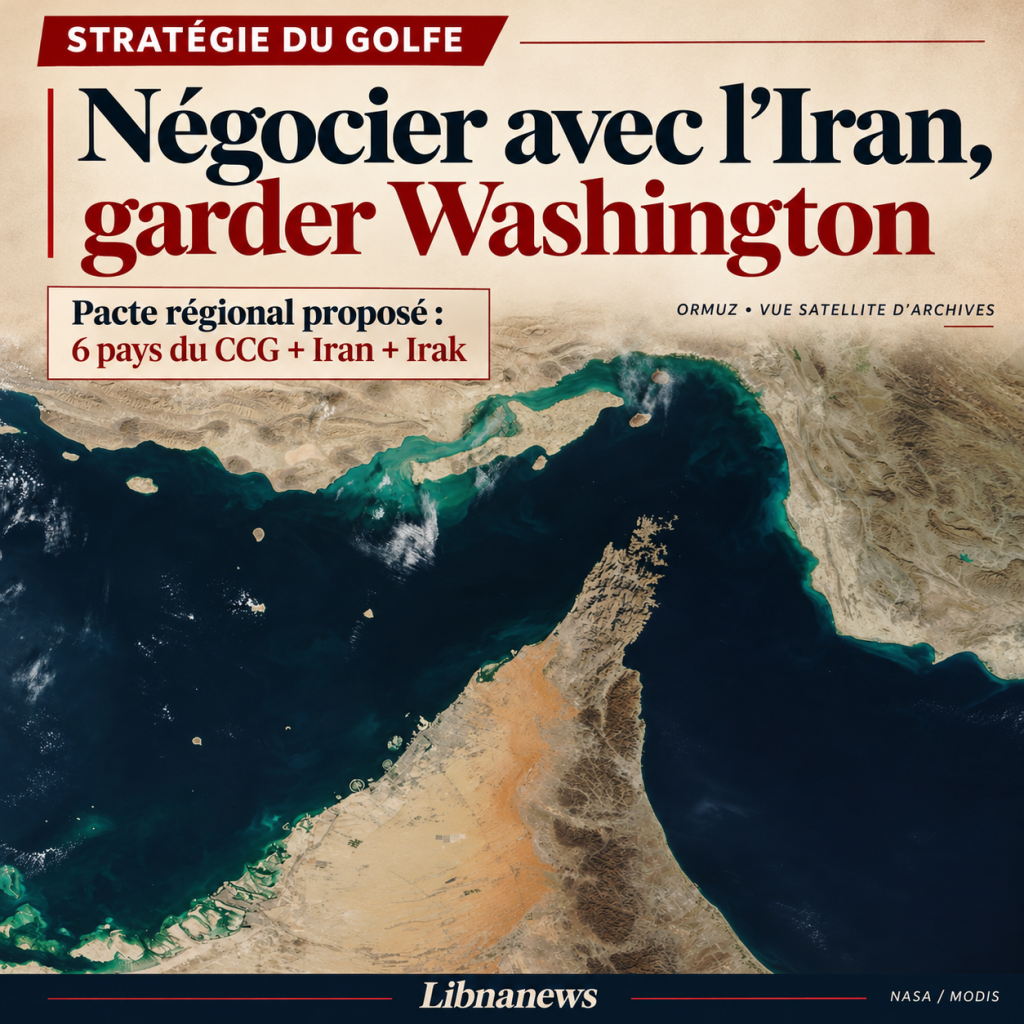
The Republican defeat of 3 November opens up an opportunity for the Gulf States to weigh more on American policy towards Iran. But their security cannot depend solely on Donald Trump’s weakening. Oman is already proposing a regional non-aggression pact. To become credible, this initiative will have to bring together neighbours with different interests, frame reprisals and preserve defences. The real challenge is to get a place in the decisions that can turn their territories into a battlefield.
The Gulf monarchies face two simultaneous risks. A new US offensive could cause further attacks on their facilities. A compromise between Washington and Tehran could also leave their own demands unanswered. Their margin of manoeuvre lies between these two threats. They seek to prevent escalation, while avoiding a negotiated peace above their heads.
American political change can serve that purpose. The Democrats won both chambers of Congress, but their new mandates will begin on 3 January 2027. Until then, Trump retained the presidency and the outgoing elected officials remained in office. The vote creates an immediate political opening, not immediate military protection. The Gulf capitals therefore have an interest in conducting their démarches in Washington and their regional dialogue in parallel.
On 5 November, Badr Albusaidi and his Iranian counterpart Abbas Araghchi again exchanged by telephone. They discussed political and technical arrangements to restore unhindered navigation in the Strait of Ormuz. They insisted on lasting agreements, maritime security and respect for sovereignty. This exchange extends regional approaches without constituting the signature of the pact envisaged.
Gulf States want to decide on security conditions
Regional diplomacy did not wait for the American result. On 26 October, Omani Foreign Minister Badr Albusaidi proposed a pact between eight states. It would bring together the six members of the Gulf Cooperation Council, Iran and Iraq. Its project retains external partnerships, but places riparian countries at the centre of security arrangements.
This proposal affects a weakness of the regional order. The Gulf States host foreign forces and have significant military capabilities. Yet they do not decide on American goals or Iranian choices. They may suffer the consequences of an operation they have not desired. They can then discover that their partners’ priorities have changed.
The conflict opened on 28 February 2026 made this dependency particularly visible. The American and Israeli strikes were followed by Iranian attacks in the region. The defences have protected facilities without removing all vulnerabilities. For economies based on trade, services and investment, the recurrence of crises itself becomes a strategic threat.
The search for autonomy addresses this concrete problem. It aims to secure commitments on territories, infrastructure and maritime traffic. It also implies that certain uses of national territory may be refused. None of these approaches requires abandoning existing alliances. Rather, they seek to narrow the gap between risk and decision-making.
Six capitals, several ways to negotiate with Iran
However, presenting the Gulf as a ready-to-sign bloc with Tehran would mask the main obstacle. The six monarchies share an exposure to conflict, but not the same relations with Iran. Their diplomatic channels, alliances and experiences of attacks differ. A collective initiative must address these gaps.
Oman defends the construction of a framework that includes all local residents. Qatar is working on a more immediate goal: to bring Washington closer to Tehran. On 3 November, his Department of Foreign Affairs confirmed the continuous exchange of proposals, without announcing any specific breakthrough. Doha also mentioned close coordination with other GCC members to avoid escalation. This convergence on urgency is not yet an agreement on concessions.
Saudi Arabia combines dialogue and diversification of its defence partnerships. On 26 October, Riyadh presented Khalid bin Salman’s visit to Tehran as a de-escalation process. Representatives of the other countries of the Mecca Defence Pact participated in this initiative. The Saudi communiqué supported Qatari and Pakistani mediation. For Riyadh, discussing with Iran can therefore accompany the strengthening of other military ties.
The United Arab Emirates has adopted a more coercive economic policy. On 19 August, their diplomacy announced the cessation of business and financial transactions with Iran. However, on 1 November, presidential adviser Anwar Gargash was still hoping for a diplomatic outcome, while affirming his country’s preparation for the worst. Abu Dhabi therefore does not allow itself to be reduced to a permanent choice between rapprochement and confrontation.
Bahrain also defends a conditional opening. At the Manama Dialogue, its Minister Abdullatif Al Zayani supported a regional framework accessible to Iran. It was linked to respect for sovereignty, navigation and the renunciation of force. Kuwait, for its part, had welcomed the United States-Iranian memorandum of June, emphasizing non-interference and durable solutions.
These positions allow a common basis, without removing disagreements. The first negotiation must therefore take place between the monarchies themselves. What commitments can they make together? What violations call for a collective response? Without an answer, Tehran could negotiate separately with each capital, and the guarantees obtained would remain fragmented.
Congress offers leverage, not veto power in the Gulf
Democratic victory makes Washington more receptive to a challenge to the conduct of war. The Gulf States can use their diplomatic relations to defend specific objectives. Auditions, expenditure control, arms sales review and operational debate offer several entry points. Their influence will depend on their ability to convince American elected officials, not just to get a presidential interview.
The strongest argument concerns American interests themselves. An escalation can expose deployed soldiers, mobilize more resources and weaken regional partners. Gulf capitals can document these costs and present negotiated solutions. This approach would benefit from remaining transparant. Replacing an exclusive proximity with Trump with an exclusive alignment with his opponents would create a new dependency.
The volume of military commitments shows why this relationship cannot be reduced to a few statements. As of September 18, a U.S. parliamentary study had identified over $64 billion in arms sales proposed since February. They concerned Israel, Jordan and five Gulf monarchies. Overall, $25.3 billion was under emergency procedures beyond the ordinary parliamentary review. These amounts refer to notifications, not deliveries already made.
A more demanding Congress could strengthen control. He would not directly command the armed forces. Trump would retain funded resources and veto power over the texts submitted for his signature. Overtaking requires two-thirds of the voters in each room. The elected representatives may also refuse new credits, but their arbitrations remain political. The result of the vote therefore does not guarantee the cessation of an operation or the adoption of a programme favourable to the monarchies.
American protection remains a need and a constraint
The search for a pact with Iran does not make existing defences useless. Diplomatic engagement can reduce conflict opportunities. It does not replace alerting, interception or facility protection capabilities. The challenge is to make these means compatible with a regional de-escalation policy.
The question of foreign bases is at the centre of this difficulty. Host countries must distinguish between defending their territory and attacking operations against a neighbour. They may seek prior consultations and more precise rules on the use of their infrastructure. Their scope would depend on the applicable agreements and their actual implementation. A statement of neutrality is not enough to regulate these uses.
Tehran, for its part, should accept that a foreign military presence does not justify an attack on a neighbouring country. Without this commitment, Iran would retain the possibility of extending its confrontation with Washington to the Gulf monarchies. A pact that leaves this indefinite exception could offer political insurance without effective protection.
The other danger would be to promise immediate military autonomy. Existing cooperation does not disappear without cost. Changing supplier does not instantly restore an integrated defence. Diversifying partnerships can broaden options, but also increase coordination issues. The Gulf States are seeking additional decision-making capacity, not necessarily the departure of all their partners.
What a non-aggression pact should really cover
The formula seems simple: each signatory undertakes not to attack others. Its application is much less. Prohibited acts, responsibilities and post-incident procedures should be defined. A general promise would be too easy to circumvent by a charge of complicity or the intervention of an armed group.
The first commitment would concern territories and civilian infrastructure. Ports, airports, power plants and desalination facilities are of vital importance. Their protection should be explicit. A notification mechanism and a permanent line of communication could help deal with an incident prior to the response. These are negotiating options, not already accepted mechanisms.
The second part would concern non-State armed actors. Iran cannot be presumed to automatically control each of their decisions. This limit should not become a general exemption. A text could impose verifiable obligations on financing, arms transfers and land use. The presence of Iraq would then have an operational usefulness, beyond the diplomatic symbol.
The third part would deal with navigation. An arrangement would not be acceptable to the monarchies if he gave Iranian discretion over the passages. The CGC’s October 18 release rejects pre-authorization, illegal restrictions and fees for passage. The safety of a strait cannot depend on renegotiated permission for each crisis.
Finally, guarantees require concrete procedures. Who finds a violation? What information should the parties provide? How long do they meet? A common investigative mechanism could limit competing charges. Graduation measures could prevent an incident from immediately causing the pact to break. Such arrangements would require agreement on and access to observers.
An external guarantee would also have limits. The support of a great power or the United Nations does not automatically produce an intervention. The undertakings of the guarantor and the circumstances of their application should be clarified. Without these details, multiple signatures would simply add actors to a promise that is difficult to enforce.
Monarchies cannot offer what they do not control
Iran would also need concrete reasons to accept these constraints. Less hostile relations with neighbours could reduce isolation and make trade more predictable. But the monarchies cannot lift American sanctions alone. Nor can they guarantee the military decisions of Israel or the United States.
A regional pact and American-Iranian negotiations should therefore be articulated without confusion. The first can frame behaviour between neighbours. The second is to deal with Washington commitments, including the economic restrictions involved. Promising one in exchange for a measure that only one third can take would create a failure to implement from the outset.
The same caution applies to expectations towards Tehran. A maritime compromise would not solve the entire nuclear issue. A commitment against attacks would not make missiles disappear. The GCC specifically calls for discussions to cover nuclear, drones, missiles and support to armed groups. It also requires participation in security arrangements.
This ambition raises a problem of timing. To resolve all disputes before any relaxation measure can block the whole. Reporting all difficult questions can, on the other hand, reproduce a fragile truce. A step-by-step approach should therefore combine a limited first result with explicit deadlines for other files. Each concession would require an identifiable and verifiable consideration.
The first event will be to bring together the participants
The main obstacle appears even before a treaty is drawn up. On 13 September Oman announced the postponement of a planned regional meeting in Salalah. The department invoked the search for consensus and favourable conditions for dialogue. This precedent shows that agreement on the principle of discussion is not enough to organise a common negotiation.
A first course would be to move forward with limited commitments. The parties would establish direct communications, reduce certain military risks and open working groups. This method could produce results without waiting for a general settlement. It would remain vulnerable without sustained political support for technical measures.
A second trajectory would be the multiplication of bilateral arrangements. Each capital would seek protection adapted to its emergencies. This path may unlock contacts, but it may prioritize the security of neighbours. A better protected country does not automatically make the region more stable if pressures move towards another.
The third course would be a return to a wider confrontation, after a diplomatic failure or a poor appreciation of the opposing intentions. Trump’s electoral weakening does not exclude him. Tehran could overestimate American constraints. Washington might consider a demonstration of strength to improve its position. The Gulf countries would then be better off keeping their channels open, including when discussions get tougher.
The next useful signs will be observable: an actual meeting, mandated participants and a common agenda. In Washington, concrete approaches to elected officials and proposed texts should be looked at. In the Gulf, the decisive question remains whether the eight states envisaged by Oman can define common obligations before the next crisis.





Comments