

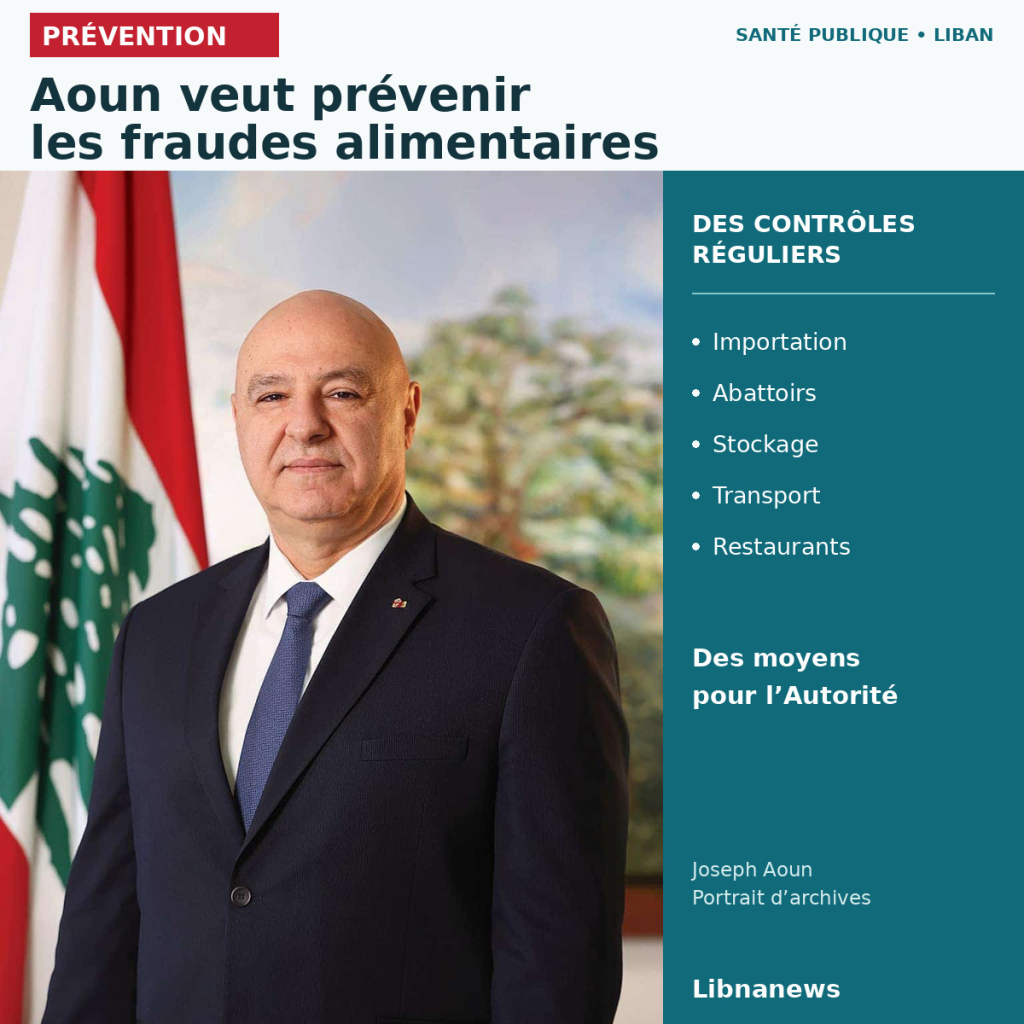
Food safety must be based on regular checks before dangerous products reach consumers. Joseph Aoun defended this priority in Baabda on 4 November before the Lebanese Food Security Authority. After incidents involving families in Beirut and Akkar, he called for surveillance of the entire sector. It also requests resources for the Authority and detailed public information on the results of the inspections.
According to the report of the meeting taken up by the Lebanese press, the President of the Republic received the President of the Authority, Elijah Naji Awad, and the members of the organization. This was their first visit since the issuance of the decrees establishing the Authority. The interview focused on the responsibilities of professionals, but also on the conditions of public control. Premises, staff, budget and laboratories are among the needs explicitly mentioned.
Aoun presents access to healthy food as a right and its protection as a responsibility of the State. He described recent fraud as « a crime that suffers no indulgence ». This statement expresses the position of the Head of State. It does not constitute a judgement against a specific institution or a judicial review of the cases.
Food security beyond closures
The President considers it necessary to close warehouses, restaurants or shops in violation. But these measures come after the damage. It therefore calls for a periodic inspection mechanism capable of covering each stage of the food route.
Importation, slaughterhouses, warehouses, transport and catering are within the perimeter described. Meat is the announced priority. Unauthorised establishments must also be checked. The passage by several operators shall not leave any link out of the surveillance.
This request extends the mobilization of the authorities in response to recent health warnings. At the beginning of November, the Government initiated checks on meat channels. The Minister of Economy, Amer Bissat, has asked for a census of warehouses, whether authorized or not. The information sought concerns their supply, storage and transport. In Baabda, Aoun is now calling for a regular organization of this surveillance.
The distinction is concrete. Close a point of sale deals with the situation of an establishment. Examining suppliers, storage and transportation allows for verification of other steps in its supply. The President asked for this continuity in the checks, without announcing a new assessment of inspections carried out.
The minutes of the meeting do not specify the frequency of visits envisaged. It also does not provide a national deployment schedule. The presidential orientation therefore focuses on the method to be put in place. The practical arrangements still need to be documented by the competent administrations.
Responsibilities sought throughout the chain
Aoun hopes that the judicial follow-up will concern all actors whose involvement would be established. He refers to the supplier, warehouse and persons who allegedly covered an offence. Its application excludes exceptions related to protection or outside intervention.
This position broadens the look beyond the last establishment that served or sold a food. She calls for a search for responsibilities throughout her journey. However, each file requires its own findings. The meeting did not provide a list of persons prosecuted or new convictions.
Elijah Naji Awad also stressed the possible flaws of the system. According to him, the fight against food risks cannot be separated from the fight against corruption. He mentioned a number of practices that could weaken supervision: protecting institutions, ignoring offences, or putting pressure on inspectors.
The President of the Authority also cites the handling of laboratory analyses or certificates of conformity. It mentions the introduction of products of unknown origin and circuits without authorisation. Licences granted without respect for health conditions and the selective application of the rules complement his remarks.
Awad presents these situations as risks to combat. His intervention does not identify particular officials and does not demonstrate every practice in recent cases. In particular, it specifies the guarantees it considers necessary to ensure the independence of control decisions.
Empowering the Authority
The Authority’s role in Baabda’s trade goes beyond restaurant inspection. Aoun describes it as the national reference for coordinating relevant ministries, municipalities and departments. He asked that she should be able to carry out the tasks prescribed by law.
Awad refers to Food Security Act 35 of 2015. It wants to unify and coordinate controls between different administrations. It also stresses the autonomy of scientific and health decisions within the legal framework. The stated objective is to protect them from private interests and interventions.
The means mentioned by Aoun correspond to the material needs of this mission. A seat must accommodate the teams. Staff must conduct the activities. The laboratories must allow the necessary analyses. A budget must support the operation of the whole. The President promised his support for the Authority to fully assume its responsibilities.
However, this promise does not allow for the costing of available resources. No budget, additional staff or equipment delivered appears in the report. Requests for resources must therefore remain distinct from an actual allocation. The meeting outlines needs and political support, without establishing that all capabilities are already operational.
Inform without maintaining rumors
Finally, Aoun calls for citizens to know the results of the checks and the measures taken. It wants accurate information from a single reference. This requirement accompanies inspections: the public must be able to understand alerts without depending on rumours.
The President links this transparency with the reputation of Lebanese cuisine, restaurants and tourism. He also referred to confidence in food exports. In his view, serious supervision also protects compliant companies from unfair competition.
Awad links prevention with confidence in the State and Lebanese products. He cites recent alerts related to trichinellosis among the events revealing the difficulties of control. Its intervention calls for preventing risks from reaching the consumer, rather than treating only their consequences.
The information available does not provide a consolidated health record of the Beirut and Akkar incidents. Nor can they attribute the same origin to each case. The next expected clarifications relate to the results of the inspections, the results of the investigations and the means actually opened up to the Authority.
Sources
- Al Hadeel: Report of Joseph Aoun’s meeting with the Lebanese Food Security Authority, 4 November 2026. Resumed presidential interventions and those of the President of the Authority.
- Al Sharq, 5 November 2026, p. 3: » هي Report of the interventions of Joseph Aoun and Elijah Naji Awad.
- Ad Diyar, 5 November 2026, p. 2: Proceedings of Joseph Aoun’s hearings, on the Lebanese Food Security Authority.
- Libnanews, November 4, 2026: « Trichinellosis: the controls go back to the industry ». Background of the checks requested on meat circuits.See reference.





Comments