

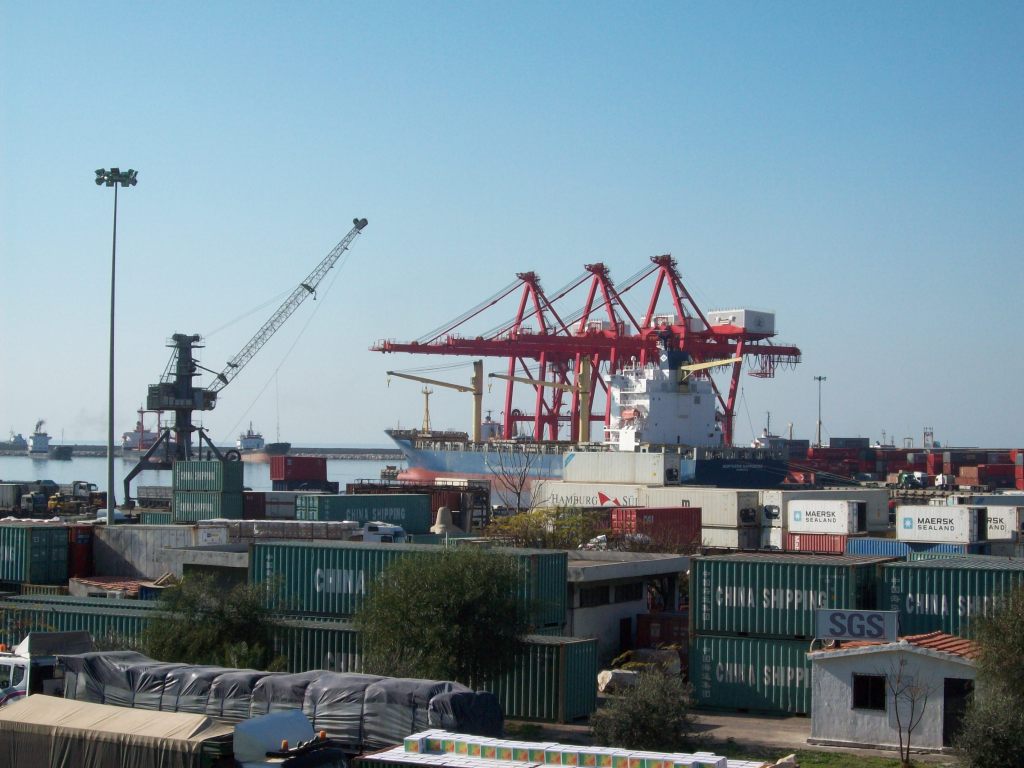
Syrian ports concentrate two distinct movements: the modernization of commercial terminals and the resumption of military contacts in the Mediterranean. In Latakia, CMA CGM is preparing to expand its facilities. In Tartous, DP World deploys new equipment. The visit of the French frigate Surcouf adds a diplomatic aspect to this activity, without being confused with the harbour concessions.
Syrian ports in time along concessions
CMA CGM has renewed on May 1, 2025 its concession of the container terminal of Lattaquié for thirty years. The group announces the acceleration of a second phase of expansion, with a planned investment of EUR 200 million, after a first tranche of EUR 30 million committed to modernisation.
The announced target exceeds one million equivalent 20 feet per year, unit of measurement of containers. The project also includes a 16 metre draught. These are targeted capabilities, not already realized traffic. The group also intends to strengthen terrestrial connections and develop domestic platforms: the efficiency of a terminal also depends on the movement of goods after their landing.
In Tartous, equipment already delivered
DP World signed a 30-year concession in July 2025 in Tartous, with an investment program of $800 million over its duration. The Dubai operator intervenes as part of a construction, operation and transfer model. The commercial perimeter includes several types of cargo, including containers and rolling cargo.
A material milestone was announced on August 17, 2026: the delivery of three mobile port cranes. DP World estimates that this equipment must increase handling capacity by 40%. Again, additional capacity does not constitute an equivalent increase in goods actually processed.
The announced schedule extends beyond 2026, with dredging and rehabilitation of the docks, as well as other equipment planned for 2027 and 2028. This succession of stages distinguishes the overall amount of a concession from the investments already carried out.
The Surcouf, a naval contact distinct from trade
On 12 November, the Syrian Ministry of Defence reported a meeting between the commander of the naval and coastal defence forces, Mohammad al-Saoud, and a French delegation led by Rear Admiral Mackara Ouk, aboard the Surcouf. Discussions focused on strengthening bilateral naval cooperation.
This contact is a matter of military relations between States. The management of a terminal organises investments, equipment and commercial exploitation. Both activities can develop on the same coast without any single agreement.
The actual traffic will be the next test
For the Syrian economy, the operational challenge is to transform long-term commitments into usable capabilities and then into regular flows. The delivery of cranes is a concrete step; The extension of the docks and the terrestrial connections are other. Their result will be measured by the volume of goods processed, the time frame and the continuity of services.
The current landscape is therefore that of several partnerships at different stages. Concessions structure commercial activity over several decades, while naval visits reopen channels of cooperation. Bringing them together under a simple competition for the ports would remove their differences in nature and timing.





Comments