

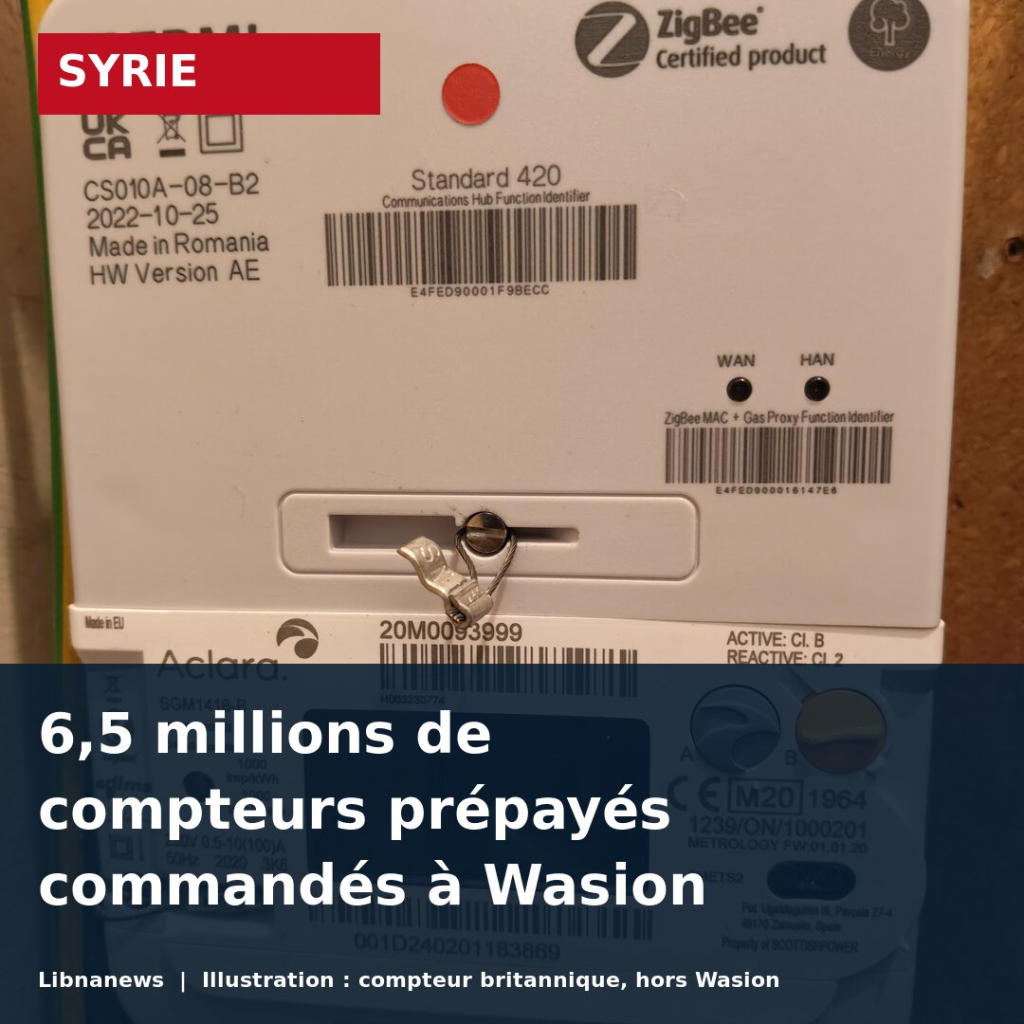
On November 8, 2026, the Syrian Electricity Company signed a contract with Wasion to supply 6.5 million prepaid meters in Damascus. The first deliveries are announced in four months, before a deployment over several years. The project must modernise consumption monitoring and payment, but does not create additional electrical capacity.
The agreement with the Chinese group includes six million monophase meters and 500,000 threephase meters. It also covers associated software and measurement equipment.
Omar Chaqrouq, General Manager of the Syrian Electricity Company, and Lyu Xinwei, representative of Wasion, signed the agreement. The public enterprise highlights the accuracy of surveys and the improvement of network management. The amount of the contract and its financing arrangements are not included in the announcement.
Prepaid meters delivered in stages
The Syrian official expects the first batch to arrive after four months. This deadline announced on 8 November sets this first deadline around March 2027, if the timetable holds. He believes that the laying should then extend over three years. Sectors without meters, where the power supply relies on circuit breakers, must receive the equipment as a priority.
Wasion’s representative in Syria and Lebanon, Elijah Khoury, spoke of a three-year performance of the contract. He announces monthly deliveries. The number of units in each lot and the schedule per province remain to be specified.
Delivering an appliance and putting it into service are two separate operations. The installation must be accompanied by a subscriber connection, setting and connection to management tools.
Consumption would be followed before the invoice
Prepayment changes the timing of settlement first. The user buys a credit before consuming, instead of waiting for an invoice after the statement. The meter records the energy used and allows to track the available balance. The so-called smart function adds opportunities for communication and remote management.
Depending on the features presented by the Syrian management, the subscriber will be able to view its consumption and recharge via a mobile app. The operator wants a faster view of network data. These functions remain those of the announced system; their actual availability will depend on the technical deployment and associated payment services.
For a household, a better understanding of its consumption can help identify an unusual expense or distribute its uses. But a meter does not decide the price of electricity. This depends on the rate schedule and the rules applied by the operator. No new rates were announced with the signature.
The six million single-phase units target these types of connections, common in habitat. In particular, three-phase devices meet greater power requirements.
Recovery changes, household protection needs to be clarified
For the operator, prior payment can reduce delays in cashing on the energy sold. More accurate surveys may also limit estimates and facilitate the examination of differences between distributed energy and recorded consumption. However, there are no expected savings, no avoided loss rates and no revenue gains.
For households, the availability of credit becomes an essential element of access to the knowledge. A family with irregular incomes may need to recharge between two cash receipts. Access to the service will also depend on the rules adopted: alerts before exhaustion, possible emergency credit, cut-off conditions and challenge procedures.
Wasion presents in its catalogue meters capable of managing low credit alerts and emergency credit functions. Their activation in the Syrian program was not specified.
The cost to the subscriber also remains to be clarified. The operator did not specify who will pay the aircraft, its installation or any charges. Nor has it announced a special scheme for vulnerable households. Without these elements, it is too early to estimate the total expenditure associated with the move to prepayment.
Finally, phone charging raises a practical question: what solutions will be accessible to people without a smartphone or without a compatible means of payment? Physical outlets or other channels could meet this need. Their existence and territorial coverage are not established in the announced contract.
Measuring electricity is not enough to transport
The counting project is part of a broader rehabilitation of the sector. Damage to lines and processing stations, as well as maintenance requirements, relate to the physical transport of the current. They require work other than the replacement of devices by subscribers.
A separate programme, approved in June 2025 with a grant of $146 million from the World Bank, specifically targets these infrastructures. It includes the rehabilitation of high voltage lines and damaged posts. The financing of the Wasion contract was not announced.
Better recovery can support the operator’s finances, but it does not automatically guarantee more hours of power. Production, fuel, lines and transformers must also work. The results will have to be measured both in the company’s accounts and in the service actually received.
The first step announced remains the receipt of the initial batch in four months. Prior to setting up, subscribers will mainly need a local calendar and specific rules on rates and charges. They will also have to know the conditions for maintaining food when their credit runs out.





Comments