

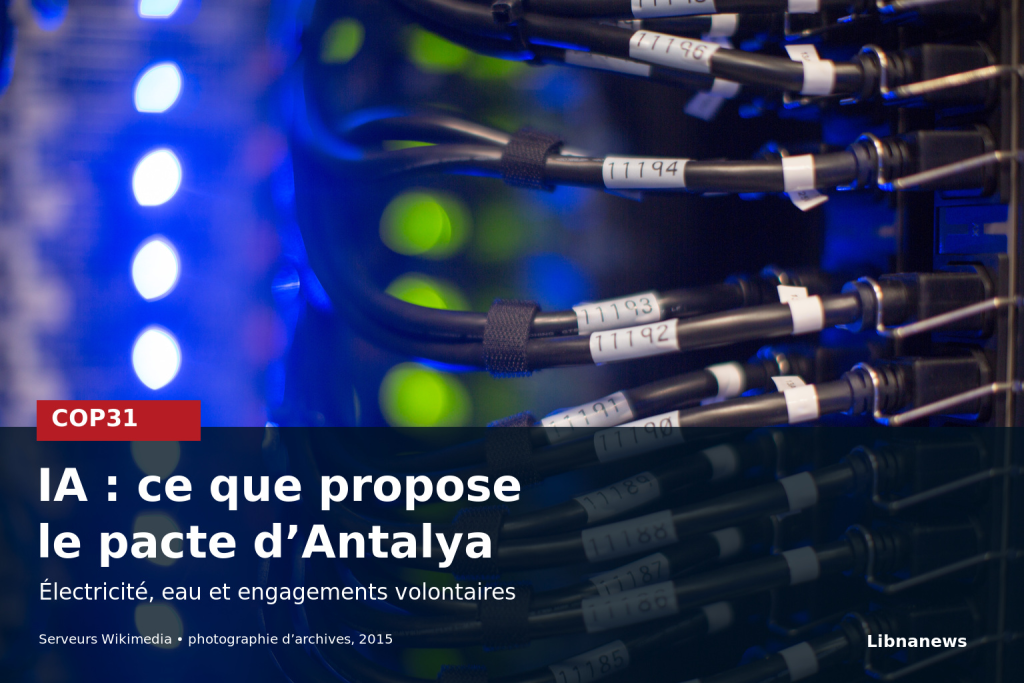
COP31 opens on 9 November in Antalya with a proposal for the environmental footprint of the AI. The Turkish Presidency wants to bring digital ambitions closer to the constraints of electricity and water. Antalya’s commitment has already been made public and will be launched on 16 November. It is based on voluntary contributions from States and organizations. Its scope will depend on the objectives chosen and the data to monitor its implementation.
The issue is one of practical difficulty: developing computing capabilities while controlling their pressure on resources. Data centres use power not only for servers but also for equipment that allows them to function. Their cooling can mobilize water on site. Electricity generation and equipment manufacturing add additional needs, sometimes away from the building concerned.
The initiative prepared with the International Telecommunication Union seeks to make these effects measurable. It concerns the design, purchase, feeding and use of systems. The meeting on 16 November will bring together climate, energy and digital leaders around this implementation.
The environmental footprint of AI is included in the commitments
The Antalya text combines four areas: infrastructure, life-long material management, environmental measurement and support for climate applications. It encourages low-emission or emission-free power supply, more efficient cooling and better integration into power grids. It also addresses the allocation of infrastructure costs for data centres.
The Annexes specify the voluntary operation of the device. For non-state actors, several boxes allow additional commitments to be selected. By choosing the corresponding commitment, participants indicate a share of low-emission energy and a deadline. Other commitments relate to the publication of environmental assessments or the criteria for purchasing equipment. Percentages and dates should be provided: they are not global thresholds already set.
However, the publication of commitments is not automatic. The ITU form asks participants if they allow their public communication, with a « yes » or « no » choice. This option distinguishes recording from a contribution to public visibility.
This architecture allows very different actors to participate. It also leaves open an essential question: what commitments will everyone really choose? Two companies will be able to support the same initiative with different objectives. So the signature will not be enough to compare them. The facilities covered, the indicators selected and the schedule announced will determine the scope of each contribution.
485 terawatt hours for data centres
The International Energy Agency’s estimate published on 16 April 2026 places global data centre consumption at 485 terawatt hours in 2025. The central projection reached about 950 terawatt hours in 2030, or nearly 3% of global electricity demand.
These figures cover all data centres, with their IT equipment and ancillary needs. They don’t measure the only artificial intelligence. The facilities also host storage, business applications and many digital services.
This projection depends on installed equipment, their use and the efficiency of the infrastructure. The availability of current, components and financing can change the trajectory. The 2030 horizon indicates a need to anticipate, not an already acquired consumption.
Decarbonated electricity must meet real needs
A commitment to renewable purchasing over the year can support clean production. But this annual equivalence does not demonstrate that the installation has this electricity at every hour of operation. Production times, equipment location and network possibilities must also be considered.
These issues are precisely on the agenda of a meeting organized in Antalya on 16 November by the International Renewable Energy Agency. Discussions should focus on the temporal and geographical correspondence of supply, its traceability and the new capacities it allows to finance. They also include the prevention of double counting of claimed benefits.
Storage, the movement of certain tasks and the choice of locations can contribute to this adjustment. Their relevance depends on the service rendered and the electrical system concerned. A credible commitment must therefore explain how it accompanies the network, beyond a percentage posted. The challenge is to reconcile the increase in the calculation of really available and verifiable production.
Organizations call for stronger safeguards
The announcement has already raised public reserves. The World Resources Institute welcomed the principle of cooperation while criticizing the inadequacy of accountability mechanisms. In its October 27 reaction, the organisation called for greater transparency on energy, water and effects on networks. It also insists on the participation of communities in settlement decisions.
The Natural Resources Defense Council expressed a close position on the same day. It considers that the text leaves an important margin for companies to define their commitments. It calls for enforcement and better protection of water resources, air quality and the populations concerned.
The debate thus contrasts different levels of action. A voluntary international initiative can bring together methods and encourage contributions. Land use permits, water access rules and connection conditions are the subject of concrete public decisions. Participation in a climate initiative does not replace these decisions, nor does it replace the local effects of a project.
Europe already has a reporting framework
The distinction with a legal obligation already exists in the European Union. A regulation adopted in 2024 organised the communication of information on the data centres concerned to a European database. Indicators include energy, water use, renewables and heat recovery. The device provides separate data for installations at different locations.
This reporting obligation does not mean that any individual information becomes public without restriction. The Regulation also organises the dissemination of aggregated data and the protection of confidential information. Transparency therefore depends on the detail actually accessible, as well as on the existence of an administrative declaration.
The Commission is also preparing proposals on the minimum performance of data centres. The consultation opened in September is scheduled to continue until 14 December 2026. This stage remains a legislative preparation. It does not allow the thresholds still envisaged to be presented as obligations already applicable throughout the Union.
The next meeting focuses on concrete commitments
Finally, the climate aspect of the AI requires measuring the benefits promised with the same precision as the costs. Improving forecasting or optimizing equipment can avoid consumption. However, the result should be compared with a relevant baseline and the necessary resources should be included in the digital service. The usefulness of an application alone does not provide its net balance sheet.
It is at this level that the commitments announced will have to become verifiable: covered scope, quantified objective, deadline and method of measurement. Governments, businesses and other participants are invited to present their contributions at the November 16 round table. The conference must then identify those who commit themselves, the results they aim for and the information they agree to make available.





Comments