

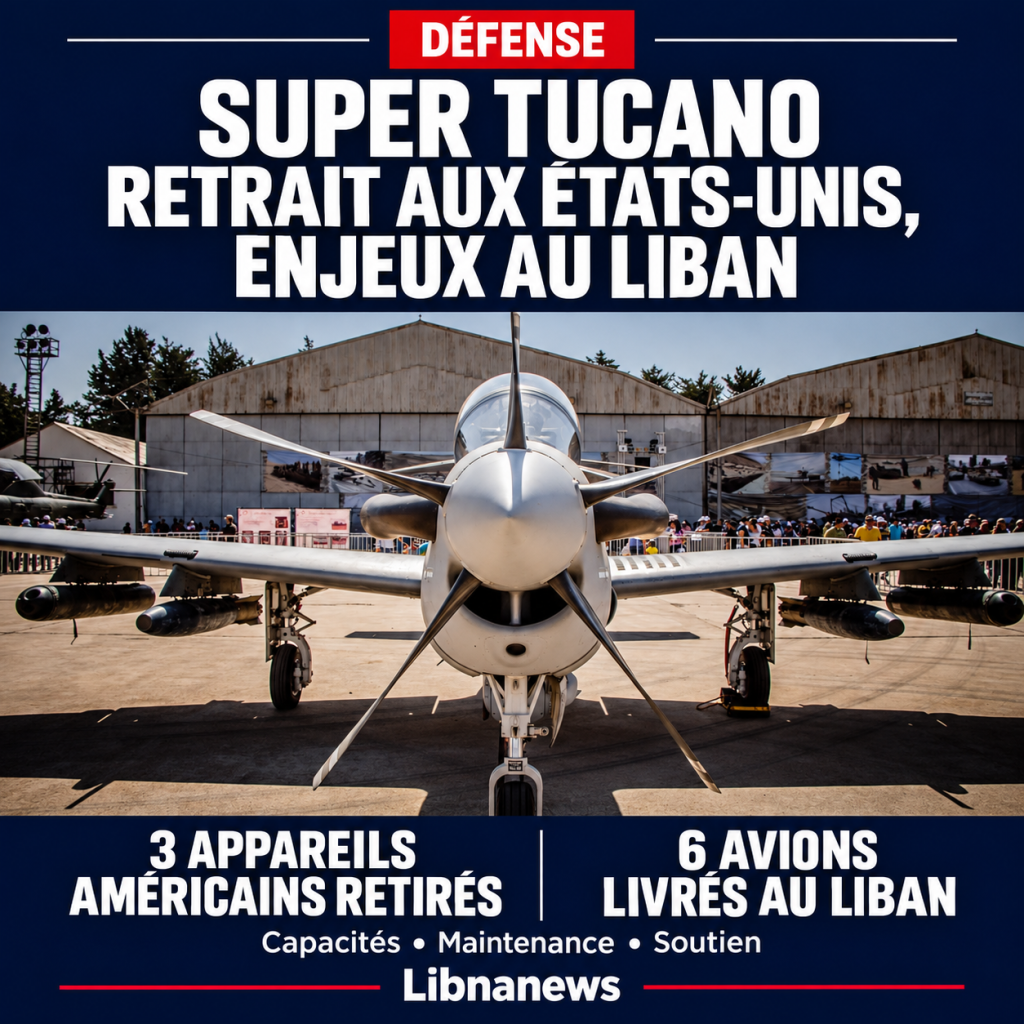
The withdrawal of the three A-29 Super Tucano from the US Air Force, confirmed in early November 2026, raises a question in Lebanon: what becomes of a program provided and supported by Washington when the US Army renounces its own aircraft? The available documents describe two distinct trajectories. The American choice concerns a pilot school test. Lebanon received six ground support and reconnaissance aircraft, the support of which was further notified in July 2025.
Three Super Tucano removed from a test school
The American announcement does not concern a large combat fleet. It covers three aircraft assigned to the Air Force Test Pilot School, based at Edwards, California. On 3 November 2026, a spokesman for the base explained to the American specialized press that the assessment had not confirmed their suitability for the school’s intended uses.
A contract notice issued on October 29 provides for their ground support. It describes three aircraft stored, without returning to the planned flight for the US Air Force. Benefits include fluid leaks, tyres and towing. They are not a re-service program.
These aircraft had first joined the US Special Operations Command. After a change of needs, they were transferred to Edwards in 2024. In July 2025, the school announced their integration to teach drop-out, spin and evaluation of mission systems. The withdrawal is therefore made after an attempt at educational conversion.
The public disclosures do not specify the detailed technical criteria that led to this decision. They do not establish a general ban on theft of the model or a suspension of support for foreign users.
In Lebanon, six aircraft delivered in 2017 and 2018
The Lebanese programme responds to another logic. Washington provided six Super Tucano to strengthen the Lebanese army’s capabilities. The first two arrived in Hamat on 9 October 2017. The following four were received on May 28, 2018, prior to a ceremony on June 12.
Designed by the Brazilian group Embraer, the Lebanese aircraft followed an American industrial chain. The six copies were produced in Jacksonville, Florida, and then modified by Sierra Nevada Corporation, now SNC, in Centennial, Colorado. The package also included training, spare parts, support equipment and logistics.
This chronology avoids a frequent confusion: the Lebanese Super Tucano did not participate in the battle of Fajr al-Jouroud of August 2017. Their arrival is posterior. The air capabilities employed during this battle included Cessna, drones and artillery coordination.
Six devices delivered do not, however, mean six devices immediately available. There is no sufficiently accurate public statement in the documents consulted to quantify their current availability, flight hours or number of operational crews.
A strike capability, not a full air defence
The Super Tucano belongs to the category of light turboprop aircraft. Its missions include close air support, armed reconnaissance, surveillance and training. It provides ground forces with a means of observing an area and, where conditions permit, receiving precise support.
In the Lebanese case, the declared capacity exceeds the theoretical equipment of a catalogue. The army confirmed in 2024 the presence of APKWS rockets and laser-guided bombs on its A-29B. The APKWS are rockets with a guidance system, not air defence missiles.
The value of this precision depends on a whole chain: objective identification, designation, communications and coordination with terrestrial units. The Lebanese army has developed from 2019 an air-to-ground integration system, the LAGI, specifically designed to organize this joint work.
These capabilities do not allow the Super Tucano to be presented as a complete response to violations of Lebanese airspace. The documented equipment does not demonstrate an ability to confront modern fighter aircraft or to achieve aerial superiority. Supporting ground unity and sustaining the national sky requires different means.
Public documentation also confirms training. On June 23, 2020, Super Tucano took part with Gazelle in a real-life exercise in Akoura. This episode attests to a manoeuvring job; it does not constitute a record of combat missions.
The US support of 2025, an essential element
The most directly relevant document for the Lebanese future dates from 11 July 2025. Washington then approved a possible sale of A-29 support for an estimated $100 million. The previous case concerned 43.7 million. The $100 million represents the new total estimate, not an amount to be added automatically to the previous amount.
The perimeter covers engine components, parts, consumables, repairs, ground equipment, software and technical services. This list shows that military capability is based on continuous maintenance. The initial delivery of aircraft is not sufficient to guarantee their use for years.
The notification explicitly links support to air support and intelligence, surveillance and reconnaissance missions. It also attaches it to the role of the Lebanese army in implementing the cessation of hostilities of November 2024. This political framework does not prove that precise strikes have been carried out in the South.
There is also a need to distinguish between authorization and enforcement. A possible sale notification does not attest to the signing of all contracts, the full payment of funds, or the delivery of each service. However, it is a documented element of continuity of the Lebanese programme, distinct from the withdrawal decided at Edwards.
Maintenance and training: real conditions of duration
The training programme launched in Moody, United States, initially included 12 Lebanese pilots and 22 Lebanese technicians. A first release with a Lebanese student in command took place on 22 March 2017. A second pilot promotion had completed its course shortly before the final delivery in 2018.
These figures describe the construction of the program. They do not provide information on qualified personnel in November 2026. Maintaining them requires retaining skills, renewing qualifications and ensuring sufficient training.
In order to assess the possible consequences of the United States withdrawal, it would be necessary to know the maintenance contracts in force in Lebanon. Timelines for repair, inventory of parts and access to technical assistance account for more than the model’s only presence in the US Air Force inventory.
The disappearance of the small US fleet can justify vigilance on the organisation of industrial support. It alone does not prove a supply disruption. Embraer continues to produce the Super Tucano for other customers: its first quarter 2026 balance sheet mentions four deliveries, notably to Portugal and Uruguay.
Costs and trends not to be confused
The financial assessment calls for the same caution. The amount of $462 million, announced in June 2015, was an estimate of a possible sale. The perimeter included aircraft, additional engines, armaments, protection systems, training and support. This amount cannot be presented as the final invoice for the six aircraft.
Divide an overall envelope by six to get the price of an aircraft would therefore be misleading. An evaluation of the program requires actual expenditures, funding and benefits. The public evidence examined does not allow for this comprehensive assessment.
The new missions proposed by the manufacturer shall also remain separate from the confirmed Lebanese capabilities. In November 2025, Embraer presented an evolution against drones, based on sensors, data links and adapted armaments. This industrial offer does not demonstrate that Lebanon has acquired or qualified this configuration.
As of 5 November 2026, no decision found in the documents consulted linked the withdrawal of the three American aircraft to a Lebanese A-29 stop. The points to be established remain concrete: execution of the support announced in 2025, real availability of aircraft, maintenance of crews and funding for the coming years.
References
- US withdrawal, confirmation published November 3, 2026
- US Notice of Support for Stored Devices, October 29, 2026
- US Air Force: Integration into Test School, July 2025
- Lebanese Army: first two aircraft received, October 2017
- Lebanese Army: receiving four aircraft, May 2018
- SNC: Completion of deliveries in Lebanon, June 2018
- Lebanese Army: Air Force Review, June 2024
- Lebanese Army: Exercise in Akoura, June 2020
- US Air Force: Lebanese training programme, December 2016
- US Air Force: first release of Lebanese student, March 2017
- DSCA: Initial notification of possible sale, June 2015
- DSCA: support from Lebanese A-29, 11 July 2025
- Embraer: first quarter 2026 deliveries
- Embraer: Evolution against drones, November 2025





Comments