

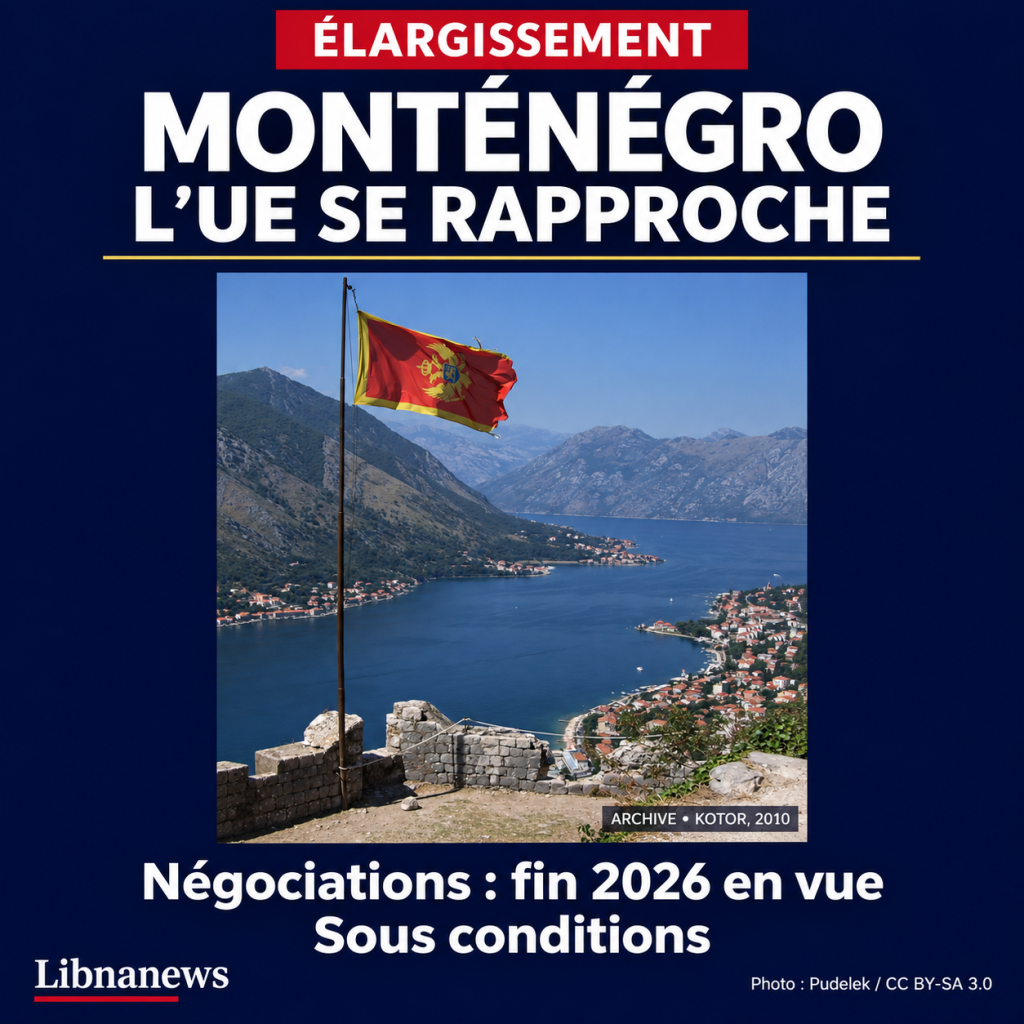
Montenegro’s European accession is clear: the country could complete its negotiations with the European Union before the end of 2026. This perspective is reflected in the enlargement package adopted by the European Commission on Wednesday 4 November. The country still needs the agreement of the Member States on the final stages. The announcement brings Podgorica closer to a Treaty of Accession, without guaranteeing it entry into the Union at a given date.
The timetable is now more precise. A treaty could be signed as early as June 2027, according to the agency press. The Montenegrin authorities sought accession in 2028. This political objective remains separate from the European decision on admission and the necessary ratifications. Montenegro, which has about 630 000 inhabitants, aims to become the twenty-eighth member of the Union.
Montenegro’s European accession: a decisive step
The assessment of 4 November places the country at the top of the most advanced candidates. The Commission accompanies its annual roadmap report for four countries: Montenegro, Albania, Moldova and Ukraine. For Podgorica, work on the future treaty has already begun. Financial preparations have also advanced. These steps accompany the negotiations, but do not replace the remaining decisions.
The scope of this advance goes beyond a simple calendar change. The Union had no longer been in a position to conclude negotiations with a candidate since the close of discussions with Croatia in 2011. The Montenegrin rapprochement is therefore a concrete test of the return to an effective enlargement. Other applications retain their own pace and conditions.
Negotiations initiated since 2012
The Montenegrin application dates back to 15 December 2008. The country obtained candidate status in December 2010, prior to the opening of negotiations in June 2012. The process involves the resumption of common European rules. It examines public policies by chapter at conferences bringing together the candidate and representatives of the Member States.
At this stage, the 33 negotiating chapters are open and 21 are provisionally closed. The last conference, on 12 October 2026, closed three areas: economic and monetary policy, statistics, social policy and employment. Two others, competition and customs union, had reached this stage in July. The Council also set up a group in April to prepare the Treaty and associated acts.
An indicative timetable until June 2027
The roadmap divides the next discussions between November and December. Energy, transport, taxation, movement of goods and food security are in the first sequence. Justice, fundamental rights, the environment and institutional arrangements are then included. The whole remains subject to Council agreement.
After a possible closure in December, the text of the Treaty could be finalized in spring 2027. The roadmap then envisages its signature in June. It states that these benchmarks do not prejudge the outcome of the discussions or decisions of the institutions. Legal translations and agreements on financial or transitional provisions must also be successful.
Monitoring of commitments would continue until accession. The Commission shall provide for regular assessments and corrective measures in case of difficulties. It also envisages a clause to postpone entry into the Union as a last resort if serious setbacks cannot be corrected otherwise.
Reforms must be sustained
The report on Montenegro notes an acceleration of preparations. Fourteen chapters were provisionally closed during the period under review. The Commission considers that all the closing criteria are met. However, this favourable technical assessment alone is not a decision of the European governments.
The text highlights the role of party cooperation in the adoption of laws related to European integration. Constitutional changes have strengthened the independence of the judiciary, prosecutors and the central bank. Vacancies in the Constitutional Court have also been filled. Further efforts are still needed to complete the preparations.
The report retains reservations about institutional working methods. The legislative procedure is still largely based on urgency, particularly for accession-related legislation. Some work is also needed on international electoral recommendations. The proximity of a deadline therefore does not exempt the authorities from consolidating the quality and implementation of reforms.
From the end of negotiations to entry into the Union
The European process distinguishes several decisions. Once the negotiations have been concluded, the Commission decides on the country’s capacity to become a member. States must then approve its admission unanimously. The European Parliament must also give its consent.
The Treaty must finally be signed and ratified by the Member States and the candidate country. The closure of the chapters, the signature of the Treaty and its entry into force are therefore not interchangeable. A date announced for one of these steps does not automatically set the following.
For Montenegro, the next operational deadline is closer: the Commission intends to forward to the Council the draft common positions still needed by mid-November. The Commission has yet to approve the next steps.





Comments